Solar Installation Timeline: Contract to Switch-On

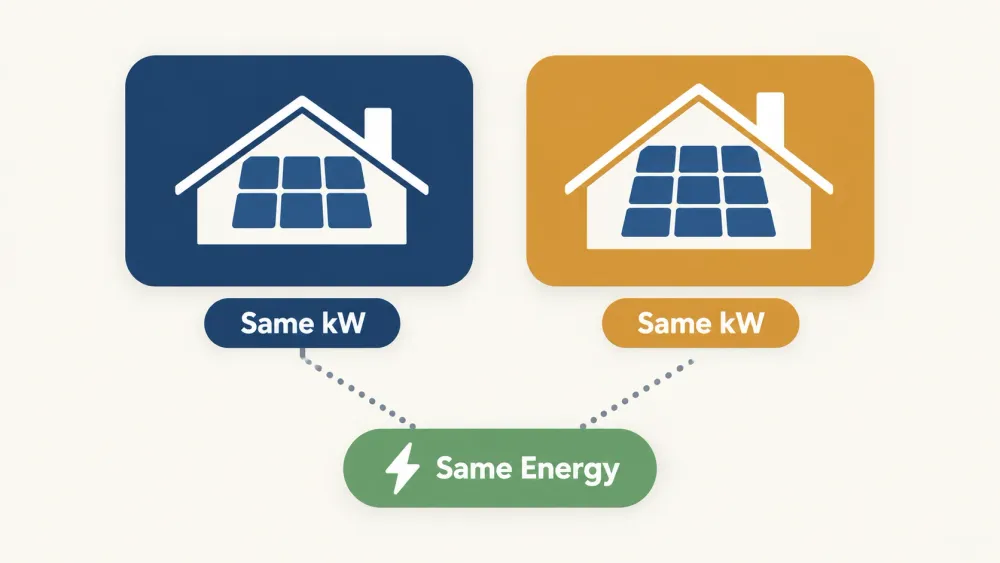
Here is solar panel efficiency explained in one line: it is the share of the sunlight landing on a panel that the panel turns into electricity, measured in a lab. A higher number means more watts from each square foot of roof. It does not mean more electricity from each watt you pay for. Two systems of the same size in kilowatts, on the same roof, produce much the same amount of energy whatever their efficiency. So efficiency matters when roof space is the limit, and matters far less when it is not.
This page is for US homeowners reading a solar proposal. It explains the number; it does not rank brands or recommend a panel.
The Department of Energy defines the conversion efficiency of a solar cell as "the percentage of the solar energy shining on a PV device that is converted into usable electricity." For a panel, the percentage on the spec sheet is the module efficiency: the panel's rated power divided by the sunlight falling on its whole surface, frame and gaps included.
That rating comes from a standard lab test, not from a roof. PVEducation, the long-running solar cell reference, states that terrestrial solar cells are measured at a temperature of 25°C (77°F) under a standard light spectrum, with an input of 1 kilowatt of sunlight per square meter. Every manufacturer rates to the same conditions, which is what makes the numbers comparable between panels.
What the test does not reproduce is your roof in July. Real panels run hotter than 25°C, see less than full sun for most of the day, and collect dust. The spec sheet efficiency is a fair yardstick for comparing two panels. It is not a forecast of what either will do on your house.
Because the test assumes 1 kilowatt of sunlight per square meter, efficiency converts directly into area. A panel's rated watts divided by 1,000 times its efficiency gives the surface it needs.
The illustration below uses round numbers chosen to show the method, not figures for any real panel. It assumes a 400-watt panel and a 20-panel, 8-kilowatt system.
| Assumed panel efficiency | Area per 400 W panel | Area for 20 panels (8 kW) |
|---|---|---|
| 20% | 2.0 m² (about 21.5 sq ft) | 40 m² (about 431 sq ft) |
| 22% | 1.82 m² (about 19.6 sq ft) | 36.4 m² (about 391 sq ft) |
In this example, two extra points of efficiency save roughly 39 square feet of roof for the same 8 kilowatts. Whether that matters depends entirely on whether you were short of those 39 square feet. If the roof fits either layout, the higher efficiency panel has bought you empty shingles.
This is the point most efficiency guides skip, and it is the one that decides whether the premium is worth anything to you.
Production estimates are built on system size in kilowatts, not on efficiency. PVWatts, the free estimator run by the National Renewable Energy Laboratory, asks for the system's nameplate kilowatts. Asked on NREL's own System Advisor Model support forum (reply posted August 16, 2021, read September 27, 2026) why a premium module setting gave almost the same output, NREL staff member Paul Gilman answered that "when you compare two systems with the same kW capacity, the module nominal efficiency would effect the size of the system rather than the system output."
Put plainly: a kilowatt of efficient panels and a kilowatt of less efficient panels are both a kilowatt. The efficient ones are smaller. Your annual kilowatt-hours come from how many kilowatts fit on the roof, which way they face, the shade, the weather and how hot the panels run. That is why checking the inputs behind a production estimate tells you more about your likely output than the efficiency line ever will.
There are small second-order differences. Panels of different designs respond differently to heat and to weak morning and evening light, so two panels of the same wattage can produce slightly different totals over a year. Those differences show up in other spec sheet lines, mainly the temperature coefficient, not in the headline efficiency.
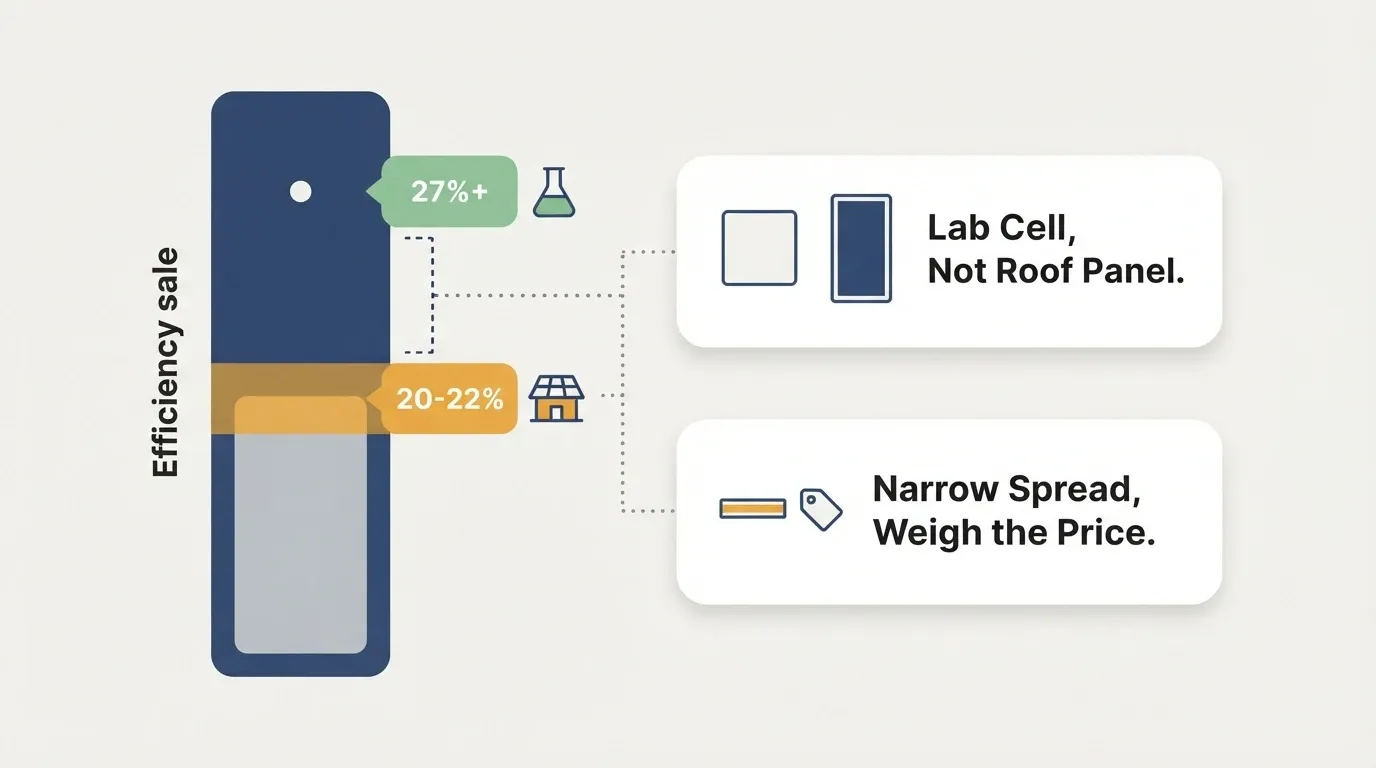
The Department of Energy's crystalline silicon photovoltaics research page (read September 27, 2026) states that industrially produced solar modules currently reach real-world efficiencies of 20 to 22 percent, and that monocrystalline silicon cells can exceed 27% in ideal laboratory conditions.
Two things follow for a buyer:
Read the exact figure from the current datasheet for the panel model on your proposal, and note the date you read it. Manufacturers update models and ratings between generations.
Efficiency pays for itself only through roof area. That gives a short list of situations where it earns its keep.
| Your situation | Does efficiency matter much? | Why |
|---|---|---|
| The system you want does not fit on the good parts of the roof | Yes | More efficient panels fit more kilowatts into the same area |
| Only one roof face gets good sun, the rest is shaded or faces north | Yes | The usable area is small, so watts per square foot count |
| Required clearances from ridges and edges shrink the usable space | Often | Same reason: less area to work with |
| You want fewer, or smaller, panels for appearance | Somewhat | Fewer panels for the same kilowatts, if the look matters to you |
| The roof has room to spare for the size you need | Little | Any panel reaching the target kilowatts will do |
| Ground mount with open space | Little | Area is rarely the constraint |
The first two rows are the ones that matter most, and both are about fit. If you have not yet checked whether the quoted system fits your roof, that comes before any efficiency comparison. On a well-oriented roof with plenty of space, the direction and pitch of the panels usually do more for annual output than a point or two of efficiency.
The fair way to compare two panels of different efficiency is at the same system size, on price per watt. If one proposal offers a premium panel and another a standard one, the question is not "which panel is better" but "what does each kilowatt cost, and do I need the extra kilowatts that only the efficient panel can fit?"
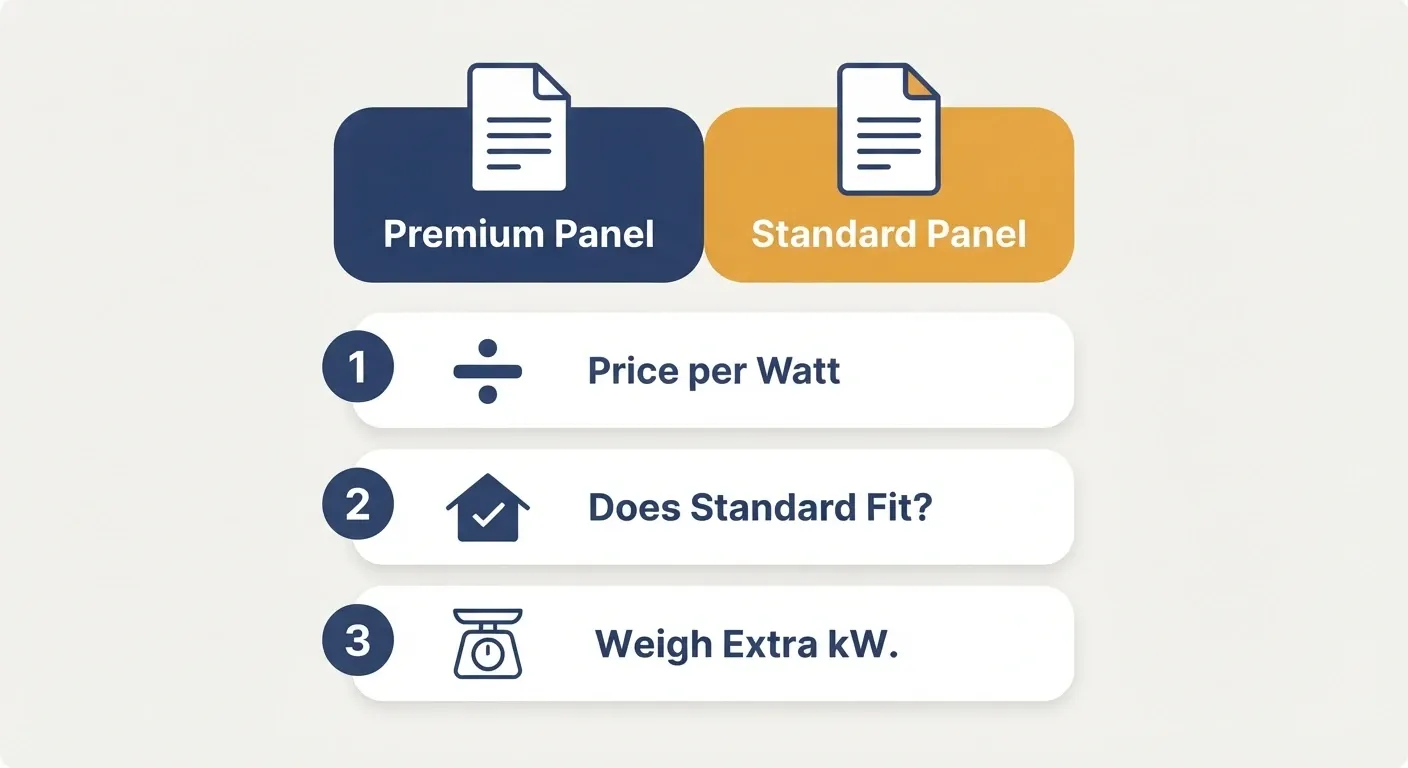
A buyer who wants a clean comparison can ask an installer for two versions of the same design: one with the premium panel and one with a standard panel, at the same kilowatt size if both fit. Then:
When comparing across installers, normalizing the quotes before comparing them keeps a panel upgrade from hiding a different system size, a different inverter or a different warranty.
If you want one number that affects energy production rather than area, it is the temperature coefficient of power, usually listed against Pmax and given as a negative percentage per degree Celsius. It tells you how much output falls for each degree the panel runs above the 25°C test temperature.
The Department of Energy's performance basics page explains why this matters: solar cells "generally work best at low temperatures," and higher temperatures cause "a much larger decrease in voltage." A panel with a smaller (closer to zero) temperature coefficient loses less output on hot afternoons. That tends to matter more in hot, sunny climates than in cool ones.
Efficiency and temperature coefficient often travel together, because cell designs that raise one tend to improve the other. They are still separate lines on the datasheet, and it is worth reading both rather than assuming.
Efficiency is an easy number to sell. It is a single percentage, higher sounds better, and it is printed large on brochures. A proposal that leads with efficiency can make a premium panel feel like better value without ever showing that the roof had room for a cheaper panel at the same size.
That framing benefits anyone whose margin is higher on the premium product. It costs the buyer when the extra efficiency is solving a space problem the roof never had. None of this makes efficient panels a bad buy. On a tight or partly shaded roof they can be the only way to reach the system size you want. The honest version of the pitch simply names the reason: "we recommend this panel because it lets us fit X kilowatts on your roof, and the standard panel would only fit Y." If the pitch cannot be put that way, efficiency is probably not what you are paying for.
The Department of Energy puts real-world efficiencies of industrially produced modules in a range of 20 to 22 percent. Most residential quotes will fall around that band. Whether a higher figure is worth paying for depends on whether your roof has space for the system size you want.
Per square foot, yes. Per kilowatt of system size, not meaningfully. Two systems of the same kilowatt size on the same roof produce similar annual energy; the more efficient one simply takes up less area. Output differences between panels of equal wattage come mostly from temperature behavior and low-light performance.
It depends on roof space. If the standard panel fits the system size you need, the extra efficiency buys unused roof area. If roof space limits the system, higher efficiency can let you fit more kilowatts. Comparing quotes at the same size, using cost per watt, shows what the premium actually costs.
Lab records are measured on single small cells under ideal conditions. A full panel includes a frame, gaps between cells and wiring, which do not produce power, so the whole panel's efficiency is lower than its best cells.
On the manufacturer's datasheet for the exact model number listed in your proposal, usually as "module efficiency." The temperature coefficient on the same sheet has more to do with output on a hot roof.
One email a week with new guides, tips, and solar news. Zero fluff, no sales pitch.