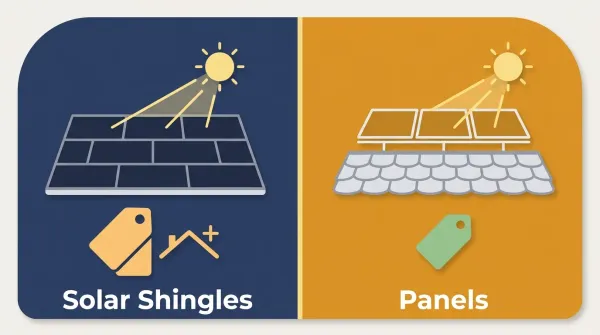
Solar Shingles vs Panels: What the Better Look Costs

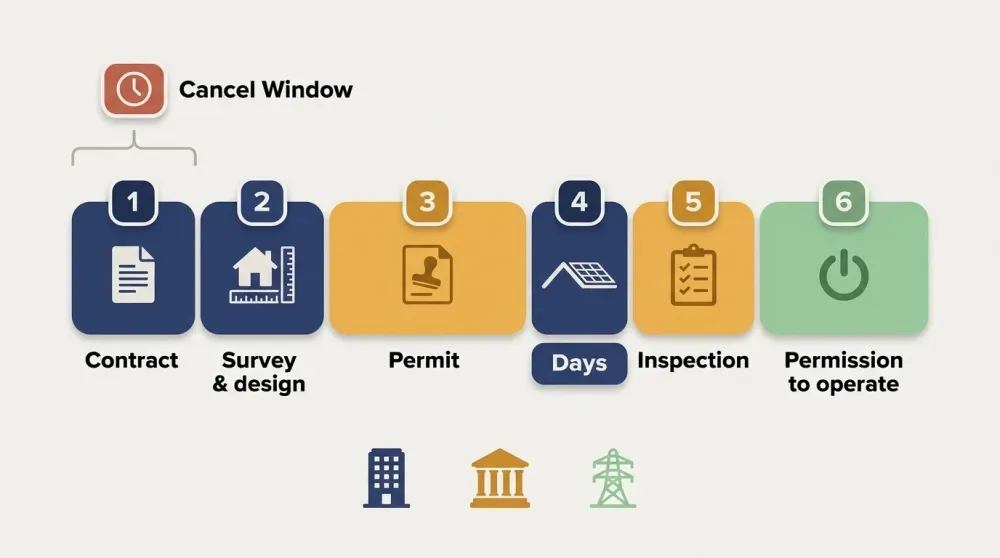
Short answer: A home solar installation timeline has six stages: contract, site survey and design, permit, installation, inspection, and the utility's permission to operate (PTO). The work on your roof usually takes a few days. Almost all of the waiting sits in the paperwork stages, where your file is held by the installer, your local permit office or your utility. Whether weeks of silence are normal depends on which of those three has your file right now, and on your town and utility. The one deadline that does not wait is your contract cancellation window, which can close within days of signing, long before anything visible happens.
That mismatch is the part of the timeline most homeowners are never shown.
If you signed six weeks ago and nothing has happened on your roof, that can be completely normal. It can also mean your file is stuck. The difference is not visible from your driveway.
Solar is a building project and a utility connection at the same time. A local government has to approve the design and inspect the finished work under its building and electrical codes. Separately, your electric utility has to approve connecting your system to its grid. Your installer coordinates both, and each has its own queue.
So the useful question is never "why is this taking so long?" It is "who has my file today, and what are they waiting for?" An installer who can answer that plainly is managing your project. One who cannot is a warning sign in itself.
| Stage | Who holds your file | What happens | What you can usefully do |
|---|---|---|---|
| 1. Contract signed | You and the installer | Agreement, financing paperwork, cancellation window starts | Note your cancellation deadline in writing |
| 2. Site survey and design | Installer | Roof and electrical panel measured, final design drawn | Confirm the final design matches the system you were quoted |
| 3. Permit | Local permit office (the "authority having jurisdiction") | Plans checked against local code | Ask for the permit number and submission date |
| 4. Installation | Installer's crew | Racking, panels, inverter equipment and wiring installed | Stay off the roof; ask what was changed from the plans |
| 5. Inspection | Local inspector | Finished work checked against the approved plans and code | Ask for the result and, if failed, the reason in writing |
| 6. Permission to operate | Your utility | Grid connection approved, meter changes if needed | Ask for the interconnection application date |
The system does not produce power for your home until stage 6 is complete. Everything before it is preparation.
The clock that matters most starts the day you sign, and it is not the construction clock.
For sales made in your home, the US Federal Trade Commission's Cooling-Off Rule can apply. The FTC's consumer page, Buyer's Remorse: The FTC's Cooling-Off Rule May Help (read September 28, 2026, page dated September 2025), says the right to cancel for a full refund "lasts until midnight of the third business day after the sale." It also says "some state laws give you more rights than the FTC's Cooling-Off Rule."
Whether the federal rule, a state rule, or a longer contractual window applies to your contract depends on where and how you signed and on your state's law. Those rules vary and change, so confirm yours with your state Attorney General's consumer protection office before relying on any number, including the one above.
Here is the trade-off. A three-day window closes long before a permit is even filed. A homeowner who waits to "see how the project goes" before deciding may find the cancellation right already expired. Our guide to finding your solar contract cancellation deadline walks through where that date usually appears in the paperwork. If the window has passed, your options for getting out of a solar contract are narrower, but not always zero.
After signing, the installer usually sends someone to measure the roof, check the rafters and attic where accessible, and look at your main electrical panel. The design is then finalized for the permit.
This is where a quote can change. The survey may find that the roof needs work first, that the electrical panel needs an upgrade, or that fewer panels fit than the salesperson estimated. Any of these can add cost and time.
Ask for the final design in writing and compare it with the contract: system size, panel count, panel model and any added line items. If something changed, you want to know before the permit is filed, not after the crew arrives.
Permitting is done by your city or county, and it is where timelines vary most from one address to the next. Some offices review plans by hand. Others use automated tools.
One example is SolarAPP+, a free permitting platform for local governments. The US Department of Energy's article 160 Communities Now Automating Solar Permitting with SolarAPP+ (read September 28, 2026, article dated December 20, 2023) says the platform "standardizes, streamlines, and automates the solar permitting process" and that more than 160 US communities in 10 states were using it at that time.
A June 12, 2024 research update from the national laboratory that publishes SolarAPP+ data reported that "the full median duration from permit submission to final passed inspection for PV-only projects was 33 days for SolarAPP+ permits and 47.5 days for traditional permits." Those are medians across the participating jurisdictions, not a promise for your town. They do show where the time goes: a large share of it is permit review and inspection scheduling, not construction.
Ask your installer whether your jurisdiction uses automated permitting and when your permit was submitted. A permit number and submission date are simple facts, and a well-run installer has them.
This is the stage people picture, and it is usually the shortest. A crew installs the roof attachments and racking, the panels, the inverter equipment and the wiring to your electrical panel. For a typical home, the physical work is often completed in a few days, though larger or more complex jobs take longer.
This is licensed work. Roof work at height and connections to your electrical panel are for the installer's crew and a licensed electrician, and nothing in this article is a guide to doing any part of it yourself. If you see something that worries you, such as damaged roofing or a change from the approved plans, raise it with the installer in writing.
After the crew leaves, the panels are on the roof but the system should not be operating. That is expected.
A local inspector checks the finished work against the approved plans and the electrical and building codes. Inspection scheduling depends on the inspector's workload in your area.
If the system fails, the installer corrects the issue and books a re-inspection, which adds time. A failed inspection is not unusual and is not automatically a sign of a bad installer, but you are entitled to know what failed and how it was fixed. Ask for it in writing.
Once the inspection passes, the installer or you submit the final paperwork to your utility. The utility reviews the interconnection, may replace or reprogram your meter, and then issues permission to operate. Only then can the system be switched on.
This is the stage that frustrates people most, because the panels are visibly finished. Utility review times are set by each utility and by state interconnection rules, and they differ widely. Check your own utility's interconnection page, or your state public utilities commission, for its current process and any published timelines.
There can also be fees at this stage. Our breakdown of solar interconnection fees lists the charges worth checking on your quote.
Do not ask anyone to switch the system on before PTO arrives. Operating a grid-connected system without the utility's approval can breach your interconnection agreement, and energizing equipment is a job for the installer, following the utility's instructions.
Most of these sit outside your control. What you control is asking the right person the right question at each stage, and keeping every answer in writing.
If your project seems stalled, these questions usually reveal where it is:
An installer who answers all six within a day or two is usually managing your file properly. If you are still comparing companies, our list of questions to ask before you sign a solar contract includes asking how the installer communicates during these stages.
It varies by town and utility. The physical installation is often a few days, while permitting, inspection and utility approval take much longer. One published median for permit submission to passed final inspection on PV-only projects was 33 days in automated-permit jurisdictions and 47.5 days with traditional permits, before utility approval is added.
The system usually needs to pass a local inspection and then receive permission to operate from your utility. Until the utility approves the connection, the system should stay off. Ask your installer when the interconnection application was filed.
Sometimes. For in-home sales, the FTC's Cooling-Off Rule gives a right to cancel until midnight of the third business day after the sale, and some states give more. Rules vary by state and contract, so confirm with your state Attorney General's consumer office.
Permission to operate is your utility's approval to connect and run your solar system on its grid. It comes after the local inspection passes and the utility reviews the interconnection paperwork.
You can avoid adding delay: respond quickly to paperwork, keep records, and ask for permit and application dates. The permit office, inspector and utility work to their own schedules.
One email a week with new guides, tips, and solar news. Zero fluff, no sales pitch.