Solar Installation Timeline: Contract to Switch-On

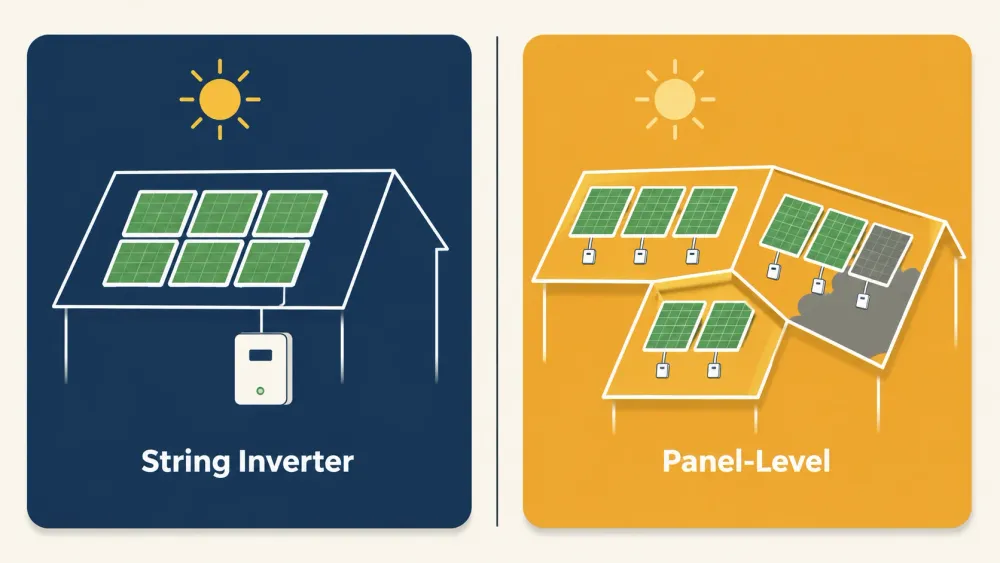
The microinverter vs string inverter choice comes down to your roof, not to which technology is newer. A string inverter is one central box, usually on a wall, that converts power from a whole row of panels. Microinverters sit behind each panel and convert power panel by panel. Power optimizers are the middle option: small devices behind each panel feeding one central inverter. On a simple, unshaded roof with one or two faces, a string inverter usually does the job for less money. On a roof with shade, several faces or awkward angles, panel-level equipment tends to earn its extra cost.
This page is for US homeowners comparing solar proposals. It explains the designs and the trade-offs. It does not name or rank brands, and nothing here is an instruction to work on solar equipment yourself.
Every grid-tied home solar system needs an inverter. Panels produce direct current (DC); your home and the grid run on alternating current (AC). Where that conversion happens is the whole difference between the three designs.
| String inverter | String inverter with optimizers | Microinverters | |
|---|---|---|---|
| Where conversion to AC happens | One central inverter | One central inverter | At each panel, on the roof |
| Electronics on the roof | None beyond wiring | One optimizer per panel (or pair) | One microinverter per panel (or pair) |
| Effect of one shaded panel | Can drag down the whole string | Limited mostly to that panel | Limited to that panel |
| Monitoring | Usually system or string level | Panel level | Panel level |
| If the central inverter fails | Whole system stops | Whole system stops | No central inverter to fail |
| Where most repairs happen | At ground level | Ground level or roof | On the roof |
A string inverter wires panels together in series, like old holiday lights. EnergySage's comparison guide (updated August 26, 2024, read September 27, 2026) puts the core weakness plainly: without panel-level electronics, "every panel connected to a string is limited to the output of the weakest panel." Optimizers and microinverters exist to break that link.
Rather than asking which design is "best", it helps to ask four questions about your own roof and plans. Each one pushes the decision one way or the other.
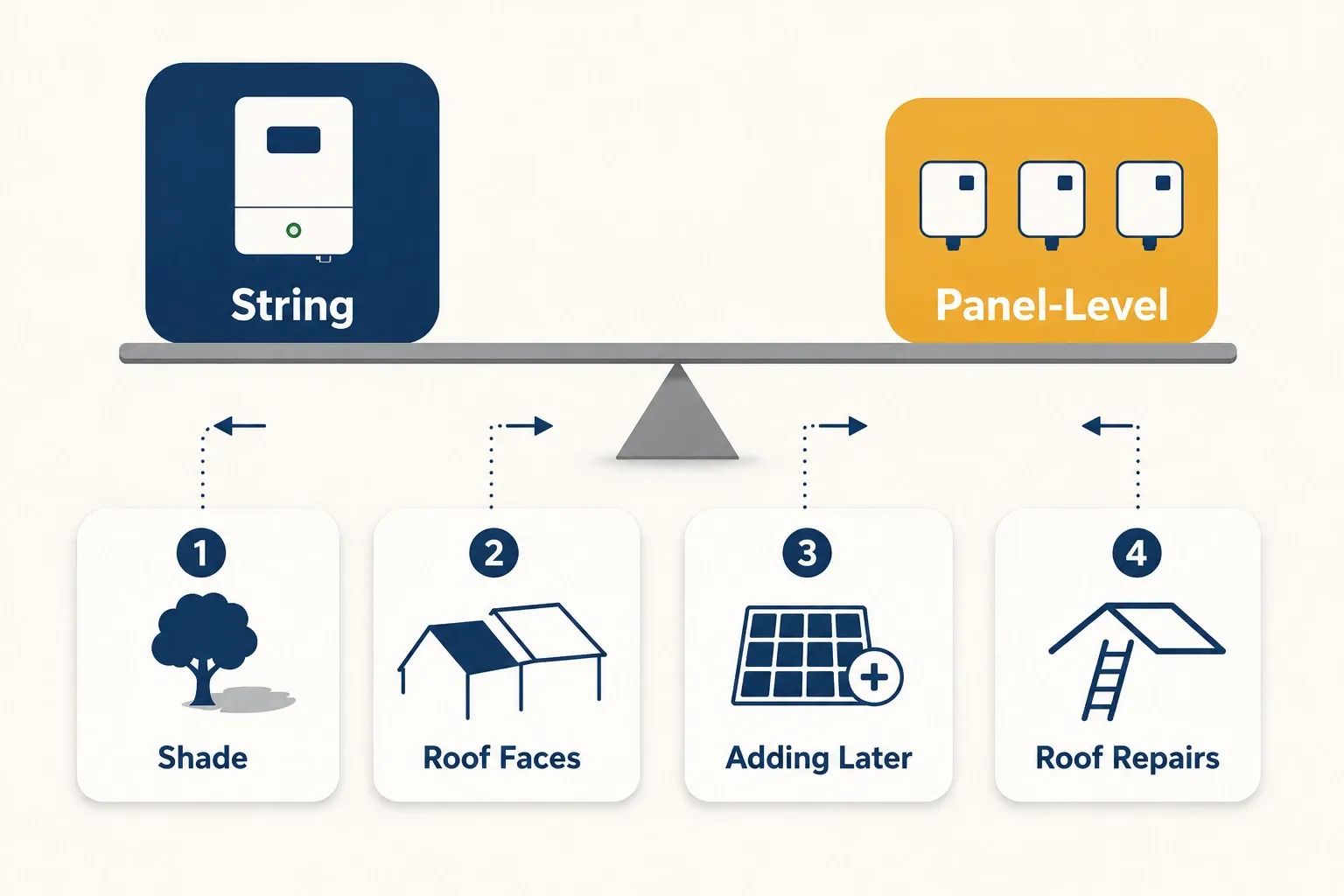
Shade is the biggest single factor. With a plain string inverter, a chimney shadow or a tree branch across one panel for part of the day can pull down the output of every panel on that string. With microinverters or optimizers, the shaded panel loses output and the rest carry on.
If the roof is clear from mid-morning to late afternoon, the shade advantage of panel-level equipment is small. If trees, dormers, vent stacks or a neighbor's house throw moving shadows across the array, it grows. Our guide to how much shade is too much for solar panels covers how to judge that before you get to inverters.
Panels on different roof faces receive sun at different times of day. A string inverter handles this by giving each face its own string, which works well when each face holds enough panels for a string. It gets harder when the design spreads a few panels across three or four small faces. Panel-level equipment treats every panel separately, so mixed faces and small groups are easier to design around.
EnergySage notes that with microinverters, system size "can be expanded easily in the future," while an optimized system "may require an additional central inverter." A string inverter is sized for a certain range of panels, so adding many more can mean a second or larger inverter. If you expect higher usage later, for example from an electric car, that is worth raising while the design is still on paper.
This is the trade-off sellers of panel-level equipment mention least. A central string inverter hangs on a wall or in a garage, where a technician can reach it from the ground. Microinverters and optimizers live under the panels. When one fails, fixing it means a crew on the roof, and often lifting panels to reach the part. A warranty may cover the part; whether it covers the labor and the roof visit is a separate line in the contract.
Optimizers are often presented as the best of both worlds, and for some roofs they are. They give panel-level output and monitoring, like microinverters, while keeping a central inverter on the wall. EnergySage describes them as "a compromise between microinverters and standard string inverters."
The compromise has two sides. You get panel-level benefits, but you still have a central inverter that can stop the whole system if it fails, and you still have electronics on the roof that need a roof visit to replace. Whether that mix is right depends on the same four questions above.
On price, EnergySage's guide calls string inverters "the most affordable option available today" and says microinverters are "usually the most expensive" on its marketplace, with optimizers in between. That matches the equipment count: one central box costs less than one device per panel.
Warranty length pulls the other way. The same guide says microinverters and optimizers typically carry 25-year warranties, while central inverters have "a shorter warranty period (around 10 to 12 years)." Treat those as typical figures reported by one marketplace, not promises; the warranty that counts is the one on the datasheet for the exact model in your proposal.
The practical consequence: if your panels are expected to last around 25 years and the central inverter's warranty runs out well before that, the proposal is quietly assuming a replacement inverter partway through the system's life. That replacement is a real future cost, and it belongs in the comparison. A cheaper upfront design is not automatically cheaper over the life of the system, and a more expensive one is not automatically better value. The only fair comparison puts both on the table side by side, which is what normalizing solar quotes before you compare them is for.
A long warranty is also only as good as the company behind it and the installer who handles the claim. If the installer who put the equipment on your roof closes, a roof-mounted part becomes harder to service. Checking whether your installer will still exist matters more when the parts most likely to need work are on the roof.
Solar panels produce electricity whenever light reaches them. Switching off your home's main breaker does not stop the panels themselves from generating. That is why the National Electrical Code requires rooftop systems to include a rapid shutdown function. The 2023 edition of the code (NFPA 70) states that PV circuits on or in buildings "shall include a rapid shutdown function to reduce shock hazard for firefighters."
Inverter choice and rapid shutdown are linked. Panel-level devices are one common way a system meets the requirement; a string system typically needs specific listed rapid shutdown equipment added. Local building departments check this at permit. The City of Vancouver, Washington's residential solar panel checklist (read September 27, 2026), for example, asks for identification of the rapid shutdown devices and their control location, a "description of shutdown activation method and compliance with NEC 690.12," and inverters "listed for utility interaction." Which code edition applies depends on what your city or county has adopted.
What this means for you as the buyer:
| Your roof and plans | Design that usually fits | The trade-off you accept |
|---|---|---|
| One or two sunny faces, little or no shade | String inverter | Less panel-level data; one central point of failure |
| Partial shade from trees, chimneys or dormers | Microinverters or optimizers | Higher upfront cost; roof visits for repairs |
| Panels spread over three or more small faces | Microinverters or optimizers | Same as above |
| You expect to add panels later | Microinverters, or a string inverter sized with room to grow | Ask the installer to show the expansion path in writing |
| You want the fewest parts on the roof | String inverter (with the rapid shutdown equipment your code requires) | Shade sensitivity; likely inverter replacement during system life |
These are tendencies, not rules. An installer with good reasons for a different choice on your roof should be able to explain them in two or three sentences.
A quote reflects equipment the installer already buys, stocks and trains its crews on. That is a normal way to run a business, but it means the design in your proposal may be the installer's default rather than a choice made for your roof, and a buyer who cannot tell the difference will never ask.
A buyer who knows the four questions can test it. On a clear, simple roof, a proposal built around panel-level electronics should explain what problem the extra equipment solves. On a shaded, broken-up roof, a plain string design should explain how it handles the shade. Asking "why this inverter design for my roof?" belongs on your list of questions to ask before you sign a solar contract, and the quality of the answer tells you a good deal about the installer.
Not in general. Microinverters handle shade and multi-face roofs better and give panel-level monitoring. String inverters usually cost less and keep repairs at ground level. Which is better depends on your roof's shade, layout and your plans to expand.
They can on roofs with shade or panels facing different directions, because each panel works independently. On an unshaded, simple roof, the difference is usually small, and a string inverter can perform comparably.
Warranty terms are the best guide. EnergySage reports central inverter warranties typically around 10 to 12 years and microinverter and optimizer warranties typically 25 years. Check the datasheet warranty for the exact model in your proposal.
It is a function the National Electrical Code requires on rooftop solar to reduce shock hazard for firefighters by de-energizing the wiring quickly. Panel-level devices are one common way to meet it. Your installer designs it and your local building department checks it at permit.
No. Inverter, disconnect and roof-mounted equipment work involves wiring that can be live whenever the sun is up. It is work for your installer or a licensed electrician, and the warranty terms for the equipment will say who is allowed to service it.
One email a week with new guides, tips, and solar news. Zero fluff, no sales pitch.