Solar Installation Timeline: Contract to Switch-On

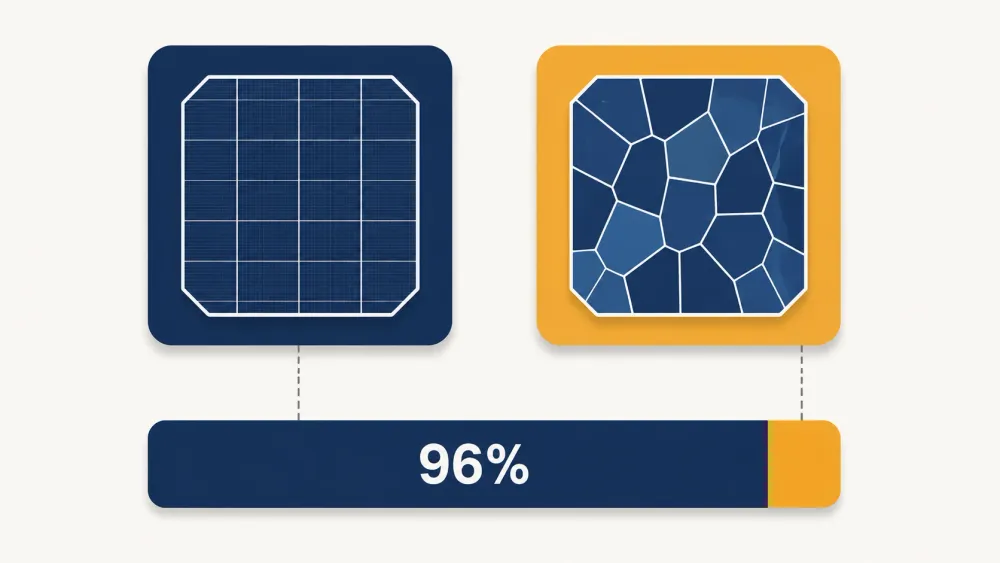
In the monocrystalline vs polycrystalline question, the market has largely answered for you. Both are silicon panels. Monocrystalline cells are cut from a single crystal and convert sunlight more efficiently; polycrystalline cells are made from many crystals and were cheaper to produce. According to the Department of Energy, monocrystalline silicon made up 96% of global solar shipments in 2022. If your quote says monocrystalline, that is normal, not a premium feature. The comparison that now matters is between specific panels, using the numbers on their spec sheets.
This page is for US homeowners reading a solar proposal. It explains the categories; it does not rank brands or recommend a product.
Both terms describe how the silicon in the solar cells is made. The Department of Energy's PV Cells 101 primer (published December 3, 2019, read September 27, 2026) puts it simply: "Monocrystalline silicon wafers are made up of one crystal structure, and polycrystalline silicon is made up of lots of different crystals." The same primer gives the trade-off in one sentence: "Monocrystalline panels are more efficient because the electrons move more freely to generate electricity, but polycrystalline cells are less expensive to manufacture."
You can often tell them apart by eye. Monocrystalline panels usually look evenly dark or black. Polycrystalline panels usually have a blue, speckled look, because the many crystal grains reflect light differently. The look is a clue, not proof; the spec sheet names the cell type.
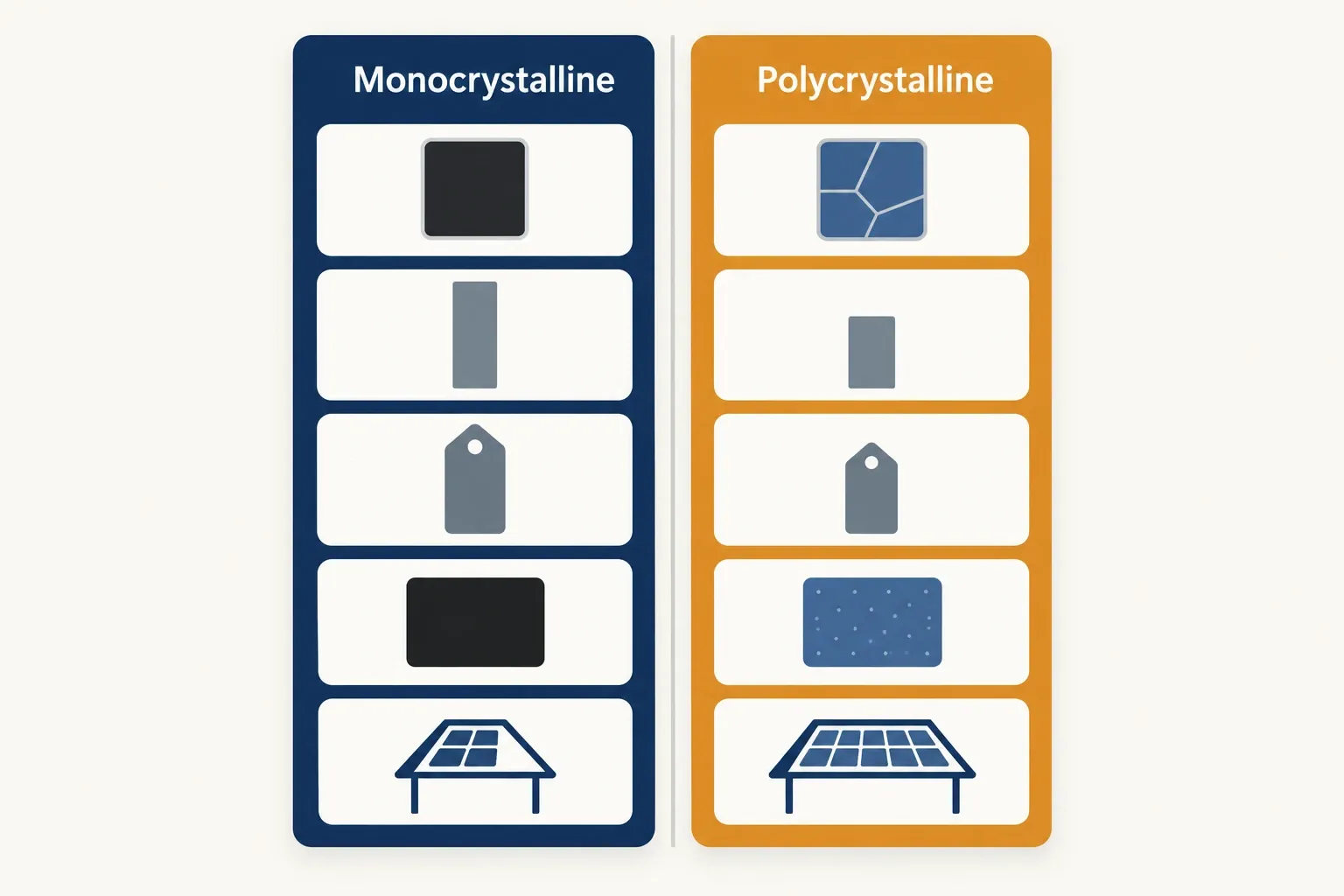
For years this was a real choice with a real trade-off:
| Monocrystalline | Polycrystalline | |
|---|---|---|
| Silicon structure | One continuous crystal | Many crystal grains |
| Efficiency | Higher | Lower |
| Cost to make | Higher | Lower |
| Typical look | Even black | Blue, speckled |
| Where it made sense | Limited roof space, buyers paying for output | Plenty of space, buyers paying for low price |
That table is what most comparison pages still reproduce. The first four rows are still true in principle. The last row is where the story has changed, because manufacturing has moved overwhelmingly to monocrystalline, and a category that almost nobody makes any more is no longer the obvious budget pick.
The Department of Energy's crystalline silicon photovoltaics research page (read September 27, 2026) states that "monocrystalline silicon represented 96% of global solar shipments in 2022, making it the most common absorber material in today's solar modules." The same page says industrially produced modules currently reach real-world efficiencies of roughly 20 to 22 percent, while monocrystalline cells can exceed 27% in ideal laboratory conditions.
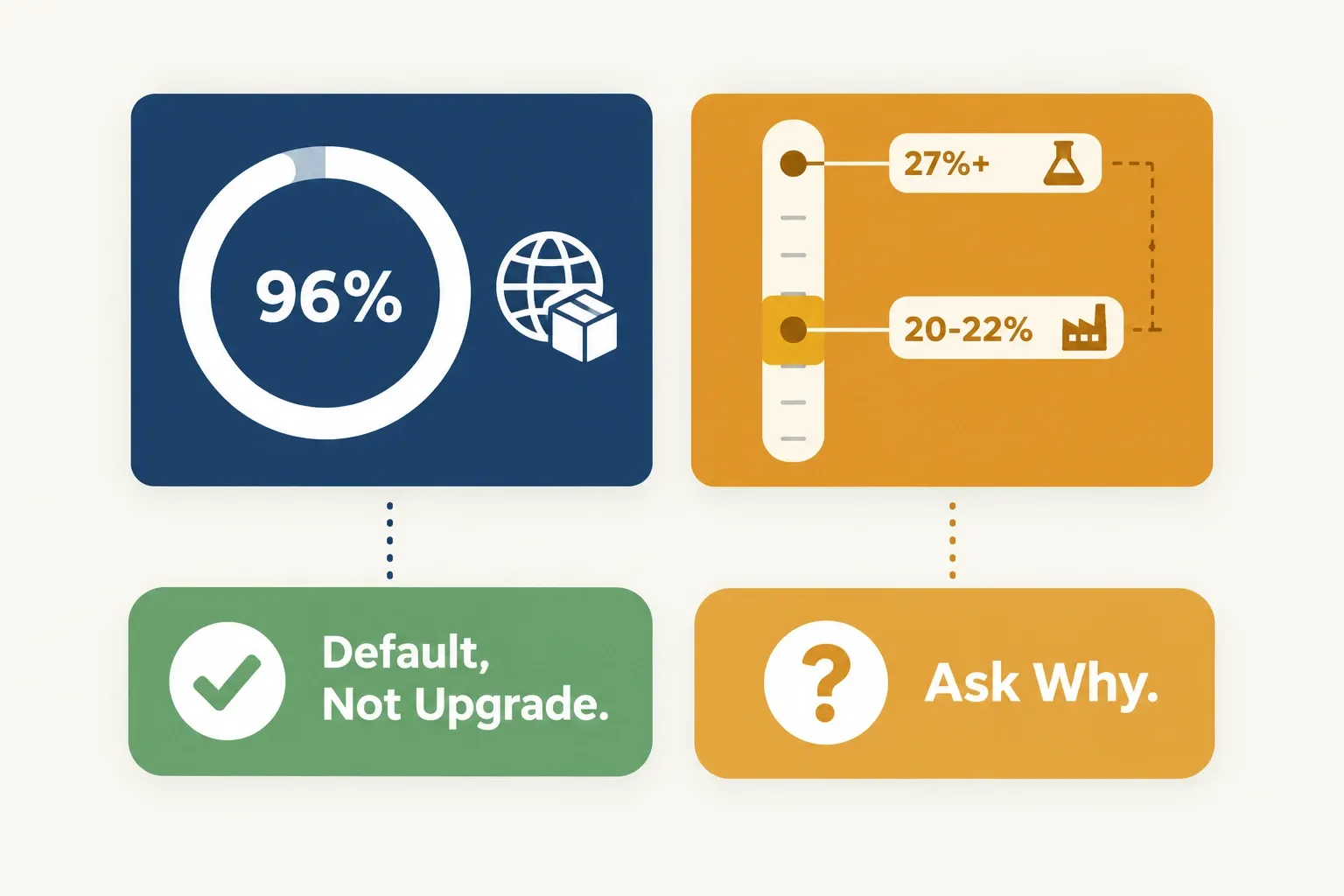
For a homeowner, that means two things:
Because nearly every panel is now monocrystalline, manufacturers compete on how the cell is built, and spec sheets carry newer labels such as PERC, TOPCon, heterojunction (sometimes written HJT), n-type and p-type, or half-cut cells. These are design details within silicon cell technology, and each maker describes its own version.
You do not need to master them. They are part of the reason two monocrystalline panels can perform differently, but the useful information shows up as numbers on the same spec sheet. A cell-technology label with no numbers behind it tells you very little about how the panel will do on your roof.
When two quotes list different panels, compare these lines from each panel's own spec sheet and warranty, not the category name:
Read each figure from the panel's current datasheet and warranty document, and note the date, rather than relying on a sales summary. Specifications and warranty terms change between model generations.
There are a few cases where the old distinction is still worth a thought:
The panel type does not tell you how much electricity the system will make. Production depends on the roof's direction and tilt, shade, local weather and the rest of the equipment. A premium monocrystalline panel on a shaded, poorly oriented roof can produce less than a modest panel on a clear, well-oriented one. Checking the inputs behind the production estimate will tell you more about your likely output than the cell type ever will.
It also does not tell you about installation quality, the inverter equipment, or the installer's workmanship warranty, which together decide much of what you experience after the system goes up.
Old comparison pages still frame this as a choice between a premium technology and a budget one. That framing helps anyone selling ordinary panels as special. If a proposal leans on "monocrystalline" as a selling point, it is borrowing credibility from a debate the market has already closed. The better question to put to any installer is which specific panel they are quoting, why, and what its datasheet and warranties say in numbers. Then compare quotes on the full picture, as normalizing solar quotes before comparing them describes.
Monocrystalline panels are more efficient, while polycrystalline cells have historically been cheaper to make. Since monocrystalline made up 96% of global solar shipments in 2022, according to the Department of Energy, most new home quotes now list monocrystalline panels, and the more useful comparison is between specific panels' spec sheets.
They are now uncommon, since the Department of Energy reports that nearly all global shipments are monocrystalline. If a new quote lists one, ask why it was chosen and compare its efficiency, price per watt and warranties with other options.
Monocrystalline panels usually look evenly dark or black, and polycrystalline panels usually look blue and speckled. The panel's spec sheet, found by its model number on your proposal or the label on the panel, states the cell type.
It affects efficiency, but production depends far more on roof direction, tilt, shade, weather and the rest of the system. Compare each panel's rated power, efficiency, temperature coefficient and warranties rather than relying on the category.
They are names for cell designs used within silicon panels. Each manufacturer describes its own version, and the practical differences show up in the spec sheet's numbers, such as efficiency and temperature coefficient, and in the warranties.
One email a week with new guides, tips, and solar news. Zero fluff, no sales pitch.