Solar Installation Timeline: Contract to Switch-On

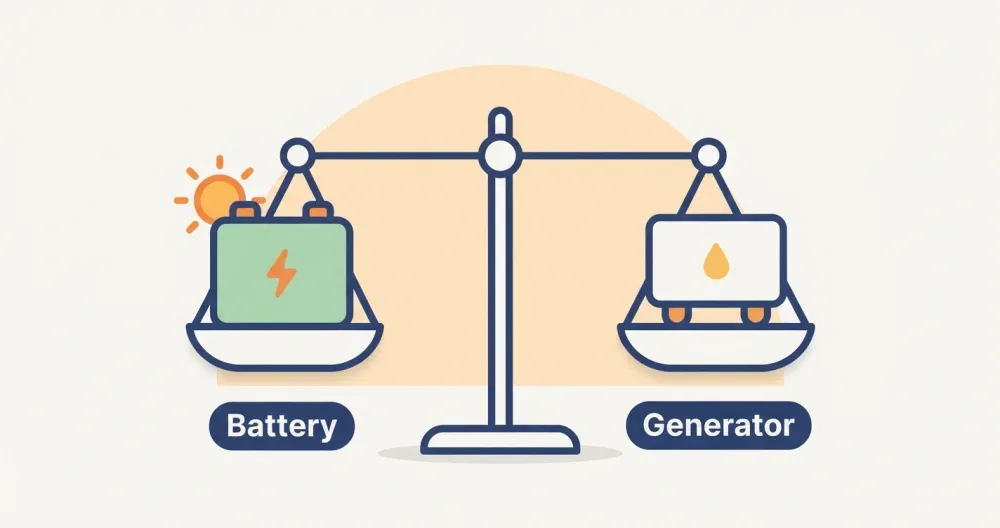
In the home battery vs generator decision, the honest answer turns on how long your outages last. A standby generator keeps running as long as its fuel supply holds out, so it suits long, multi-day outages and heavy loads like central air. A home battery runs silently and switches over on its own, but it holds a fixed amount of stored energy, so it suits shorter outages and a smaller set of circuits, unless solar panels can recharge it. Homes that lose power for days at a time often end up weighing both, or combining them.
This page is for US homeowners who have grid-tied solar or are pricing it. It compares the two as purchases. It does not cover installation: connecting either one to your home's wiring is permit work for a licensed electrician, and nothing here replaces their load calculation.
Before any comparison, the safety fact that separates these two machines. A generator burns fuel, and burning fuel makes carbon monoxide, a gas you cannot see or smell. The Consumer Product Safety Commission's 2026 hurricane-season generator warning (released May 27, 2026, read September 27, 2026) tells people to "operate generators outdoors only, at least 20 feet from homes and buildings, with exhaust directed away from windows, doors and vents," and to install working carbon monoxide and smoke alarms on every level of the home and outside sleeping areas.
The Department of Energy's Building America Solution Center, in its guidance on generators for backup power (read September 27, 2026), says generators "should never be operated inside the home, the garage, or a basement." A permanently installed standby unit is placed by the installer to meet the manufacturer's clearances and your local code, which is part of what you pay for. Carbon monoxide alarms still belong inside the house.
A home battery burns nothing and has no exhaust. It carries its own fire-safety rules under the building and fire codes, which is a different risk, not the absence of one.
| Question | Home battery | Standby generator |
|---|---|---|
| Where the power comes from | Energy stored in advance, from the grid or your solar | Made on demand by burning natural gas, propane or diesel |
| How long it runs | Until the stored energy runs out, unless solar recharges it | As long as fuel lasts and the engine keeps running |
| How much it runs at once | Capped by the battery system's power rating and which circuits are wired to it | Capped by the generator's rated output |
| Noise and exhaust | Quiet, no exhaust | Engine noise and exhaust, sited outdoors |
| Useful on a normal day? | Possibly, if your rate plan rewards shifting use away from peak hours | No, it waits for an outage |
| Owner upkeep | Watching alerts and keeping the space around it clear | Scheduled test runs, servicing, fuel supply |
| Who connects it | Licensed electrician, under a permit | Licensed electrician under a permit, plus a gas line by a qualified fitter where needed |
Neither column says "better". Each answers a different kind of outage.
The first input is not a spec sheet. It is your own outage history. The Energy Information Administration reported in its December 1, 2025 analysis of 2024 outages (read September 27, 2026) that US customers averaged 11 hours of interruptions in 2024, and that "interruptions attributed to major events averaged nearly nine hours in 2024, compared with an average of nearly four hours per year in 2014 through 2023." Hurricanes Beryl, Helene and Milton accounted for 80% of those hours. Interruptions not triggered by major events, the same analysis says, "routinely average about two hours per year."
The spread matters more than the average. The EIA found South Carolina customers went without power for nearly 53 hours in 2024, the most of any state, while customers in states such as Arizona, South Dakota, North Dakota and Massachusetts averaged less than two hours.
So write down what actually happens where you live: how often the power goes, how long it stays off, and what season it happens in. A household that loses power twice a year for an hour and a household that sits in the dark for four days after every hurricane are shopping for different things, even if both are told "backup power".
A battery earns its place when outages are short or frequent, when noise matters, and when you already have or are adding solar.
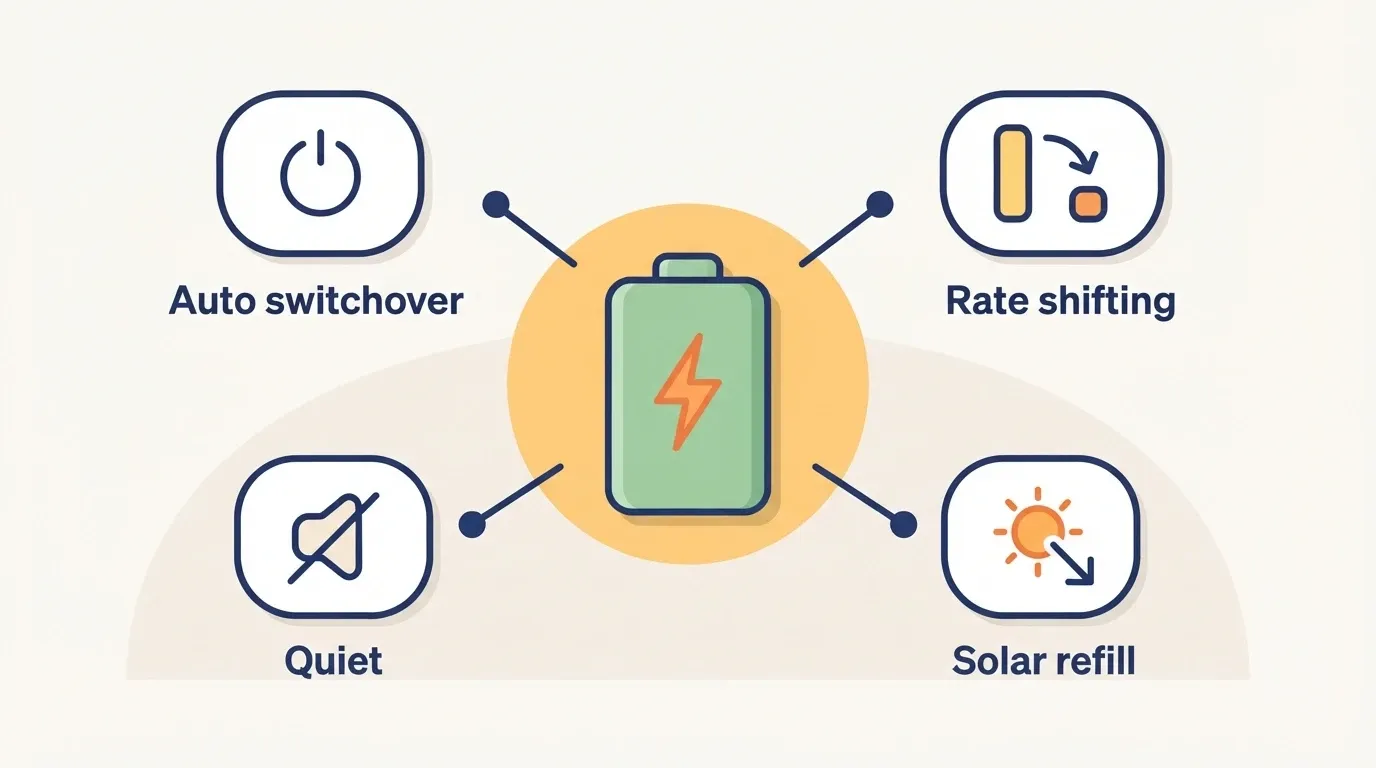
That last point needs care. An ordinary grid-tied solar system without a battery is designed to shut down when the grid goes down, so utility crews are not hit by power flowing back into the lines. The panels on your roof do not keep your lights on by themselves. With a battery and equipment set up for backup, the system can disconnect your home from the grid and keep recharging from the panels in daylight. How much it recharges depends on season and weather, and the cloudy days after a big storm are exactly when output is lowest.
A generator earns its place when outages run for days, or when the loads you need are large.
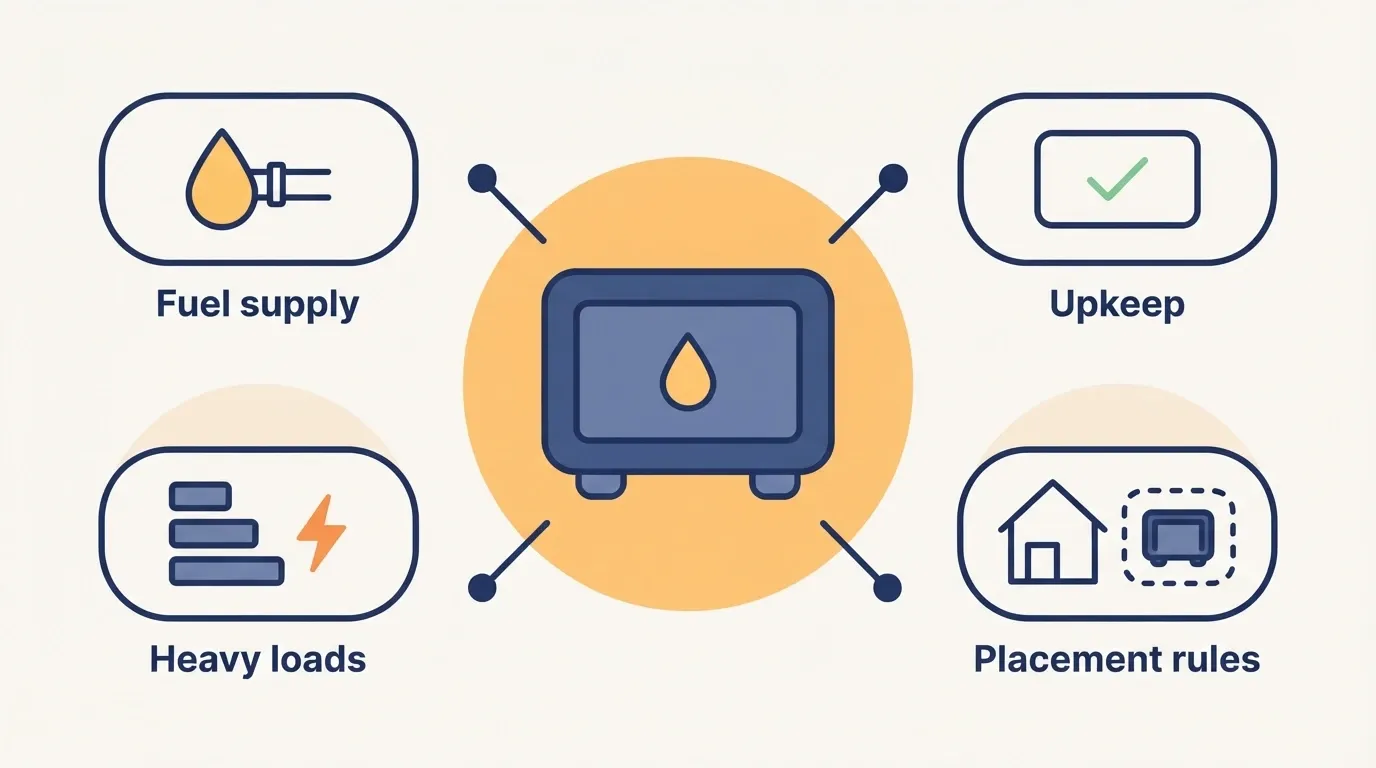
Most battery quotes do not back up the whole house. They back up a selected group of circuits, often wired through a separate essential-loads panel. That is a sensible way to stretch stored energy, and it comes with a real limit: the system can only deliver so much power at once.
If the backed-up circuits ask for more than the battery system is rated to supply, for example because central air, an electric range and a well pump all start together, the system protects itself by tripping or shutting down. You lose backup power at exactly the moment you were counting on it. A generator sized too small for the loads it serves has the same problem, reaching its output limit and tripping.
This is why sizing is not a homeowner job. Which circuits get backed up, whether they can safely run together, and whether your main panel can take the equipment are decisions a licensed electrician makes with a load calculation. Do not move circuits between panels, add loads to a backed-up panel, or plug a generator into a wall outlet yourself. Ask the installer to put in writing which circuits are backed up and which large appliances the system can and cannot start.
A generator connected to home wiring must go through a transfer switch or a listed interlock, installed by an electrician. The DOE guidance tells homeowners to have electricians install "safe and reliable transfer switches" to prevent backfeeding, which is power flowing from your generator back into the utility's lines. Backfed power can injure or kill line workers who believe the lines are dead. The same logic is built into grid-tied solar and battery equipment, which is one more reason none of this is a do-it-yourself connection.
Some homes pair a battery for instant, silent coverage of short outages with a generator for the long ones. It can be a sound arrangement, and it is also two purchases, two sets of permits and two sets of upkeep. Whether a particular battery system can accept charging from a generator is set by the manufacturer's documentation and the installer's design. Ask for that answer in writing before you plan around it.
We do not print an average price here, because installed prices vary widely with the size of the system, your electrical panel, the fuel supply and local permit rules, and any single figure would be wrong for most readers. What we can tell you is what belongs on each quote:
Incentives changed too. The federal residential credit that older articles still quote for batteries has ended, and what changed when the federal solar tax credit expired walks through what that means. Some states and utilities still run battery programs, often with strings attached; what you trade for a home battery rebate covers those terms. Line items that go missing from quotes are covered in the hidden costs of solar panels.
Battery sellers tend to present a battery as a clean, quiet generator replacement. Generator dealers tend to present a battery as too small to matter. Both are selling something, and both leave out the half of the picture that favors the other product.
The questions that cut through both pitches are the same: which circuits stay on, for how many hours, under what assumptions about weather and fuel, and what happens when the backed-up loads all start at once. Add them to the questions to ask before you sign a solar contract, and compare quotes only when they answer them in writing.
For outages lasting several days, a fueled standby generator can keep running as long as its fuel supply continues. A battery can only cover a long outage if solar recharges it, and solar output drops in cloudy weather. Your own outage history is the best guide.
Some systems are designed to, but many quotes back up only selected circuits. Whether a battery can run your whole house depends on its power rating, its stored energy and your loads, which a licensed electrician determines with a load calculation.
Yes. Any fuel-burning generator produces carbon monoxide. The Consumer Product Safety Commission advises working carbon monoxide alarms on every level of the home and outside sleeping areas.
Usually not. A standard grid-tied system is designed to shut down when the grid fails, to protect utility workers. Keeping power on during an outage requires a battery or other backup equipment designed and installed for that purpose.
No. A generator must connect through a transfer switch or listed interlock installed by a licensed electrician under a permit. Connecting it any other way can send power back into utility lines and endanger line workers.
One email a week with new guides, tips, and solar news. Zero fluff, no sales pitch.