Solar Installation Timeline: Contract to Switch-On

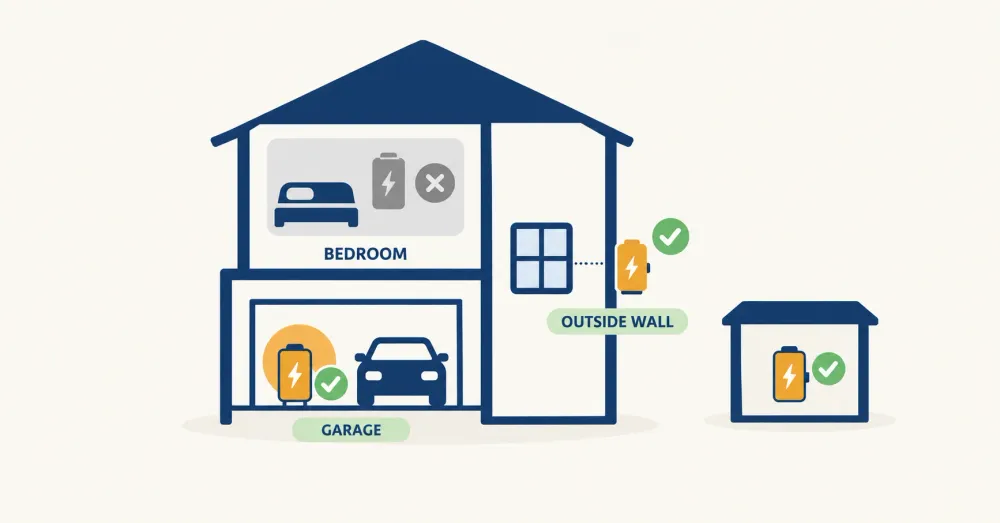
Under the model codes most US jurisdictions build on, a home battery can usually go in a garage, on an outside wall at least 3 feet from doors and windows into the home, in a detached structure, or in an enclosed utility space such as a basement or utility closet. It cannot go in living space, and bedrooms are the clearest example. The home battery installation location code that actually applies to your house is whatever your state and local building department have adopted, and the placement is designed by a licensed electrician and approved through a permit.
This page covers US homes only and explains the rules so you can read a proposal intelligently. It is not installation guidance. Mounting, wiring and connecting a battery is licensed electrician work, done under a permit and inspected.
There is no single national rule. Two model documents set the pattern, and each state and city decides which edition to adopt and what to change:
Your local building department, sometimes with the fire marshal, is the "authority having jurisdiction". It decides which edition applies to your permit and what local amendments sit on top. Two neighboring towns can answer the same question differently, and a rule that changed in the last code cycle may not have reached your town yet. Ask the building department directly which edition it enforces before you rely on any summary, including this one.
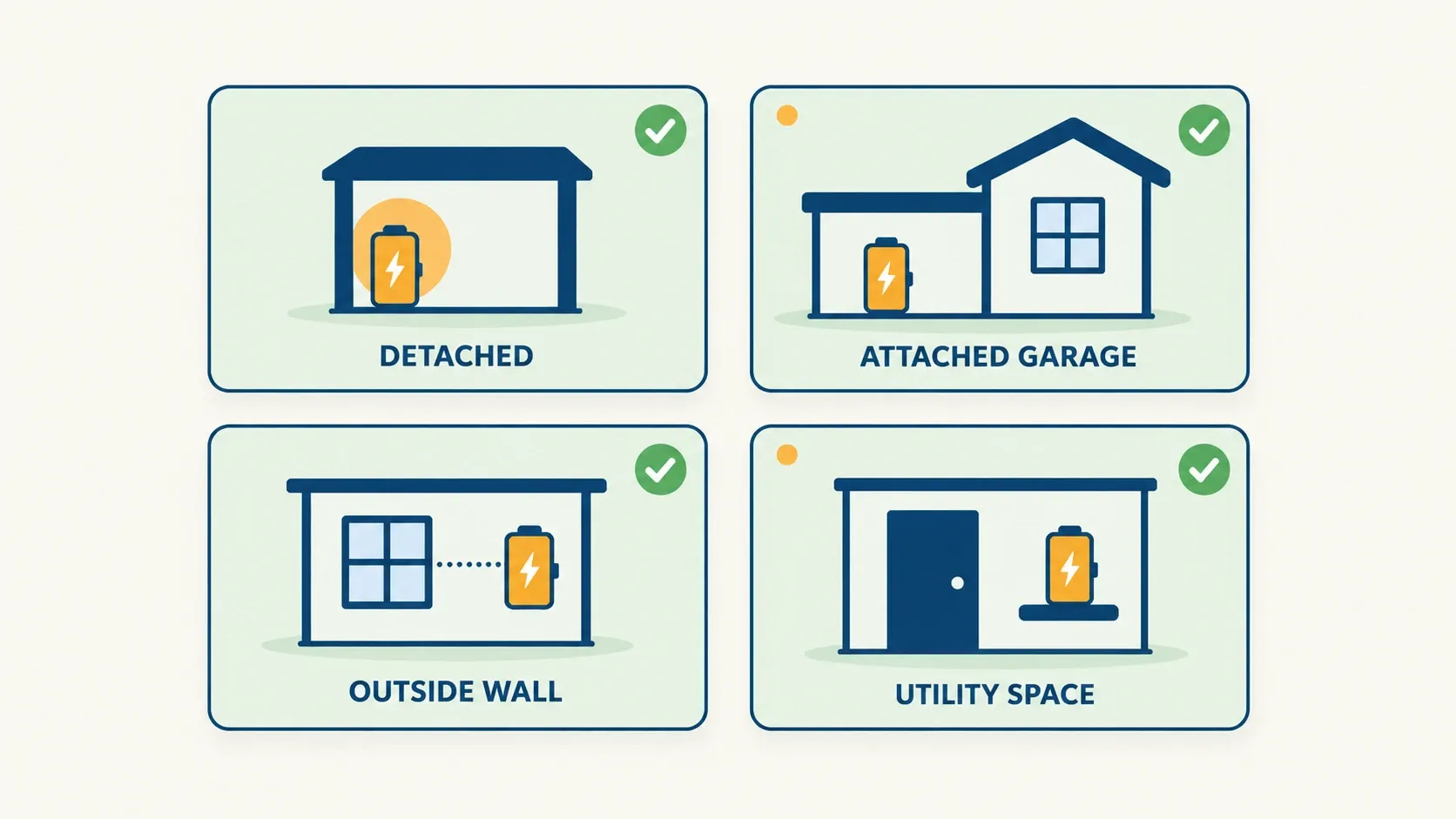
The pattern across the model codes and the state code text we read is consistent. A battery is allowed in:
That fourth location carries a condition people miss. An unfinished basement or utility room with exposed wood framing may need fire-rated wall and ceiling covering around the battery before it qualifies. That is a construction cost, and it may not be in the battery quote. The hidden costs of solar works the same way: the extras that make an install legal are real line items.
Living space is off limits. The location rules are written as a list of allowed places, so anywhere not on the list, including the rooms people live in, is not allowed. UL Solutions, the organization behind the UL 9540 safety standard for energy storage systems, describes the same direction in its Q&A on residential energy storage marking (published November 18, 2021, read September 25, 2026): residential batteries limited to garages, sheds, utility closets, basements and storage spaces, and kept out of habitable and living spaces, with a narrow exception for systems whose cells did not go into thermal runaway in testing.
In practice, that means no battery in a bedroom, a living room, a kitchen or a finished family room. The reasoning is straightforward: if a battery fails, the people most at risk are the ones who are asleep beside it.
A battery that "fits nicely" in a finished room is not a question of taste. If an installer suggests a location inside living space, ask which code section allows it, and confirm the answer with the building department.
Location rules come with limits on how much battery can sit in one place. The UL Solutions Q&A notes that the IRC and NFPA 855 both reference UL 9540 and typically cap individual residential units at 20 kWh of stored energy.
The state fire code text we read, New York State's residential energy storage section as published on UpCodes (read September 25, 2026), sets aggregate limits by location: 40 kWh in utility closets and storage spaces, and 80 kWh in garages, detached structures, on exterior walls and on the ground outside. It also requires individual units to be at least 3 feet apart unless large-scale fire testing documents that less spacing is adequate. Your jurisdiction's numbers may differ by edition, so treat these as the shape of the rule, not your answer.
Garages add two requirements worth knowing before the site survey:
Outdoors solves the living-space problem, but not every outside wall qualifies. The 3-foot clearance from doors and windows into the home rules out a lot of wall. Setbacks from property lines, homeowners association rules and local zoning can remove more.
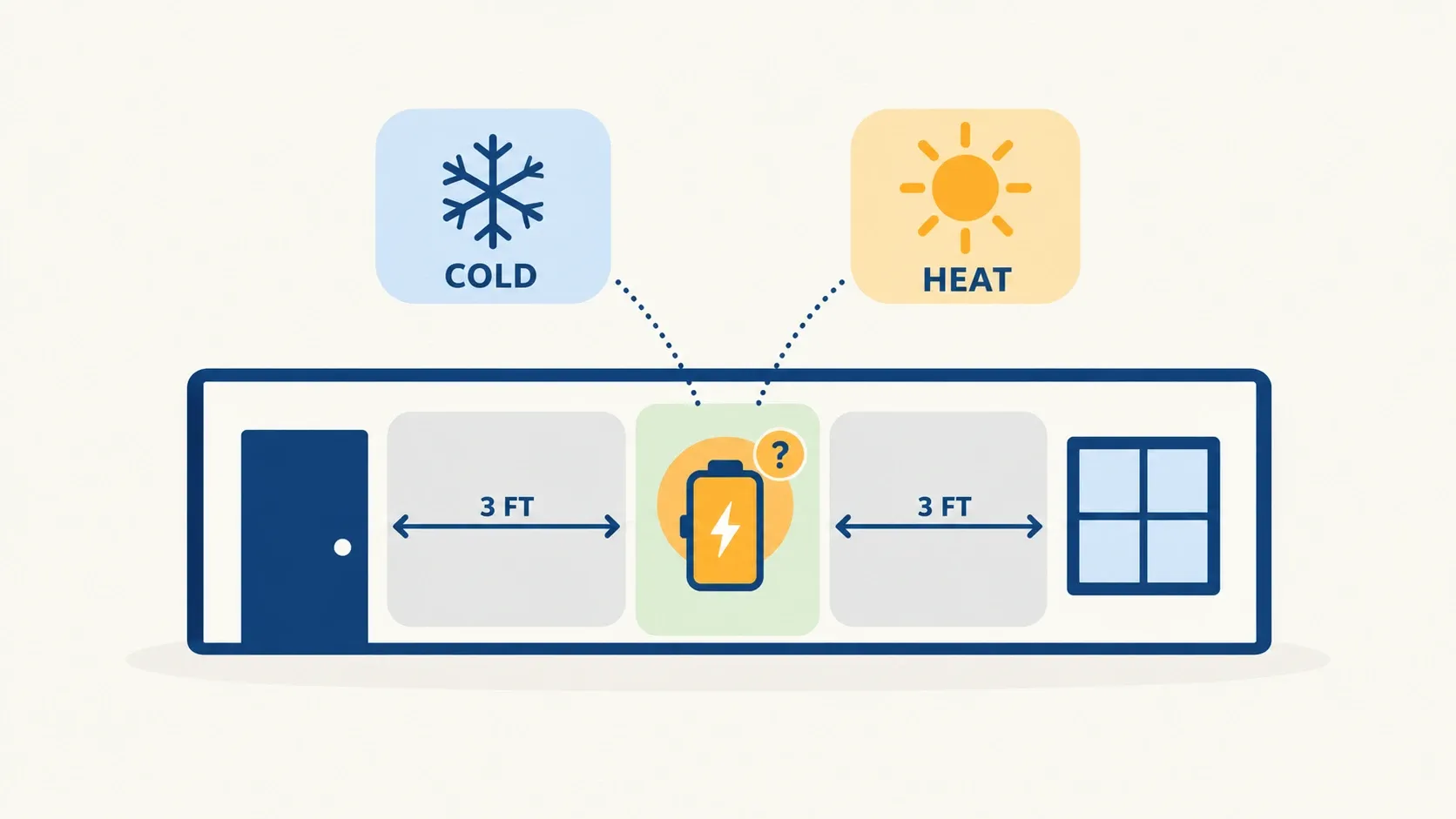
The weather is the other constraint. Batteries have operating temperature ranges set by the manufacturer, and EnergySage's battery warranty guide (updated September 12, 2024, read September 25, 2026) notes that temperature restrictions and indoor or outdoor location requirements can void warranty coverage if they are not met. A location that satisfies the code can still fail the warranty. In a hot climate, a south-facing wall in full sun, or in a cold one, an unheated shed, deserves a direct question to the installer about the manufacturer's limits.
The best location for the installer is often the quickest one: close to the main panel, with a short wire run and easy access. That is not wrong, and a short run can also mean a lower price. But the choice has consequences the homeowner lives with for years: floor space in the garage, a barrier in front of the car, wall work in the basement, or a wall facing the afternoon sun.
A proposal should say where the battery will go and why that spot was chosen. If two installers propose different locations, their prices are not directly comparable until you know what each location requires. Add location to the questions to ask before you sign: the proposed spot, the code basis, any barrier or wall work, and whether that work is in the price.
The homeowner's part is knowing the rules well enough to ask good questions. Everything past that belongs to licensed trades and the permit process:
If a utility or state program is paying part of the cost, its rules may add conditions of their own. Home battery rebates in 2026 covers what those programs typically ask for.
Usually yes, in the model codes, provided an attached garage is separated from the living space as the building code requires. Garages typically bring extra requirements such as protection from vehicle impact and heat detection. Your local building department decides which edition and amendments apply.
Only in certain spaces. The model codes allow enclosed utility closets, basements and storage or utility spaces, with conditions on the wall and ceiling finish. Living spaces such as bedrooms, living rooms and kitchens are not on the allowed list.
No. Bedrooms are living space, and the location rules keep residential batteries out of living space.
The model codes and the state code text we read set at least 3 feet from doors and windows that open directly into the home. Local amendments, setbacks and HOA rules can add more.
A licensed electrician designs the installation, and your local building department approves it through the permit and inspection. Ask which code section allows the proposed spot.
One email a week with new guides, tips, and solar news. Zero fluff, no sales pitch.