Best Solar Panel Brands: How to Judge Any Ranking

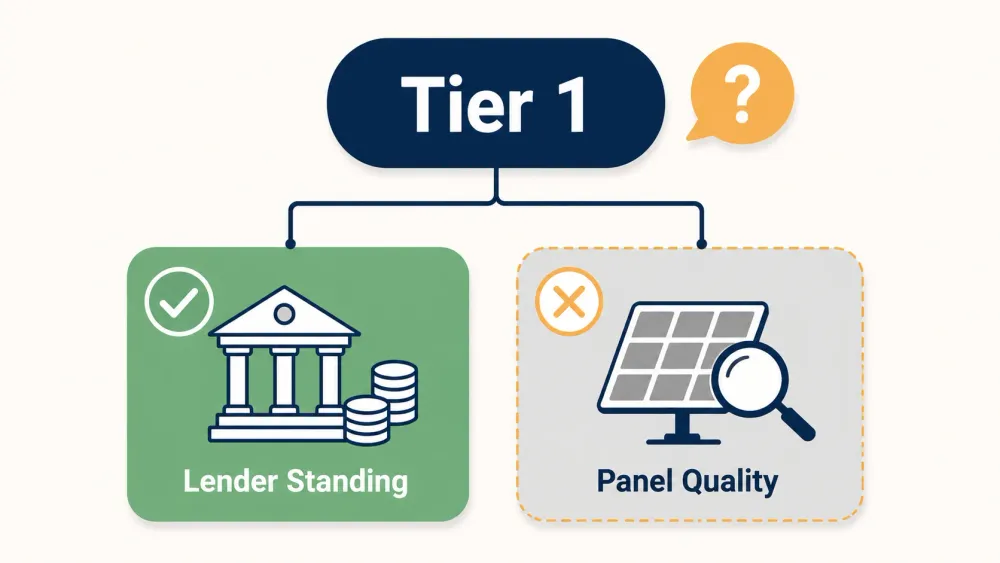
Short answer: "Tier 1" comes from a list kept by BloombergNEF (BNEF), a research firm that tracks which panel makers have supplied their own-brand panels to large projects that banks were willing to finance. It is a measure of bankability, not of panel quality. BNEF itself tells buyers not to use the list as a quality measure. So the Tier 1 solar panels meaning is narrower than a sales pitch implies: it tells you something about the manufacturer's standing with lenders, and nothing directly about how the specific panel on your roof will hold up.
That gap matters, because "Tier 1" is often said in a sales meeting as if it closes the question. It opens one instead.
BNEF publishes the list quarterly. Its purpose was never to grade panels for homeowners. It answers a question lenders and analysts ask: which manufacturers are established enough that banks will lend against projects using their products?
The Midwest Renewable Energy Association (MREA), a nonprofit that runs group solar buying programs, summarizes it this way in its explainer on what "Tier 1" means (read September 27, 2026): the term "refers to the 'bankability' of these modules," meaning how likely large projects using them are to be offered non-recourse debt financing by banks.
BNEF's own wording of the test, as quoted by the due diligence firm Phoventus from BNEF's methodology, is that Tier 1 makers "have provided own-brand, own-manufacture products to six different projects, which have been financed non-recourse by six different (nondevelopment) banks, in the past two years."
A few things follow from that definition:
This is the part that rarely makes it into a proposal. According to the MREA page cited above, BNEF's methodology states that the classification "is purely a measure of industry acceptance, and there are many documented examples of quality issues or bankruptcy of tier 1 manufacturers."
BNEF goes further and recommends that "module purchasers and banks do not use this list as a measure of quality," and instead consult a technical due diligence firm. It names firms such as RINA, PVEL, Black & Veatch and TUV, among others.
Put plainly: the organization that created the label says the label should not be used the way it is most often used in home solar sales.
Tier 1 is not meaningless. It is just a different kind of signal than most buyers assume.
| What Tier 1 can suggest | What Tier 1 does not tell you |
|---|---|
| The maker has recently sold at scale into bank-financed projects | How the specific panel model on your quote performed in testing |
| Lenders have been willing to accept its products | Which factory built your panels |
| It was a going concern when the list was compiled | Whether it will still exist when you need a warranty claim in year 15 |
| It belongs to a limited group of established makers | Whether it has a US office that handles homeowner warranty claims |
| Nothing about your installer | Anything about the quality of the installation on your roof |
The most useful thing Tier 1 hints at is scale. A company that sells into large financed projects is less likely to be a small, thinly capitalized brand. That has some bearing on whether a 25 year panel warranty has a real company behind it. But the BNEF line about "bankruptcy of tier 1 manufacturers" is a reminder that it is a hint, not a guarantee.
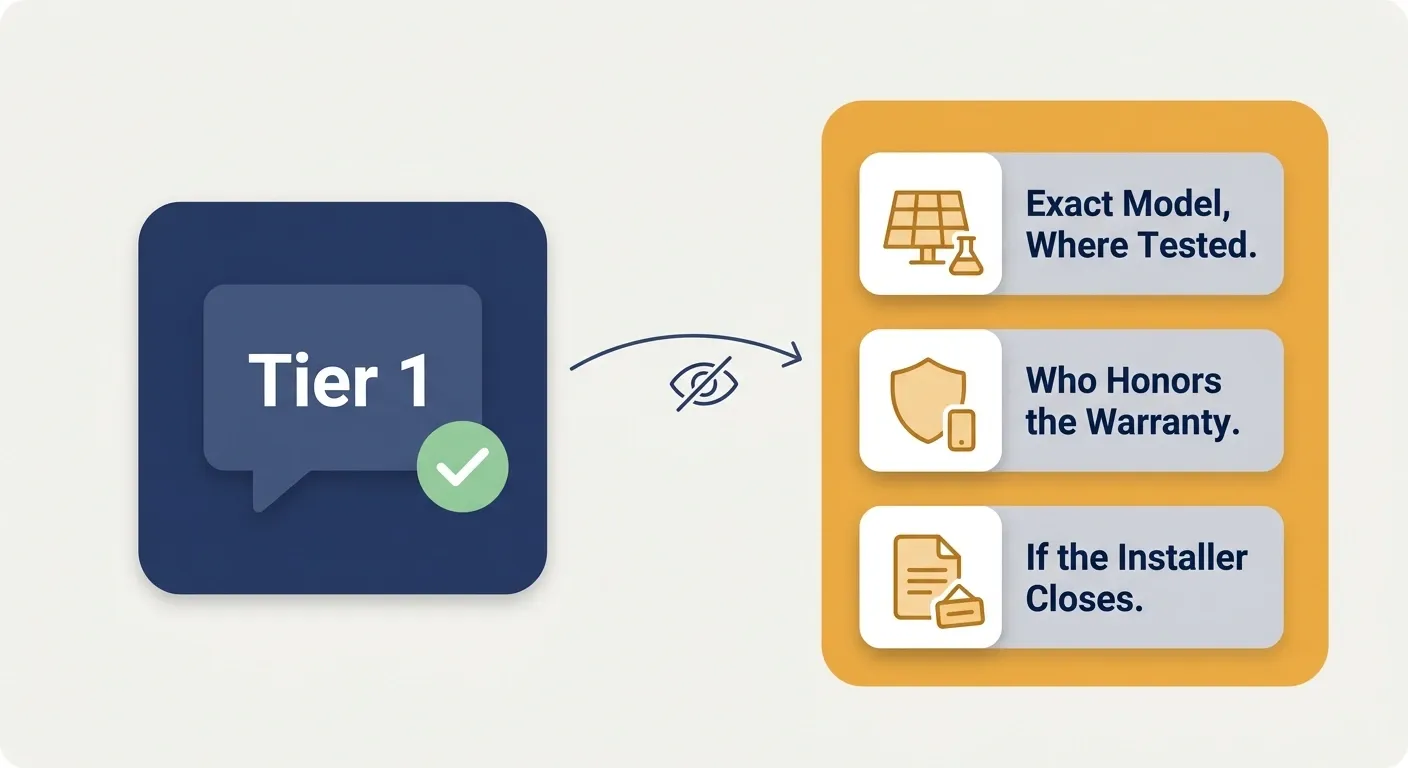
A salesperson who says "these are Tier 1" is usually not lying. The maker probably is on the list. The problem is what the phrase is doing in the conversation. It moves the discussion away from questions that are harder to answer on the spot:
Those questions are where the real risk sits, and they are the same ones we walk through in our guide to questions to ask before you sign a solar contract. If Tier 1 is offered as the answer to all of them, that is a signal to slow the meeting down. Our list of solar sales red flags covers the wider pattern of a single reassuring label standing in for detail.
If BNEF points buyers to technical testing, the reasonable next step is to look at the testing that is published.
The best-known public example is the Kiwa PVEL PV Module Reliability Scorecard (checked September 27, 2026). Its 2026 Scorecard is the 12th edition, and it names manufacturers whose specific module designs met its criteria as "Top Performers" in stress tests such as thermal cycling, damp heat, mechanical stress, hail stress and potential induced degradation. The Scorecard site states that 43 manufacturers appear in the 2026 edition as Top Performers.
Two details from this year's results are worth knowing:
That second point is the clearest illustration of why a bankability label cannot stand in for product testing. Most makers that submitted products had something fail somewhere.
A caution in the other direction: the Scorecard is not a buying list either. Manufacturers submit their own products to the program, so a missing name means "not in this program," not "failed." Use it as one input, not a verdict.
You do not need to become a module engineer. A short, practical approach:
None of this requires rejecting a Tier 1 panel. It requires not treating the label as the end of the conversation.
Here is the trade-off, stated plainly. The Tier 1 label is convenient for everyone on the selling side. It is short, it sounds official, and it comes from a respected research firm. It lets an installer reassure a homeowner without committing to anything specific about a product, a factory or a warranty process.
The person who benefits from the buyer not knowing what Tier 1 measures is anyone who would rather not answer the harder questions above. That is not always a bad actor. Sometimes it is just a busy salesperson using industry shorthand. But the shorthand leaves the homeowner holding a 25 year product with less information than they could have had.
We do not sell panels, and we do not rank brands on this site. Our view is simply that the label should be read the way its creator describes it.
Tier 1 means the manufacturer appears on BloombergNEF's quarterly list of makers whose own-brand panels have been used in multiple large projects financed by different banks without recourse. It measures bankability, meaning lender acceptance. BNEF says it should not be used as a measure of panel quality.
Not necessarily. BNEF's methodology, as quoted by the Midwest Renewable Energy Association, says there are "many documented examples of quality issues or bankruptcy of tier 1 manufacturers." Quality is better judged by independent test results for the specific panel design, such as the Kiwa PVEL Scorecard.
The Tier 1 list is the one BNEF describes in its methodology. "Tier 2" and "Tier 3" are labels used informally in the market, usually to mean "not on the Tier 1 list." Treat them as sales language rather than an official grade.
Yes. The list is updated each quarter, and a maker has to keep meeting the criteria to stay on it. That is why it is worth asking which quarter's list an installer is quoting from.
That is a decision for you and depends on the full quote. The absence of the label is not proof of poor quality, and its presence is not proof of good quality. Look at the specific model, independent test results, and who stands behind the warranty in the US.
One email a week with new guides, tips, and solar news. Zero fluff, no sales pitch.