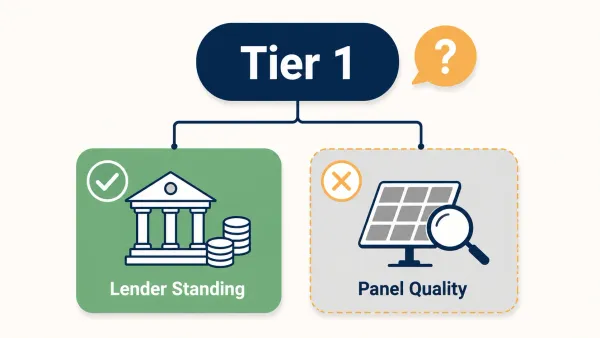
Tier 1 Solar Panels Meaning: What the Label Really Says

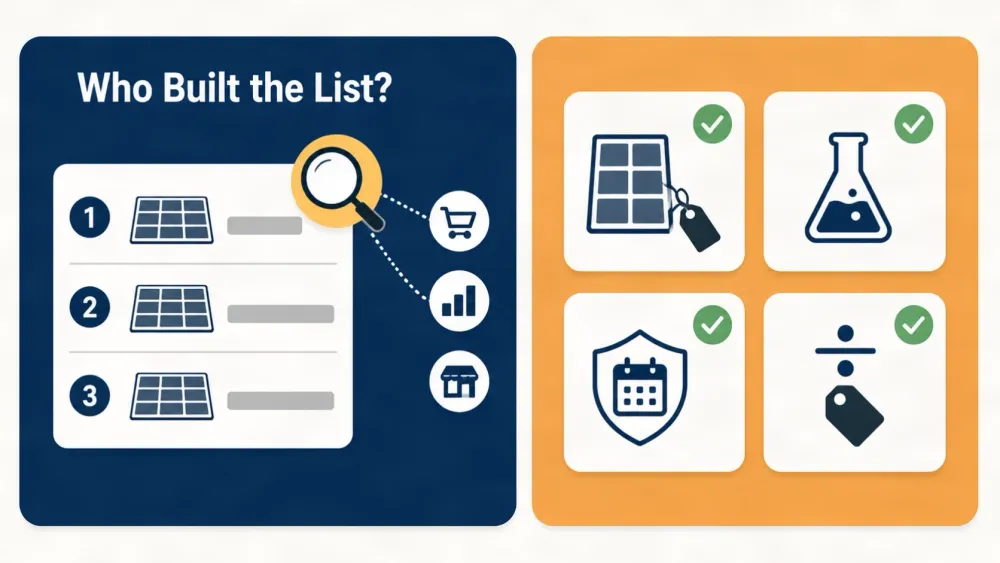
Short answer: There is no neutral, official ranking of the best solar panel brands. Every "best" list is built from someone's data, and that data decides the winners: one list scores the panels installers quote most on its own marketplace, another leans on its own sales, another is written by a company that sells or installs the panels it names. The useful move is not to pick a list. It is to find out how each list was built, then check the specific panel on your own quote against the same few measures: the exact model, independent test results, the warranty and who honors it, and value per watt.
This page does not name a winner. We do not sell panels, and we think a buyer is better served by knowing how the lists work than by reading one more of them.
Search for the best solar panel brands and you will see a handful of names repeat, in a different order on almost every page. That is not a sign that nobody knows the answer. It is a sign that each publisher is answering a slightly different question.
Here are three real examples, as they describe themselves:
None of these is a scandal. But notice what each method rewards. A list built only from panels that were already quoted a lot cannot rank a panel that installers rarely quote, however good it is. A list built from a company's own sales reflects what that company sells. A list written by an installer tends to feature what that installer carries.
Before you give a list any weight, look for the answer to four questions. Most lists answer at least one of them somewhere on the page, often in small print near the bottom.
| Question to ask | Why it matters |
|---|---|
| Where did the candidate panels come from? | If only frequently quoted or frequently sold models were eligible, popularity is baked in before scoring starts. |
| What was scored, and how was it weighted? | A list that weights warranty heavily will reward different brands than one that weights price per watt. |
| Did anyone test the panels, or read test results? | Spec sheets are the maker's claims. Independent stress testing is a separate thing. |
| How does the publisher make money? | Marketplace fees, installer leads, affiliate commissions and direct sales all create an interest in the outcome. |
A list that answers all four openly is more useful than one that answers none, even if you disagree with its weights. A list that answers none is closer to an advertisement than a ranking.
In the US, the Federal Trade Commission expects a site that earns money from a product link to say so. The FTC's guidance page, FTC's Endorsement Guides: What People Are Asking (read September 28, 2026), says a publisher "should disclose your relationship to the retailer clearly and conspicuously on your site, so readers can decide how much weight to give your endorsement," and that "the closer the disclosure is to your recommendation, the better."
That tells you where to look. Scan the top of a "best" page and the area near each product link for wording like "we may earn a commission," "paid link," "sponsored" or "partner." Then read the methodology or "how we make money" page if there is one.
A disclosure does not make a list wrong. It tells you who benefits if you pick from it. Lead-generation sites are a quieter version of the same thing: the list may carry no affiliate links at all, but the page exists to send you into a quote request, and the business earns from the installers who receive it.
The trade-off is plain. The publisher benefits when you treat its ranking as the answer, because that shortens your path to a click or a quote. You benefit from treating it as one input.
Even a well-built ranking scores brands or product lines. Your quote contains one specific panel. Several things about that panel are not settled by the brand name:
One caution about the Scorecard itself: it reports designs that met its criteria. A brand that is not listed has not necessarily failed anything. Use it as evidence for a specific model, not as a pass or fail list for every brand.
You do not need to trust any list to make a reasonable judgment. You need the quote and about an hour.
If the panel clears those five checks, its place on anyone's "best" list matters much less.
Brand is not irrelevant. It matters most in two places.
The first is the warranty. A long product warranty from a company with a US presence and a record of paying claims is worth more than the same words from a company you cannot reach. The second is supply. If a panel is damaged in year eight, an installer may need a compatible replacement, and a maker still selling in the US makes that simpler.
Brand matters less where the installation is concerned. The crew, the roof attachments, the wiring and the permit work decide more about how a system performs on your roof than the difference between two well-regarded panels. A premium panel installed badly is a worse purchase than a solid mid-range panel installed well. That is why the installer questions in our guide to questions to ask before you sign a solar contract deserve at least as much time as the panel choice.
Some pages can be set aside quickly:
We are not naming a best brand, and that is deliberate. A ranking from us would be one more list with its own weights, and we have not tested panels ourselves. The honest thing we can offer is the method: how rankings are built, where their incentives sit, and how to check the one panel that is actually on your quote.
It depends on who is ranking and how. Published 2026 lists weight different things, such as how often installers quote a panel, sales on a company's own marketplace, warranty terms or price per watt. The same few brands recur across lists, but the order changes with the method. Check the method first, then check the specific model on your quote.
Some are and some are not. US guidance from the FTC says a site earning money from product links should disclose that clearly and close to the recommendation. Look for commission or partner wording near the links and for a "how we make money" page. Marketplace and lead-generation sites may earn from installers rather than from panel makers.
For most homes, the installer matters at least as much. A well-regarded panel can underperform or leak if the roof attachments and wiring are done poorly. Brand matters most for warranty claims and replacement supply years later.
The Scorecard reports specific designs that met Kiwa PVEL's test criteria for its 2026 edition. That is useful evidence about durability for that design. It says nothing about price, your roof, or the installer, and a panel not on it has not necessarily failed.
Check the date, then check whether every brand it recommends still sells residential panels in the US. A list recommending a maker that has left the market has not been maintained, and its other claims may be stale too.
One email a week with new guides, tips, and solar news. Zero fluff, no sales pitch.