Solar Panel Degradation Rate: What the Warranty Promises

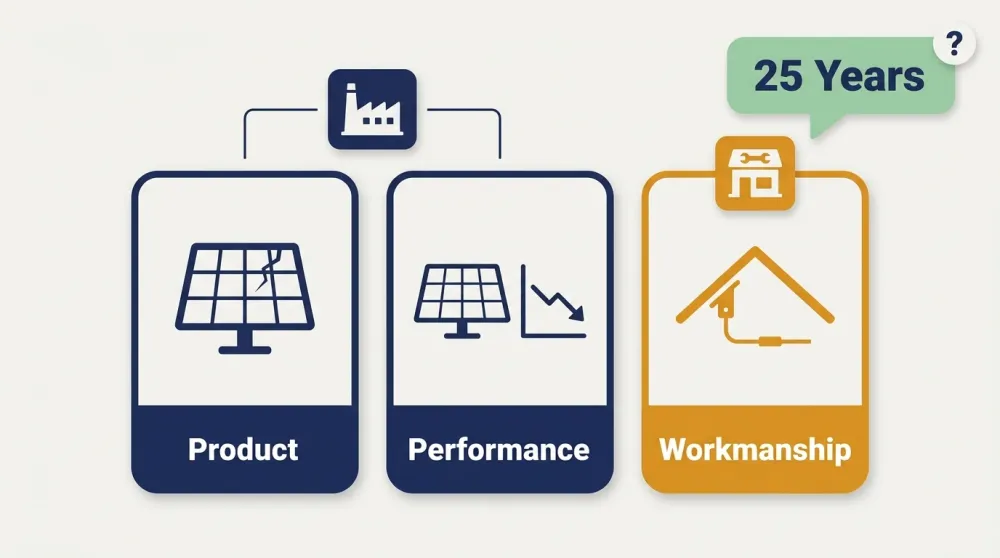
Short answer: There are three main solar panel warranty types, and each covers a different failure. A product warranty comes from the panel manufacturer and covers defects in the panel itself. A performance warranty, also from the manufacturer, promises the panel will still produce a minimum share of its rated output after a set number of years. A workmanship warranty comes from your installer and covers the installation: the mounting, the wiring, the roof penetrations. Two are backed by the manufacturer and one by the installer, which matters most when one of those companies is no longer around.
A proposal that says "25 year warranty" has told you very little until you know which of the three it means.
Sales materials often lead with the longest number on the page. That number is usually the performance warranty, because it tends to run the longest. It is also the warranty least likely to pay out for the problems homeowners actually call about, like a leak around a roof attachment or a system that stops reporting.
The Federal Trade Commission's consumer page Solar Power for Your Home (read September 27, 2026) tells buyers that each written bid should spell out "what warranties apply to the equipment (like the panels and inverters...) and the installation workmanship." It treats equipment and workmanship as separate items. A quote that merges them into one headline figure is doing the opposite.
The product warranty, sometimes called the materials or equipment warranty, is the manufacturer's promise about the physical panel. EnergySage, in its guide to solar panel warranties (updated August 14, 2025, read September 27, 2026), describes it as covering "the integrity of the equipment itself," including defects, breaks and fractures, and says it is typically "at least 10 years of coverage," with some premium panels offering longer terms.
That labor gap is the detail most homeowners discover late. A free replacement panel still has to be taken off the roof and a new one put on, and that is work for a qualified installer, not a homeowner on a ladder. The warranty document for your specific panel is the only place that tells you who pays for that visit.
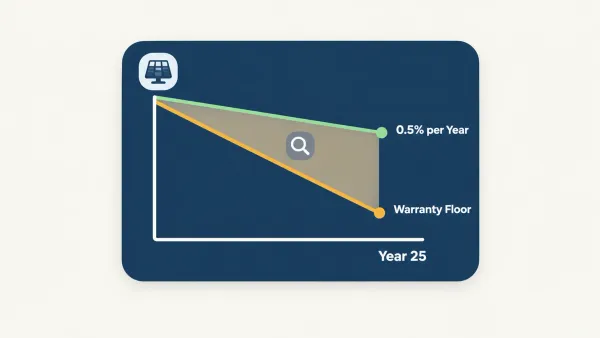
Every panel loses some output as it ages. The performance warranty, also called the power or output warranty, puts a floor under that decline. EnergySage describes the typical version as guaranteeing "at least 80% of the original output by the end of the warranty term," over a standard term of about 25 years, with some manufacturers now offering longer.
Three things to understand about it:
The performance warranty is often confused with a production guarantee. They are not the same thing. A production guarantee is a promise, usually from the installer or the leasing company, about how much energy the whole system will produce. The FTC page notes that lease and PPA customers should compare "the minimum power the provider says a system will produce, and what happens if the system doesn't produce that amount." We cover how those promises are written, and where they fall short, in our guide to solar production guarantees.
The workmanship warranty is the installer's promise about its own work. It is the one that typically applies to the problems that happen on a roof: a leak where a mounting bolt goes through the shingles, a loose connection, a conduit that was not secured.
Unlike the other two, its length and scope are set by the individual installer, so there is no single typical figure worth quoting. That is exactly why it deserves the closest reading:
If you have a roof leak or any electrical concern around the system, it is a job for the installer, a licensed roofer or a licensed electrician. Touching the array or its wiring yourself is a safety risk, and unauthorized work can also give a manufacturer grounds to refuse a claim.
| The problem you are worried about | Warranty that usually applies | Who usually honors it |
|---|---|---|
| A panel cracks or fails from a defect | Product warranty | Panel manufacturer |
| Panel output drops faster than promised | Performance warranty | Panel manufacturer |
| Water leaks at a roof attachment | Workmanship warranty (or a separate roof warranty) | Installer |
| A wiring or mounting fault from installation | Workmanship warranty | Installer |
| The inverter stops working | The inverter's own equipment warranty | Inverter manufacturer |
| The whole system underproduces a promised annual figure | Production guarantee, if your contract has one | Installer or leasing company |
| Labor and shipping for a warranty replacement | Often none; check both the product and workmanship terms | Depends on your contract |
The inverter row is worth noticing. The FTC page names panels and inverters as separate pieces of equipment, and a warranty written for a panel is about the panel. Ask for the inverter's warranty terms as a separate document.
This is the section most warranty guides skip. Each warranty is a promise from a specific company. It is only as good as that company's existence and willingness to answer.
Our article on whether your solar installer will still exist covers the checks you can run on the company before you sign. None of them guarantee anything, but they tell you how much weight a 10 or 25 year promise can bear.
A short list that turns three vague warranties into specific answers:
We go through a broader version of this list in questions to ask before you sign a solar contract, and our guide on how to compare solar quotes shows how to line warranty terms up side by side.
A single large warranty number is easy to sell. It sounds like total protection and it takes one sentence. Separating the three types takes longer and exposes the weakest link, which is often the shortest one: the installer's own workmanship promise.
The buyer who does not know there are three warranties is less likely to ask about labor, roof leaks, or what happens when the installer is gone. Those are the questions that decide whether a warranty is worth anything years from now. Warranty terms vary by company and by contract, so the documents you are given are the only reliable source for your own system. If a claim is refused and you think the terms are being ignored, the FTC page points consumers to the FTC and their state consumer protection agency for complaints.
The three main types are the product warranty, which covers defects in the panel; the performance warranty, which guarantees a minimum output level over time; and the workmanship warranty, which covers the installation. The first two come from the panel manufacturer and the third comes from the installer.
Usually not the panel warranty itself. Leaks at roof attachments are typically handled under the installer's workmanship warranty or a separate roof penetration warranty, if your contract includes one. Check the written contract for the exact wording.
Often it does not. EnergySage notes that most manufacturers do not reimburse labor for replacements or repairs, and shipping is usually the owner's cost. Some installers or premium warranties cover labor, so it is worth asking before you sign.
The installer's workmanship warranty generally has no one left to honor it. The product and performance warranties come from the manufacturer, so they can remain valid, but you may need another qualified installer to do the replacement work.
No. A performance warranty covers the output of individual panels against their rating. A production guarantee, where offered, is a separate promise about how much energy the whole system will produce, usually from the installer or leasing company.
One email a week with new guides, tips, and solar news. Zero fluff, no sales pitch.