Solar Panel Warranty Types: Which One Covers What

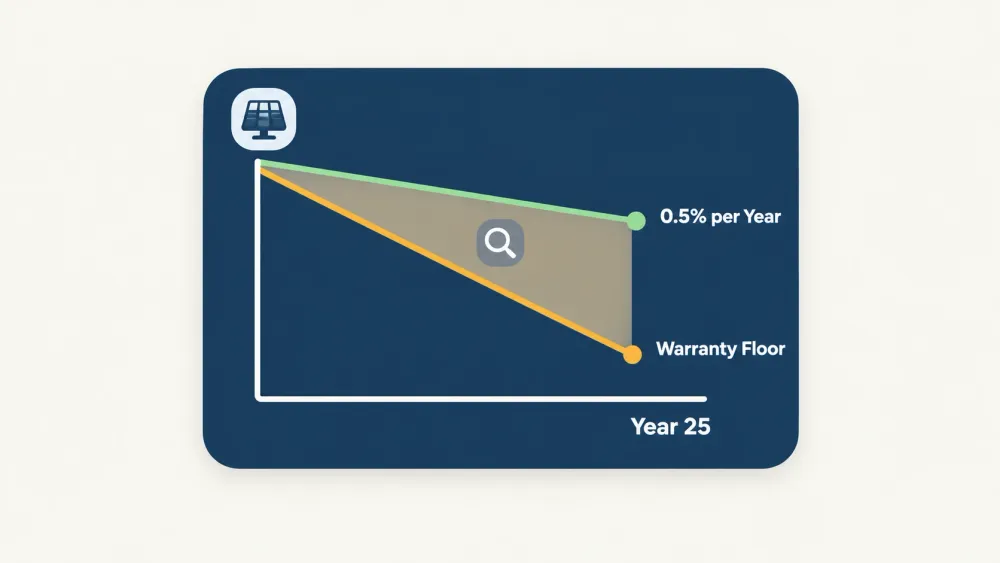
The best-known figure for solar panel degradation rate comes from the National Renewable Energy Laboratory: a review of nearly 2,000 field measurements found a median loss of 0.5% of output per year. A panel losing output at that pace would still produce roughly 87 to 88 percent of its original rating after 25 years. A 25-year performance warranty is something different. It does not predict that figure; it sets a floor below which the manufacturer agrees to act, on its own terms. Knowing the gap between the two is what protects you.
This page is for US homeowners reading a panel warranty or a solar proposal. It explains the numbers and the document; it does not rank brands or recommend a panel.
Degradation is the slow loss of a panel's ability to turn sunlight into electricity. A panel rated at 400 watts when new will, years later, produce somewhat less under the same test conditions. It is not a failure. It is normal wear from years of sunlight, heat and the daily cycle of heating up and cooling down.
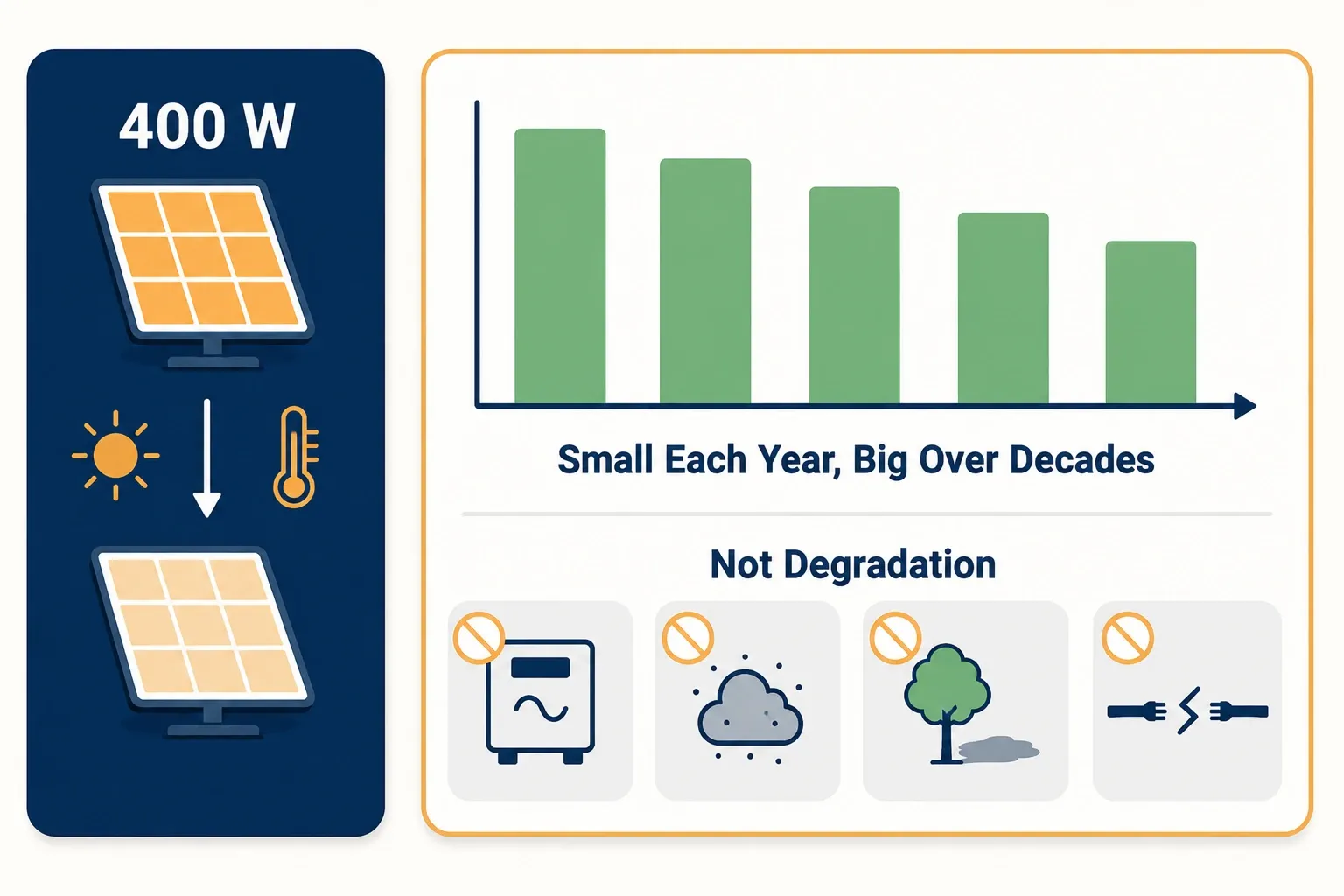
Two features make it easy to misread:
The anchor for most published figures is a review by NREL researchers D. C. Jordan and S. R. Kurtz, Photovoltaic Degradation Rates: An Analytical Review. The NREL version held by the University of North Texas digital library (dated June 1, 2012, read September 27, 2026) describes nearly 2,000 degradation rates, measured on individual modules or whole systems in field testing over roughly four decades, "showing a median value of 0.5%/year."
Three things about that number matter for a buyer:
Here is the arithmetic for a panel losing 0.5% a year, as an illustration of the method, not a prediction for any product.
| Point in time | Output if losses are a straight 0.5 points a year | Output if losses compound at 0.5% a year |
|---|---|---|
| New | 100% | 100% |
| After 10 years | about 95% | about 95% |
| After 20 years | about 90% | about 90.5% |
| After 25 years | about 87.5% | about 88% |
The two methods barely differ at this rate. What matters more is the rate itself: at twice the pace, the year-25 figure would be far lower. That is why the warranty's own numbers, not the industry median, are what a buyer should read closely.
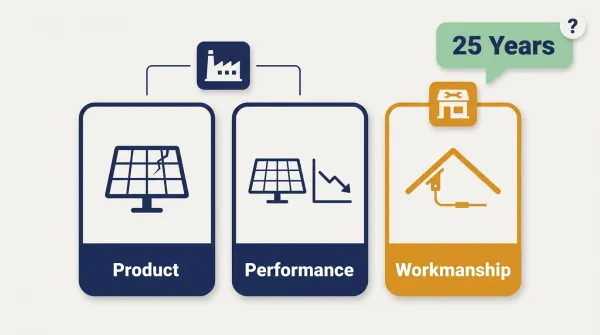
A panel usually comes with two separate manufacturer warranties, and a proposal that says "25-year warranty" may mean either.
Performance warranties are usually written as a schedule. They name a maximum loss allowed in the first year, then a maximum loss for each year after, ending at a guaranteed minimum percentage at the end of the term. The exact numbers vary by manufacturer and model, so read them from the warranty document for the exact panel in your proposal, and note the date and version of that document.
To see how the pieces interact, take a hypothetical warranty, not any real product: it guarantees 98% of rated power at the end of year one and allows 0.5 percentage points of loss each year after. At year 25 the floor would be 98 minus 24 times 0.5, or 86%. A panel that follows the field median would sit slightly above that floor the whole way. The warranty would only come into play if the panel fell below its schedule.
This is the part that sales conversations tend to skip.
None of this makes a performance warranty worthless. It gives you a documented floor and a remedy against panels that wear out unusually fast. It is simply narrower than "your panels are guaranteed for 25 years" suggests.
A savings or payback estimate that assumes your system makes the same energy in year 20 as in year 1 is overstating the later years. The honest version builds a yearly loss into the production estimate and states the rate it used.
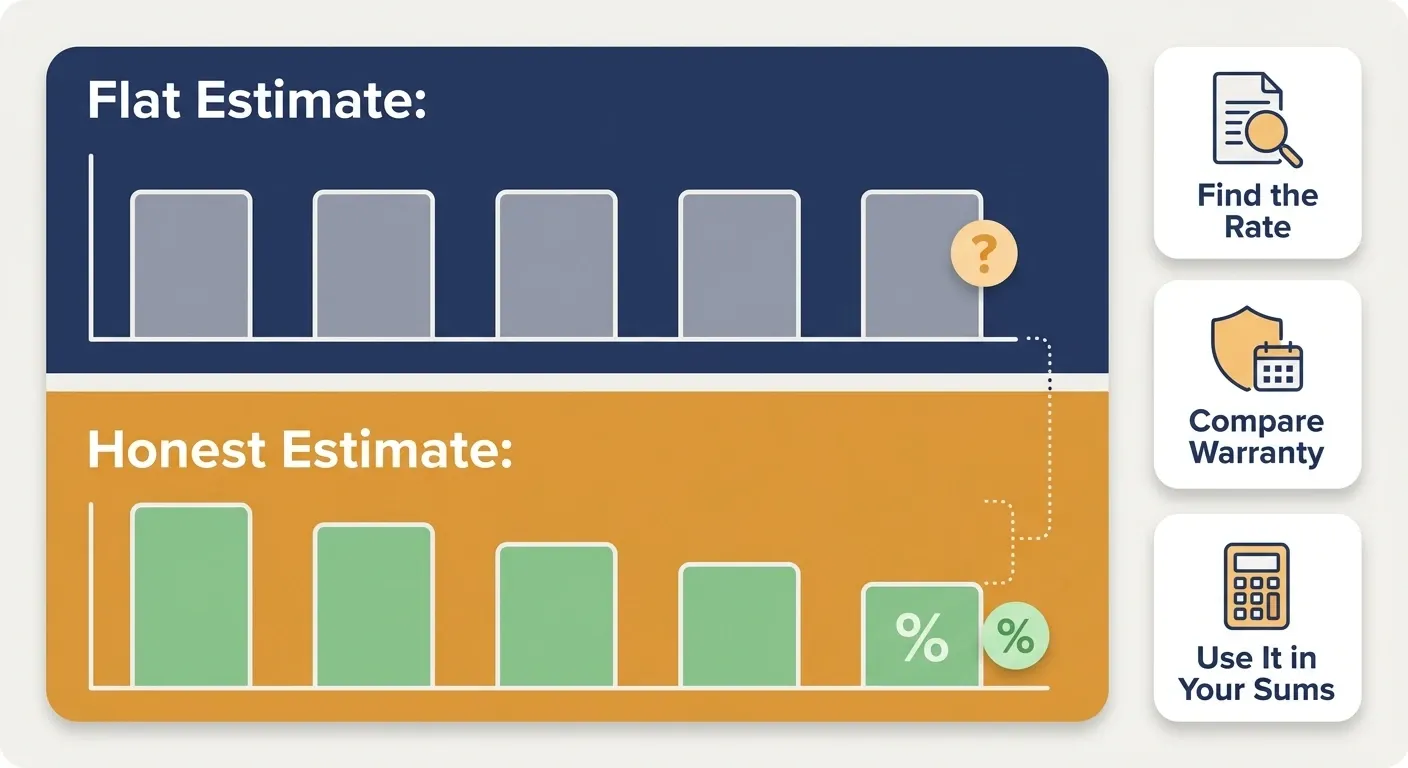
When you review a proposal:
If you want to see whether an estimate's other inputs are sensible too, checking the assumptions behind a production estimate covers shade, orientation and system losses.
"25-year warranty" sounds like a promise that the system will keep working as it does now for 25 years. It is not. It is a floor under one piece of equipment, measured one way, with a remedy the warranty defines. A proposal that leans on the phrase without showing the performance schedule, or a savings estimate that ignores degradation, is presenting the best-looking version of the numbers.
Neither the industry median nor the warranty tells you how your particular panels will age. What you can control is which documents you read before signing: the full performance warranty for the exact model, the degradation rate built into the estimate, and the installer's own workmanship warranty, which covers the installation the panel warranty does not.
An NREL review of nearly 2,000 field measurements, published in 2012, found a median of 0.5% of output lost per year. Individual panels vary above and below that. The warranty for your specific panel states the maximum loss the manufacturer accepts.
A panel losing 0.5% a year would produce roughly 87 to 88 percent of its original rating after 25 years. Your panel's performance warranty states the minimum the manufacturer guarantees at that point; read it from the warranty document for your exact model.
No. It covers the panel's power output measured under test conditions. Production losses from shade, dirt, inverter faults or wiring are outside it. A production guarantee, if your contract includes one, is a separate promise.
Often, yes. Performance warranties are commonly written with a separate first-year allowance and a different yearly allowance after that. The exact figures are in each manufacturer's warranty schedule for the specific model.
The warranty document sets the process, including how the shortfall must be measured and who pays for testing, removal and shipping. Keep your monitoring records and the warranty version you were given, and ask your installer whether it handles claims with the manufacturer.
One email a week with new guides, tips, and solar news. Zero fluff, no sales pitch.