How to Read a Solar Panel Spec Sheet: The Lines That Matter

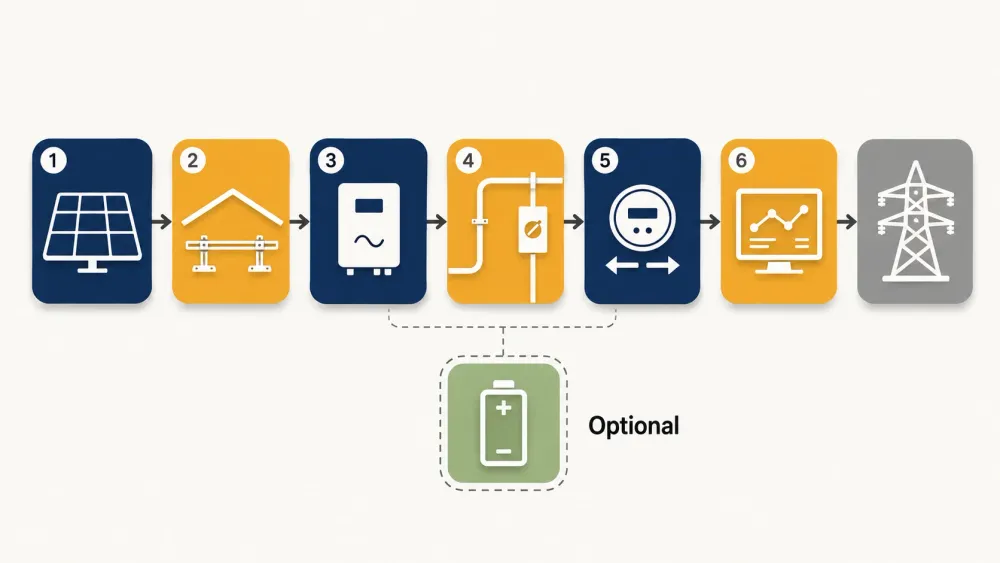
A home solar system has six main solar panel system components: the panels that make electricity, the racking that holds them to the roof, the inverter equipment that turns their direct current into the alternating current your home uses, the wiring and safety disconnects, the utility meter that records what flows to and from the grid, and the monitoring that reports how it is all doing. A battery is optional. For a buyer, the useful question is not what each part does in physics terms. It is which line of the proposal it sits on, which warranty covers it, and which choices you can judge yourself.
This page is for US homeowners reading a grid-tied solar proposal. It names no brands and ranks no products.
Proposals lead with the panel because it is the part you see. The Department of Energy puts it plainly in its solar photovoltaic system design basics (read September 27, 2026): solar modules "are where the electricity gets generated, but are only one of the many parts in a complete photovoltaic (PV) system."
The other parts decide much of what you experience over the years: whether the roof leaks, how shade affects output, what fails first, and who fixes it. A proposal that spends a page on the panel and one line on everything else is telling you what the seller wants you to look at.
| Component | What it does | Where it shows up in a proposal | Usually covered by |
|---|---|---|---|
| Panels (modules) | Turn sunlight into direct current electricity | Model, wattage per panel, number of panels | Panel manufacturer's product and performance warranties |
| Racking and roof attachments | Hold the panels to the roof and seal the holes | Often one line, or only in the permit drawings | Racking maker for the hardware; installer's workmanship warranty for the attachments |
| Inverter equipment | Converts direct current to the alternating current your home uses | Inverter type and model | Inverter manufacturer's warranty |
| Wiring, disconnects, safety equipment | Carry the power safely and let it be shut off | Rarely itemized | Installer's workmanship warranty |
| Utility meter | Records electricity in both directions | Mentioned under interconnection | Your utility |
| Monitoring | Reports production and faults | Named as an app or portal | Inverter or monitoring maker, and your installer |
| Battery (optional) | Stores energy for later or for outages | A separate line with its own model | Battery manufacturer's warranty |
The right-hand column is the one to keep. When something goes wrong in year eight, the question will be whose warranty it falls under, and the answer is different for each row. Check your own contract, because coverage terms vary by company.
Panels are made of cells wired together behind glass in a frame. A proposal usually lists the panel model, its rated wattage and how many panels you get. Multiply the two, divide by 1,000, and you have the system's size in kilowatts, which is the number to compare across quotes; the cost per watt method uses exactly that.
What the panel line does not tell you is how much electricity the system will make on your roof. That depends on direction, tilt, shade and local weather, which is why checking the inputs behind the production estimate matters more than the panel's headline wattage.
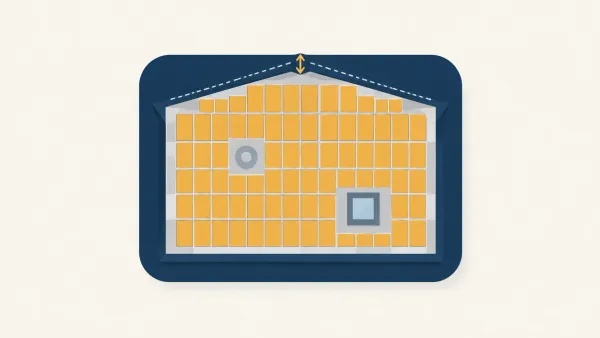
Racking is the metal framework the panels clamp to. Attachments, also called mounts or feet, fasten the racking through the roof covering into the structure below, and each one is a hole in your roof that has to be sealed.
This is the component least visible in a proposal, and a badly flashed attachment can leak. It is also almost entirely the installer's work rather than the hardware maker's. Ask what attachment and flashing method they use for your roof type, how many attachments the design needs, and whether the workmanship warranty covers roof leaks at the attachments, for how long, and who pays for the roof repair. Installing racking is work at height and on your roof structure; it is the installer's job, not a homeowner's.
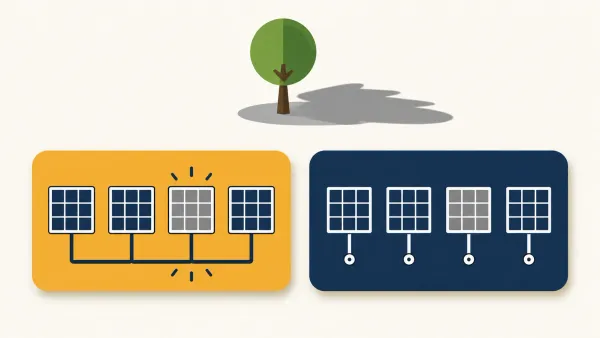
Solar panels produce direct current, and your home runs on alternating current. The inverter converts one to the other. The DOE's inverter basics page (read September 27, 2026) describes the two common home layouts: a string inverter connects a set of panels, called a string, to one inverter, while microinverters are smaller inverters placed on every panel. A third approach adds a small electronic device called an optimizer to each panel and keeps one central inverter.
The practical difference is how the system handles a shaded or failed panel, and how much equipment sits on the roof rather than on a wall. Inverter equipment usually carries a different warranty term from the panels, so check both. If your roof has partial shade from trees or a chimney, ask the installer to explain why the inverter layout they chose suits it; how much shade is too much covers the shade side of that conversation.
Between the panels and your electrical panel are wires, conduit, fuses and disconnect switches that let the system be shut off for service or in an emergency. Rooftop systems also include equipment that lets the array be quickly de-energized, which protects firefighters working on the roof. Local electrical code decides exactly what is required where you live, and the inspector checks it.
For a homeowner, this is look-but-do-not-touch territory. Solar wiring carries power whenever light hits the panels, and connecting to your service panel is licensed electrician work under a permit. What you can do is ask where the disconnects are, what each one does, and that they are clearly labeled.
A grid-tied system connects to the grid through your utility meter, which needs to record electricity flowing both ways. Depending on the utility, the meter may be swapped or reprogrammed as part of interconnection. The meter belongs to the utility, and so do the rules on how exported electricity is credited. Those rules differ by state and utility, and they change, so confirm the current terms with your own utility before you rely on any savings estimate.
Most systems come with an app or web portal that shows production. It is worth more than it seems, because a failed inverter or a dead string can go unnoticed for months without it. Ask who can see the data, whether panel-level or system-level detail is included, whether the monitoring has an ongoing fee, and who is responsible for acting on an alert.
A battery is not a required component of a grid-tied system. It is a separate purchase with its own warranty, its own permit and its own questions about outage backup and rate plans. If a proposal includes one, ask for it to be priced as a separate line so you can see the system cost with and without it.
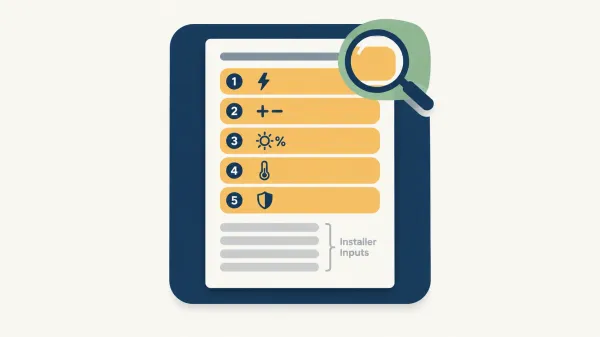
Take any quote and check that it answers these, in writing:
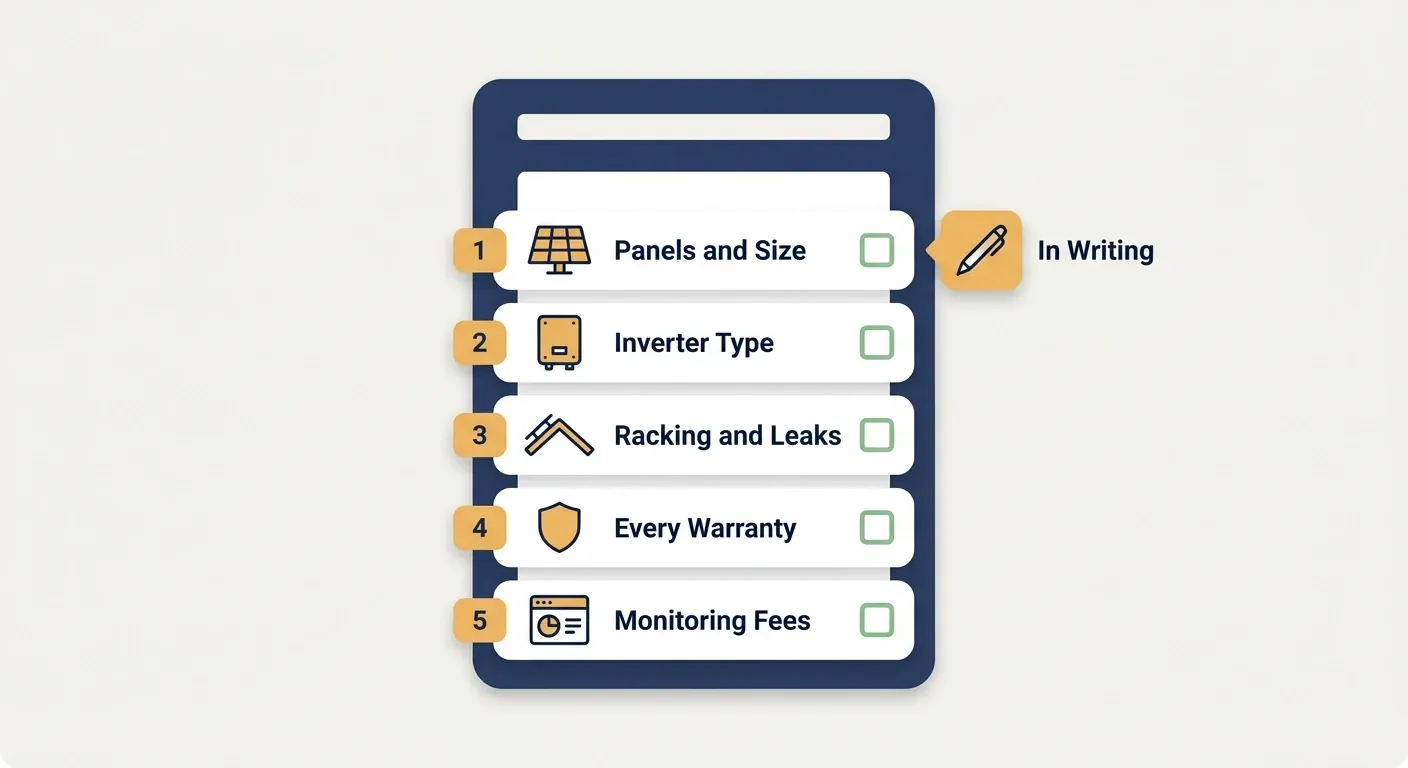
If two quotes differ, lay them side by side using the table above. Comparing solar quotes by normalizing them first walks through the rest.
A buyer who only compares panels is comparing the one component sellers most like to talk about. Installation quality, attachment method and workmanship coverage are where one installer's job can differ from another's, and they are the lines most often left vague. Asking about every component is not being difficult. It is how you find out what you are actually buying.
Panels, racking and roof attachments, inverter equipment, wiring and safety disconnects, the utility meter and monitoring. A battery is an optional addition in a grid-tied system.
Panels have no moving parts, while inverter equipment is electronics that works hard every sunny day, and it usually carries a different warranty term from the panels. Compare the warranty terms for each component on your quote rather than assuming.
No. A grid-tied system works without one. A battery adds backup during outages and can help on some rate plans, but it is a separate decision with separate costs.
It means the parts other than the panels, such as the racking, wiring, disconnects and related hardware; some definitions also include the inverter. These parts are often lumped into one line on a quote.
Grid-tied solar involves roof work, electrical connections to your service panel, a permit and a utility interconnection agreement. It is work for licensed professionals, and this site does not cover do-it-yourself grid connections.
One email a week with new guides, tips, and solar news. Zero fluff, no sales pitch.