Solar Panel System Components, Explained for Buyers


If you want to know how to read a solar panel spec sheet as a homeowner, start with five lines: rated power (Pmax), power tolerance, module efficiency, the temperature coefficient of power, and the warranty terms. Those decide what you are paying for and how the panel behaves on a hot roof. The voltage and current figures (Voc, Vmp, Isc, Imp) are real and important, but they are the installer's design inputs, not your buying decision. Everything on the sheet is measured in a lab, so read it as a comparison tool, not a production forecast.
This page is for US homeowners holding a solar proposal that names a panel model. It does not rank brands or recommend a panel.
A proposal usually names the panel by manufacturer and model number. Datasheets often cover a family of models in one document, with a column for each wattage. Before you read a single number:
If the proposal does not name a panel model at all, only a wattage or "tier 1 panel", that is the first question for the installer. You cannot read a spec sheet for a panel nobody has named.
Almost every electrical figure on the sheet is followed by "STC", short for Standard Test Conditions. PVEducation, the long-running solar cell reference, states that terrestrial solar cells are measured at 25°C (77°F) under a standard light spectrum, with 1 kilowatt of sunlight per square meter.
Those conditions exist so every manufacturer measures the same way. They are not what your roof looks like. A panel in full summer sun sits well above 25°C, and your roof sees full-strength sunlight for only part of the day. So a 400-watt rating means 400 watts in the lab test, not 400 watts from your roof at noon.
Some sheets also list a figure at NOCT or NMOT, a second test point meant to reflect a panel running warmer in less intense light. Expect those watts to be lower than the STC figure. That is normal, not a defect.
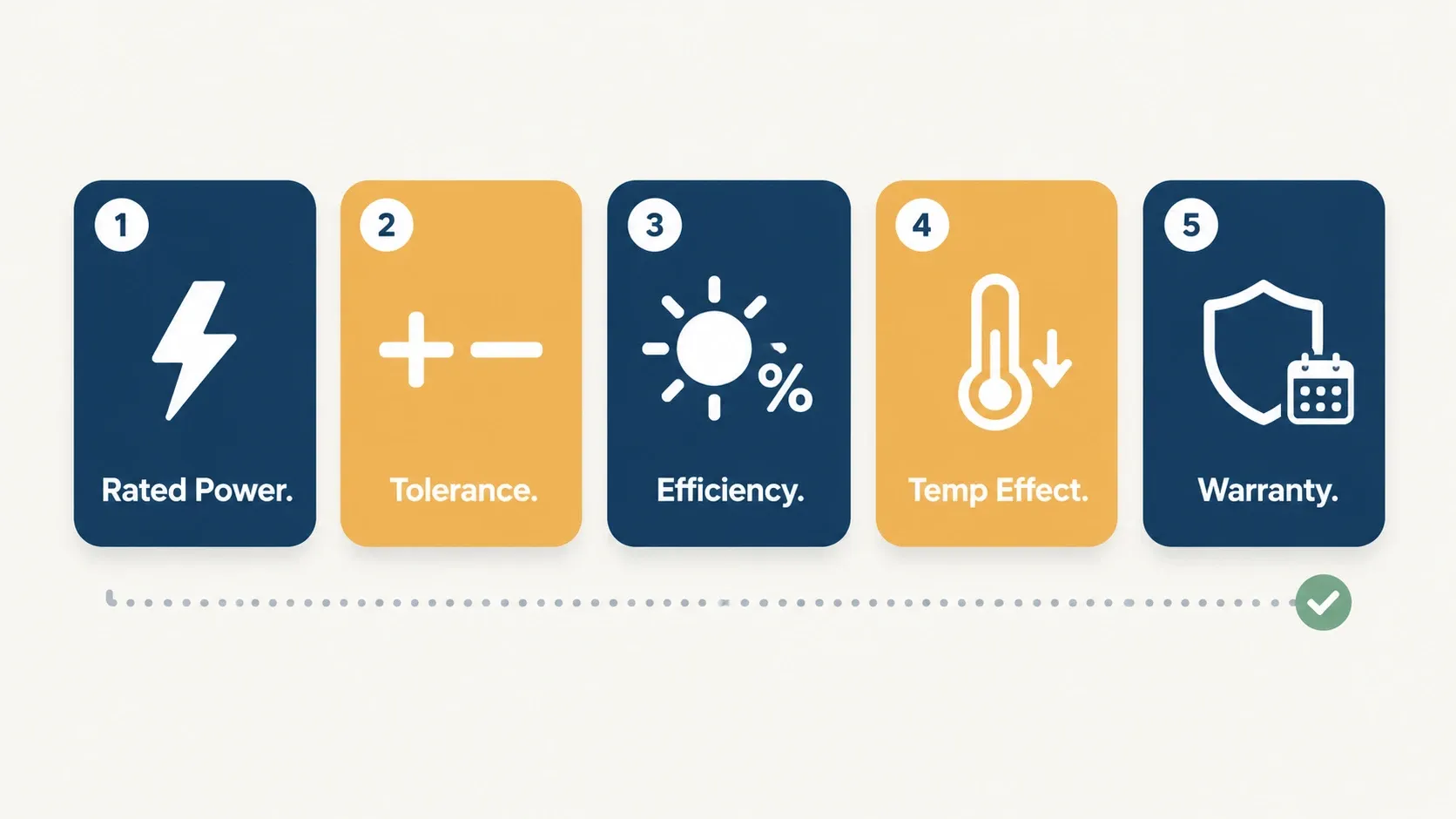
This is the panel's output at STC. Multiply it by the number of panels in the proposal to get the system size in watts. That total is what you divide the price by to get the cost per watt of the quote, the fairest single way to compare two proposals.
Usually written like "0 to +5 W" or "0/+3%". It says how far a delivered panel's actual output may differ from its rating. A tolerance that only goes upward means the manufacturer is not shipping panels below the label. A tolerance that allows negative values means some panels may arrive rated slightly below what you paid for. Read which one your sheet says.
The share of the sunlight hitting the whole panel that becomes electricity at STC. Higher efficiency means more watts per square foot, which matters when roof space is tight. It does not make each watt produce more energy. If you are unsure whether space is your constraint, checking whether the quoted system fits your roof answers that.
Given as a negative percentage per degree Celsius. It tells you how much output drops for each degree the panel runs above 25°C. The Department of Energy's performance basics page explains the reason: solar cells "generally work best at low temperatures," and heat causes "a much larger decrease in voltage." A number closer to zero loses less on hot afternoons, which matters more in hot climates. The sheet often lists separate coefficients for voltage and current too; the one for power is the one that describes output.
Most sheets summarize two warranties: a product warranty (defects in the panel) and a performance warranty (how much of its original output the panel is promised to keep after a stated number of years). They are separate promises with separate lengths. The summary on the datasheet is a pointer; the full warranty document is what governs, and it is worth asking the installer for a copy.
A spec sheet also carries figures that matter a great deal, but to the person designing the system:
| Line | What it is | Who uses it |
|---|---|---|
| Voc (open-circuit voltage) | The panel's voltage with nothing connected | Installer, to keep strings within the inverter's and code's voltage limits, especially in cold weather |
| Vmp (voltage at max power) | Voltage when producing rated power | Installer, to match panels to the inverter's operating range |
| Isc (short-circuit current) | Maximum current the panel can push | Installer, for wire and fuse sizing |
| Imp (current at max power) | Current when producing rated power | Installer, for design checks |
| Maximum system voltage | The highest system voltage the panel is rated for | Installer and permit reviewer |
| Series fuse rating | The largest fuse the panel is rated to be protected by | Installer and permit reviewer |
You do not need to check these. They are electrical design values, and matching them to the inverter and to code is licensed work checked at permit and inspection. A buyer who wants reassurance can ask the installer one plain question: "Has the string design been checked against this panel's voltage limits for our coldest temperatures?"
The sheet also lists physical data: dimensions, weight, frame, glass, cell count and layout, connector type, and load ratings for snow and wind, usually in pascals. For a homeowner, three things are useful here:
The certification block lists the safety and performance standards the model was tested to. Your installer and local building department confirm that the equipment meets what your jurisdiction requires.
Datasheet numbers are self-reported by the manufacturer. There is one public place to cross-check them. The California Energy Commission keeps Solar Equipment Lists (read September 27, 2026) that include PV modules and inverters, updated three times a month. Its PV module list gives "information such as PTC value, reported nameplate ratings, and temperature coefficients" for each listed model.
Two honest caveats come with it. First, the Commission says plainly that while it reviews submissions, "manufacturers' self-reported information is not confirmed." So the list tells you a model has been submitted and what the maker reported, not that the figures were independently tested. Second, it is a California program, although the list is searchable by anyone in any state.
The PTC figure is the useful extra. The state's CaliforniaDGStats site (frequently asked questions, read September 27, 2026) defines PTC, PVUSA Test Conditions, as "1,000 watts per square meter solar irradiance, 20 degrees C air temperature, and wind speed of 1 meter per second at 10 meters above ground level." Because PTC fixes the air temperature rather than the cell temperature, the panel runs warmer than in the STC test, so its PTC figure is typically lower than its nameplate watts. The same site adds that PTC still does not account for real-world losses such as soiling, shading, wiring, inverter losses and degradation over time.
Comparing the PTC figures of two panels on your shortlist is a reasonable way to see how each holds up once it warms up, alongside the temperature coefficient. Neither is a production forecast for your roof; that comes from a model using your location and layout, and checking the inputs behind the production estimate is the step that turns a datasheet into an expected output.
A spec sheet puts the rated wattage and efficiency in large type because they look good. The lines that tell you about the panel on a hot roof, how the tolerance is written, and what the warranty actually promises are in smaller type further down. A sales conversation that stays on the headline numbers is not necessarily misleading, but it leaves out the parts of the sheet most likely to separate two panels on your house.
A buyer who reads the five buyer lines, leaves the design values to the installer, and runs the model through the state list is in a much stronger position. Adding "which datasheet version are you quoting from?" to your questions to ask before signing a solar contract costs nothing, and a clear answer is a good sign.
For comparing prices, rated power (Pmax), because it sets the system size and cost per watt. For performance on a hot roof, the temperature coefficient of power. Read both, along with the power tolerance and the warranty terms.
Standard Test Conditions: the lab conditions every manufacturer uses to rate panels, a cell temperature of 25°C and sunlight of 1 kilowatt per square meter. Real roofs are usually hotter and see less intense light, so real output is lower than the STC rating most of the time.
STC fixes the cell temperature at 25°C. PTC, used on California's equipment list, fixes the air at 20°C with a light wind, so the panel runs warmer and its PTC rating is typically lower than its STC nameplate. PTC still excludes real-world losses like shading and soiling.
Not to buy a panel. Those voltage and current figures are inputs for the installer's electrical design, which is licensed work checked at permit and inspection. You can ask the installer whether the design has been checked against the panel's voltage limits for cold weather.
On the manufacturer's website, under the exact model number named in your proposal. The California Energy Commission's Solar Equipment Lists also show reported ratings and a PTC value for listed models.
One email a week with new guides, tips, and solar news. Zero fluff, no sales pitch.