Time of Use Battery Savings: Does the Math Add Up?

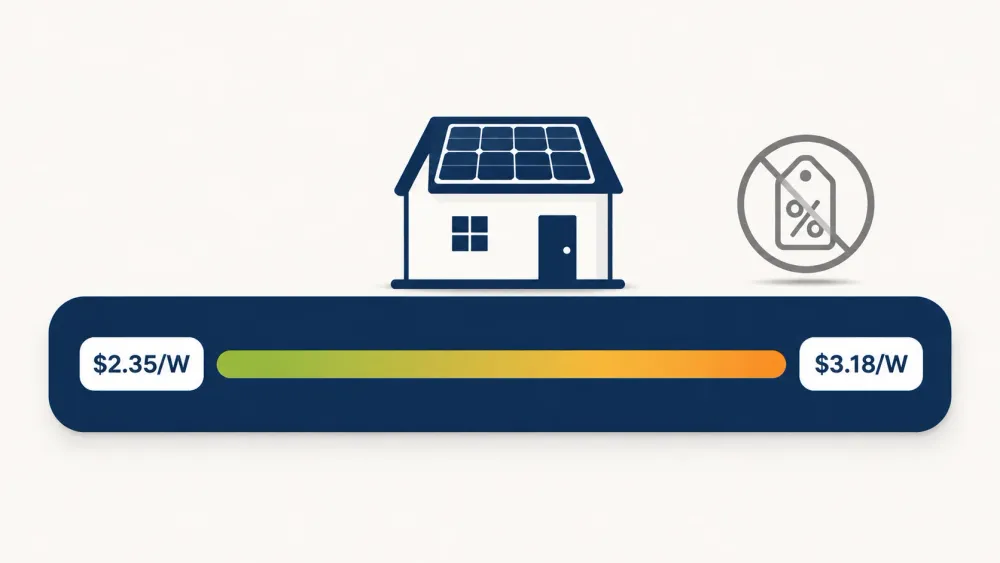
A real installed home solar system in the US in 2026 typically costs between about $2.50 and $3.50 per watt before any incentives, according to national pricing trackers, with state-level averages ranging from roughly $2.35/W in lower-cost markets to $3.18/W in higher-cost ones. For a system in the common 6-10 kW range, that puts total installed cost in the rough neighborhood of $15,000 to $35,000 before financing. There is no federal tax credit in 2026 for a cash or loan purchase, so this range is closer to what you'll actually pay than it would have been a year ago.
That range is wide on purpose. A single blended national number hides the handful of things that actually move your own quote, and this article is about those, not about pretending one number applies to every roof. If you're still deciding whether to get quotes at all, Are Solar Panels Still Worth It in the US in 2026? is the place to start that broader question.
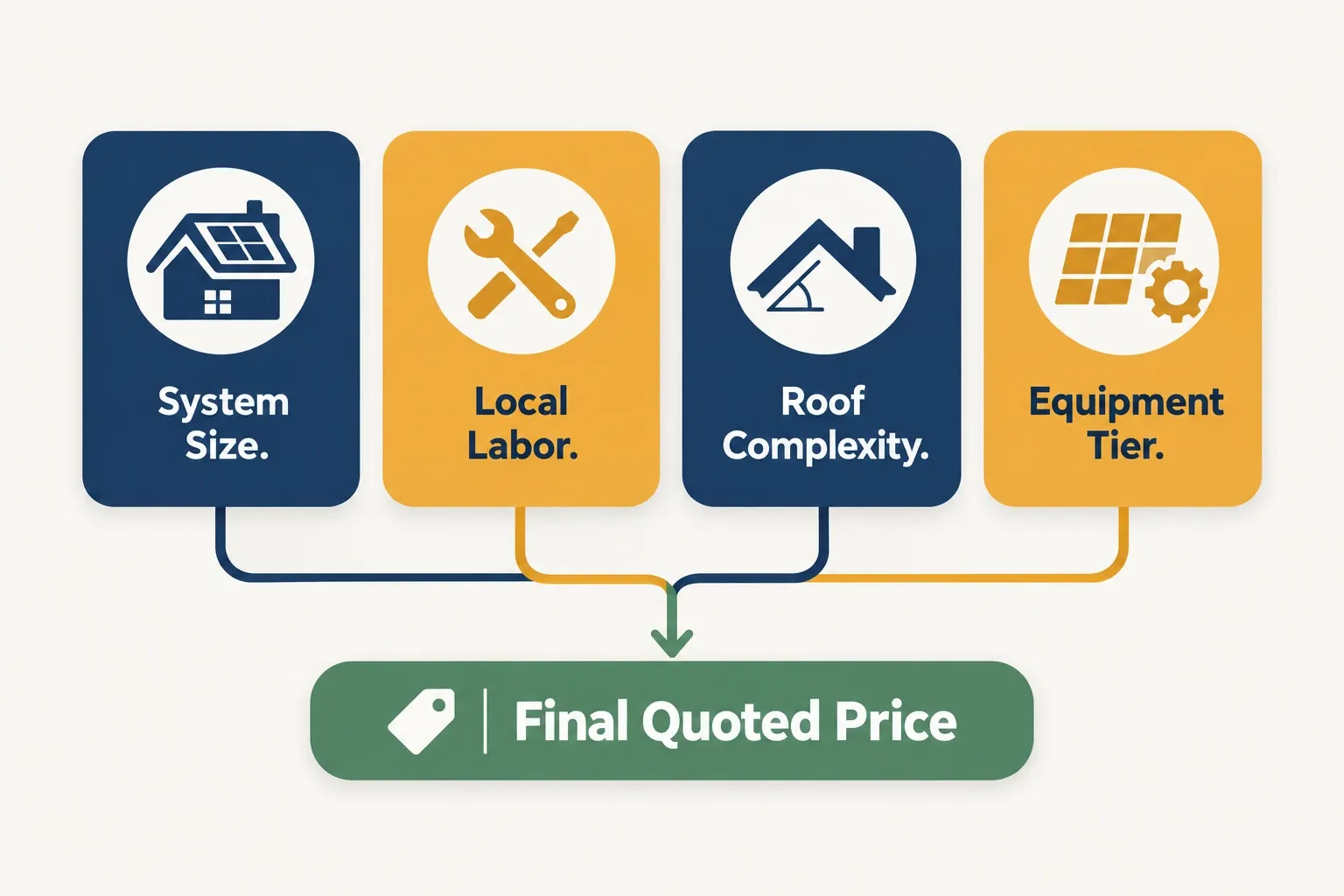
System size, driven by your household's own electricity use, is the single biggest lever. A bigger system costs more in total but usually a bit less per watt, because fixed costs like permitting and the inverter get spread across more panels.
Local labor and permitting cost varies by state and even by city; this is a large part of why per-watt pricing differs across states even for similar equipment.
Roof complexity matters more than most quotes make obvious. A simple, unobstructed, single-story roof is the cheapest install. Multiple roof planes, steep pitch, unusual roofing material, or the need for extra structural work all add labor time, which adds cost.
Equipment tier is a real, disclosed choice, not a hidden markup: a standard-tier panel and string inverter cost less than a premium panel paired with microinverters or power optimizers. Higher-tier equipment can have real advantages on some roofs (shade, multiple orientations); it's a decision, not something you should be talked into by default. The tradeoffs between inverter types are their own topic and are not covered here.
Through the end of 2025, a homeowner could treat their quoted price as roughly 30% lower after the federal Section 25D credit. That credit ended December 31, 2025. For a cash or loan purchase in 2026, the number on your quote is the number, with no federal reduction to apply afterward. This is the single biggest reason 2026 cost conversations look different from 2025 ones, and it's covered in full in What Changed for Solar Buyers When the 30% Federal Credit Expired.
Some state and utility incentives still exist and can reduce the effective price further, but they are jurisdiction-specific, change on their own schedules, and should be verified for your own state and utility before you rely on one, rather than assumed from a national article.
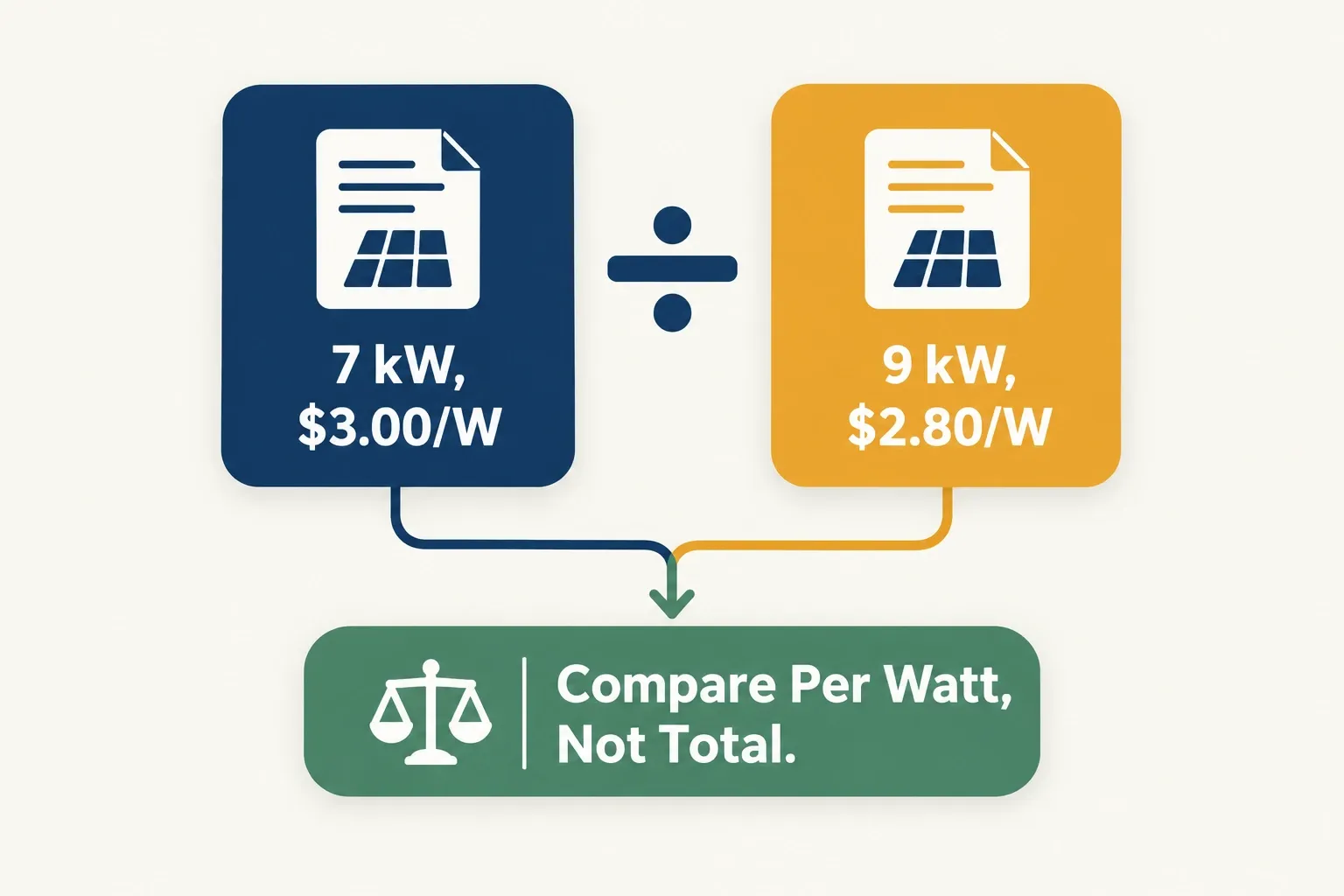
Two installers can quote wildly different total dollar figures and still be offering comparable value, if one is proposing a bigger system. That's why cost per watt exists as a unit: it lets you compare quotes of different sizes on the same basis. A quote for a 7 kW system at $3.00/W and a quote for a 9 kW system at $2.80/W are not directly comparable by their total price alone; per-watt pricing is what actually tells you which is the better deal, assuming the equipment tier and warranty terms are genuinely similar. Comparing quotes properly, including installer markups that don't show up as a line item, is its own subject and deserves more space than this page has.
Most installed-price quotes bundle the panels, the inverter, mounting hardware, wiring, labor, and the cost of pulling permits. Monitoring hardware and its companion app are usually included too, since the installer needs it to verify the system is producing as expected. What varies a lot between installers is whether the quoted number also includes a main electrical panel upgrade if you need one, tree trimming, or a production guarantee that backs up the estimated output. None of these are scams when they're excluded; the problem is when a quote doesn't say either way, and you find out only after signing. Ask an installer to walk through their quote line by line and name what is and isn't included, rather than accepting a single bottom-line number.
The dollar figures above describe the installed price of the system itself, before you decide how to pay for it. A cash purchase means that price is what you pay, full stop. A loan adds interest on top, so your total outlay over the loan's term is higher than the quoted installed price, even though your monthly payment may be lower than your old electric bill. A lease or PPA doesn't involve a purchase price at all in the way described here; you're paying for the system's output over time instead of buying the hardware. The cost ranges in this article are about the system itself; how that cost actually plays out for your wallet depends on which of the four payment structures you choose, covered in Cash, Loan, Lease or PPA: How to Pay for Solar in 2026.
A few costs regularly show up after the headline number, not because installers are hiding them maliciously, but because they depend on your specific house and aren't knowable until a site visit: a main electrical panel upgrade if your existing panel can't handle the new load, extra structural work for an older or non-standard roof, tree trimming if shading is a problem, and permit or inspection fees that some quotes bundle in and others list separately. Ask directly whether your quote is "all-in" or whether any of these are still pending a site assessment, before you compare it to another quote as if it were.
This site's approach to sourcing cost figures like the ones above, and how they get reviewed as pricing changes, is described on the About page.
What is the average cost of solar panels in the US in 2026? Most homeowners see quotes in the range of about $2.50 to $3.50 per watt installed, before incentives, according to 2026 national pricing data. For a typical 6-10 kW residential system, that's roughly $15,000 to $35,000 total before financing, though your own quote is what matters, not the average.
Why do solar costs vary so much by state? Local labor rates, permitting requirements, and how much competition exists among installers in a given market all move the per-watt price. States like Texas have reported some of the lowest per-watt averages; states like New Hampshire have reported some of the highest.
Is there still a discount for the federal tax credit in the cost I'm quoted? No, not for a cash or loan purchase in 2026. The 30% federal residential credit expired December 31, 2025. The number on your 2026 quote is the number, unless a state or utility incentive applies separately. See what changed when the credit expired for the full picture.
Does a bigger system always cost more per watt or less? Usually somewhat less per watt, because fixed costs like the inverter, permitting, and labor setup get spread across more panels. But your total dollar cost still goes up with system size, so the right comparison is your total price against what a system that size is likely to produce and save, not per-watt price alone.
How do I know if a quote's price is a good deal? Compare it on a cost-per-watt basis against your other quotes for genuinely similar equipment tiers and warranty terms, confirm whether it's all-in or whether items like a panel upgrade are still pending, and work out your own payback with the method in Solar Payback Period: How to Calculate Yours, Not the Average rather than trusting a salesperson's payback claim.
Does financing change how much the system actually costs? It changes how much you pay overall, not the installed price of the hardware itself. A loan adds interest on top of the quoted price. A lease or PPA replaces the purchase price entirely with ongoing payments for the system's output. See Cash, Loan, Lease or PPA for how the four structures compare on total cost.
One email a week with new guides, tips, and solar news. Zero fluff, no sales pitch.