Time of Use Battery Savings: Does the Math Add Up?

Reviewed on August 5, 2026.
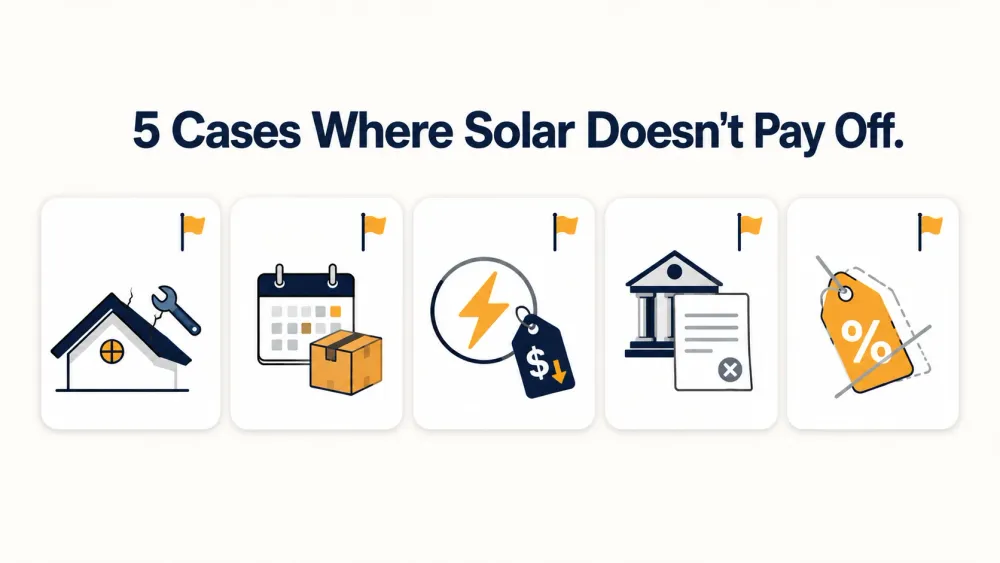
For a US homeowner, solar is a bad financial decision in five specific, checkable situations: your roof can't support a system without expensive work first, you won't stay in the house long enough to recover the cost, your electricity rate is already too low for the savings to add up, you can't get financing on workable terms and don't have cash, or the case you were shown depends on an incentive you don't actually qualify for. This is not a mood or a general caution. Each condition below is something you can verify about your own house without needing a quote first.
Most articles on this question hedge. They list a caution, then walk it back in the next sentence, because the site publishing them usually has a lead-generation form on the same page. This article doesn't have one, and its answer doesn't soften: if one or more of the five conditions below genuinely applies to you, solar does not pencil out for your house, and no sales pitch changes that arithmetic. If none of them apply, that's a different article; see Are Solar Panels Still Worth It in the US in 2026? for the balanced version of that question. This page exists specifically for the reader who suspects they're the exception to the general "solar pays" case, and wants a straight answer instead of a reframed pitch.
Solar production depends on how much usable sun your roof actually receives, and on whether the roof itself can hold a 20 to 25 year system without needing to come off partway through.
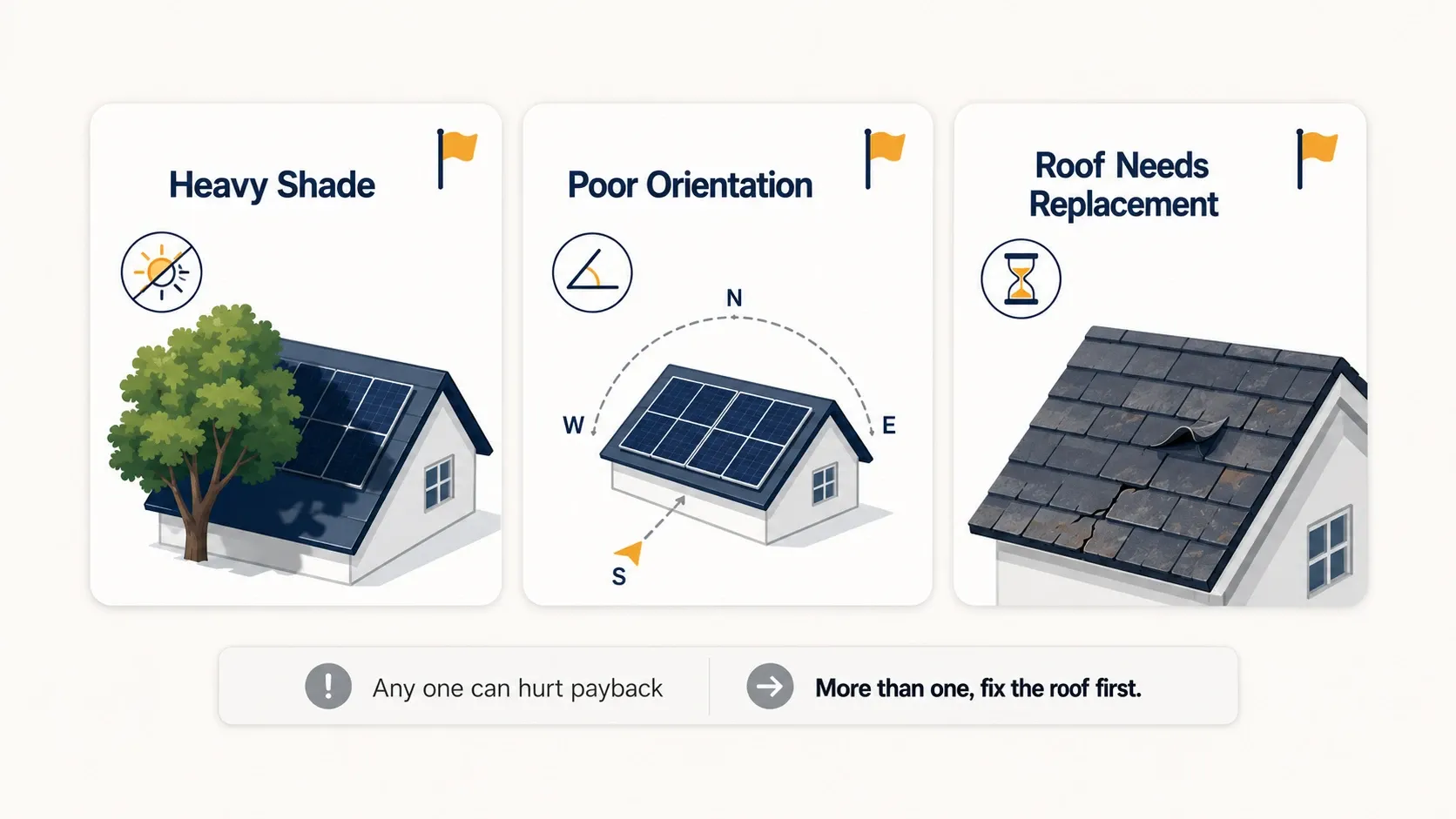
Three roof-specific conditions can each independently make solar a bad decision:
If your roof fails more than one of these, the honest answer is to fix the roof problem first or accept a materially longer payback, not to proceed on the installer's optimistic production estimate.
A solar system's cost is recovered over years, not months, through the electricity it offsets. If you plan to sell your home before that recovery point, whether because of a job relocation, a planned downsize, or any other reason, you may not personally see the savings that make the purchase worthwhile, and you cannot assume a buyer will pay you back for the system at resale. The honest way to check this for yourself, rather than trust a sales estimate, is to calculate your own payback period against your own timeline; Solar Payback Period: How to Calculate Yours, Not the Average shows the method. If your own number, run honestly, is longer than the number of years you expect to stay, that is a real reason not to buy, not a reason to find a way around the math.
Solar saves money by offsetting what you'd otherwise pay your utility. If your rate per kilowatt-hour is already low relative to your region, the same system produces the same electricity but offsets less in dollar terms, which lengthens payback. This is genuinely one of the most decisive variables in whether solar works for a given house, more than most marketing suggests, and it depends entirely on your own utility and rate plan, not on a national average. How Your Electricity Rate Decides Whether Solar Pays explains how to check your actual effective rate, not just the number printed at the top of your bill, before you take any payback estimate at face value.
Since the federal Section 25D credit ended for systems placed in service in 2026, a purchase (cash or loan) receives no federal offset regardless of financing terms, a change explained in full in What Changed for Solar Buyers When the 30% Federal Credit Expired. If you don't have the cash to buy outright and the loan terms you're offered carry a high interest rate or a significant dealer fee baked into that rate, the financing cost itself can erase much of what the system would otherwise save you. A lease or PPA avoids the upfront cost but introduces its own tradeoffs, including who owns the system and how contract terms behave over time. If neither a competitive loan nor cash is realistically available to you, that is a legitimate reason the numbers don't work right now, not a problem a more optimistic sales pitch solves.
Some of the strongest-looking payback numbers homeowners are shown lean on an incentive that either no longer applies or was never applicable to their specific situation, such as a federal credit that expired for purchases after 2025, a state or utility program with eligibility rules the pitch didn't mention, or a rate structure assumption that doesn't match their actual utility. If the math you were shown depends on an incentive, verify independently, using a named source rather than the salesperson's own summary, that you actually qualify for it before treating that number as real. A projection built on an incentive you don't qualify for isn't a smaller version of the promise; it's a different, worse number wearing the original one's clothes.
Is solar never worth it if my roof faces north? Not never, but it's a real disadvantage. A north-facing roof in the Northern Hemisphere produces less than a south-facing one at the same location, and combined with other factors like shade or a short ownership horizon, it can tip the decision the wrong way. Ask your installer for a location-specific production estimate rather than a generic one.
How do I know if my electricity rate is too low for solar to pay off? There's no single national cutoff, because utility rates and rate structures vary widely. See How Your Electricity Rate Decides Whether Solar Pays for how to find your actual effective rate and use it, not a national average, in your own payback calculation.
If I'm planning to sell my house in a few years, should I skip solar entirely? Run your own payback period first against your own expected timeline before deciding either way. If the payback period is longer than the years you expect to own the home, that's a genuine reason to hold off, covered in Solar Payback Period: How to Calculate Yours.
Can a salesperson's numbers be wrong even if they seem detailed? Yes, particularly when the projection depends on an incentive you haven't independently confirmed you qualify for, or on a production estimate that hasn't accounted for your roof's actual shading and orientation. Detailed does not mean verified.
Does this mean solar is generally not worth it in the US in 2026? No. This article covers the specific situations where it isn't, for the readers those situations apply to. For the general, balanced answer, see Are Solar Panels Still Worth It in the US in 2026?
One email a week with new guides, tips, and solar news. Zero fluff, no sales pitch.