Time of Use Battery Savings: Does the Math Add Up?

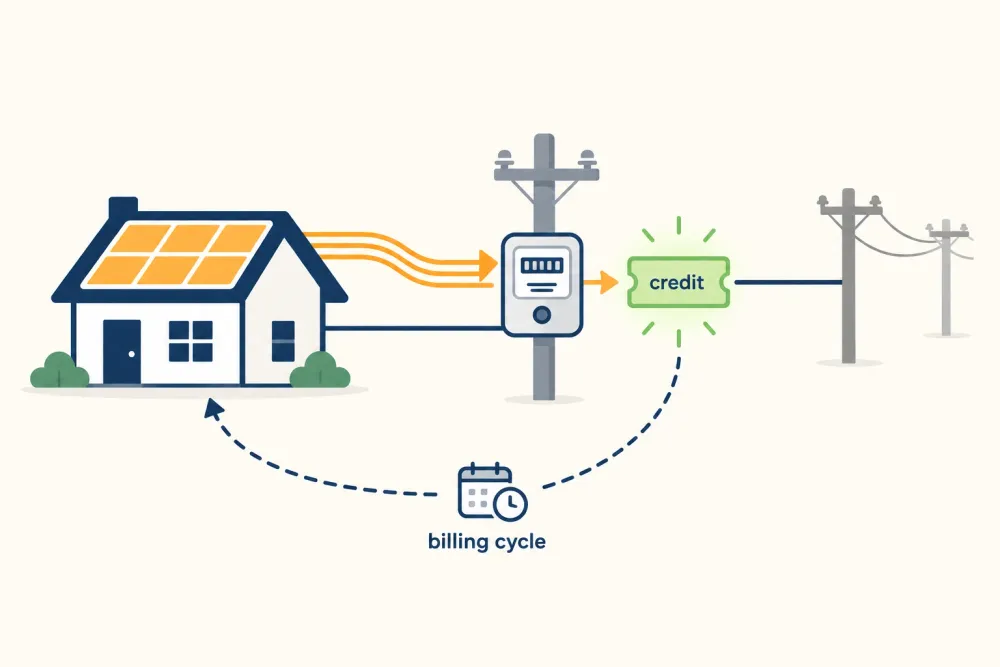
In the United States, net metering is a billing arrangement that lets a home solar system's owner get credit for electricity sent back to the grid, then use that credit to offset power drawn from the grid later, over a monthly or annual cycle. It relies on staying connected to the utility grid; it does not store extra power, it credits it. How much a credit is worth varies by state and utility, covered below.
Reviewed on August 19, 2026. Next review: September 19, 2026. This is general information about how the mechanism works, not a description of what any specific utility offers or a promise about your own bill. Net metering programs, rates, and eligibility rules are set state by state and utility by utility, and they change independently of anything on this page. Verify current terms with your own utility before assuming anything below applies to you.
The US Energy Information Administration describes net metering as utility tariffs or billing programs that let certain customers reduce the volume of billed electricity supplied by the grid within a defined billing period, by crediting electricity the customer generates and sends back. In practice, that means a home solar system that produces more power than the house is using at a given moment exports the surplus to the grid, and the utility tracks that export against what the house draws back later, whether that is an hour afterward or a season afterward, depending on the program. It is a billing mechanism, not a battery. Your extra electricity does not wait for you physically; it is converted into a credit that a program's rules then apply against your future usage.
A home with solar and a grid connection is drawing power at some moments and exporting it at others, often within the same day: exporting around midday when panels are producing more than the house needs, drawing from the grid in the evening once production drops. A net metering program measures both directions over a billing period and settles the difference. Some programs bank a surplus month to month, letting summer overproduction offset a winter month when a system produces less, up to an annual settlement date, sometimes called a true-up. Other programs reset more frequently or handle the export and import sides differently. Which of these applies to a given home depends entirely on that utility's specific program design, not on a single nationwide rule, which is why the next two sections matter more than any general description can.
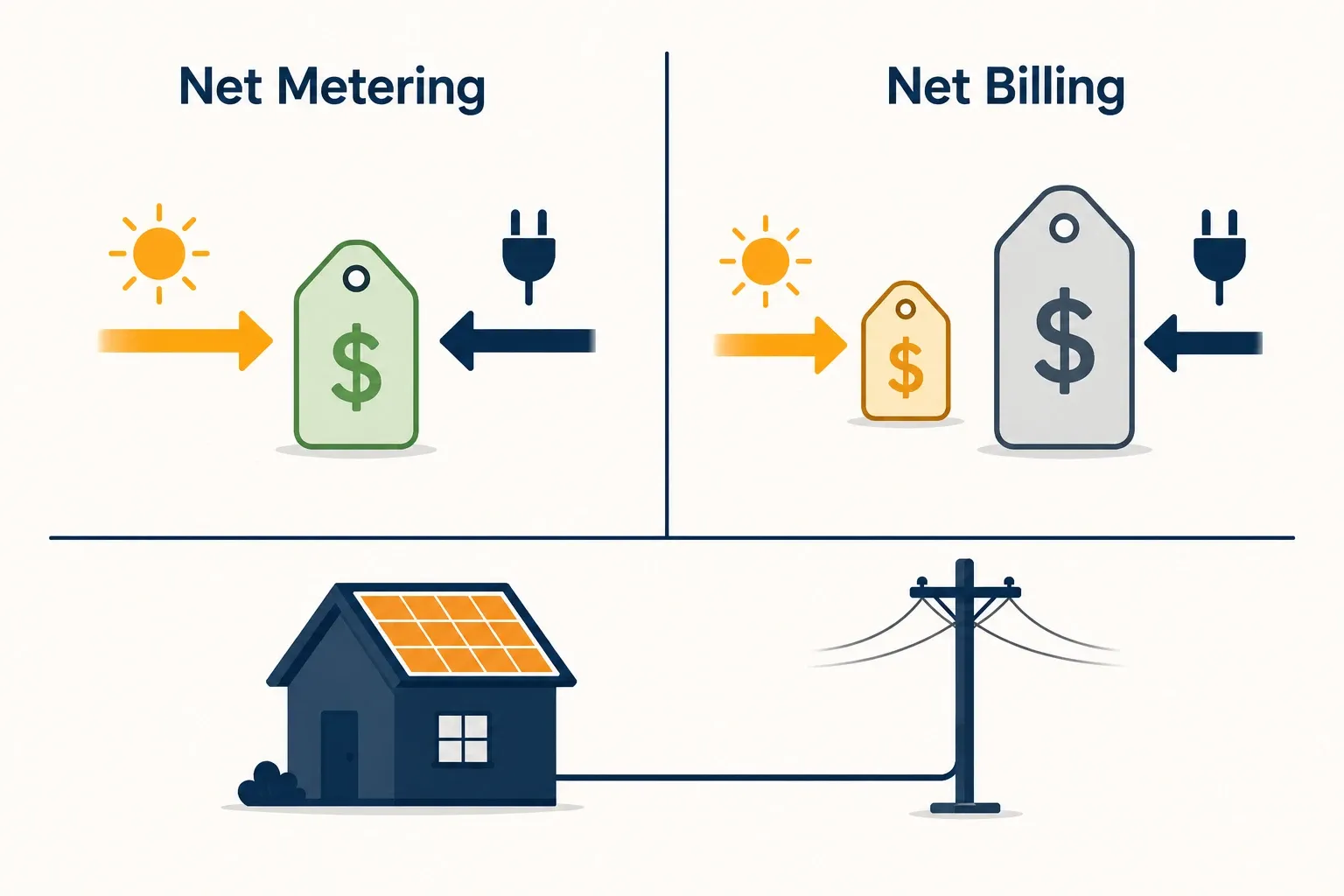
"Net metering" and "net billing" describe two different ways of valuing the electricity you export, and the terms are not always interchangeable even though both get called "net metering" casually.
| Typically valued at | What that means | |
|---|---|---|
| Net metering (in its traditional form) | The same retail rate you are billed for electricity you draw from the grid | A kilowatt-hour you export offsets a kilowatt-hour you import, at the same price |
| Net billing | A separately set rate, often set by the utility or a state regulator and often lower than the retail rate | A kilowatt-hour you export is credited at a different value than a kilowatt-hour you buy back |
Which structure a given utility uses, and what the actual export rate is under either one, is set at the state and utility level, not nationally, and it can change for new applicants even where it stays the same for people already enrolled. Some states have moved some or all of their utilities away from the traditional retail-rate structure toward a net-billing style program in recent years. This article is not going to attach a number, a ratio, or a state name to that shift, because doing so accurately requires a current, dated source for that specific state and utility, and printing a wrong or outdated figure here would be worse than sending you to check it yourself, which the last section of this article does.
There is no single number that answers "what is my solar export worth" across the United States, and any article that gives you one without naming your state and utility is guessing on your behalf. Net metering and net billing programs are authorized and defined at the state level, typically by a state's public utilities commission, and then administered utility by utility within that state, sometimes with different terms for a large investor-owned utility than for a smaller municipal or cooperative utility in the same state. Programs also frequently apply different rules to customers who enrolled years ago than to new applicants today, a practice generally called grandfathering, so two houses on the same street can be under genuinely different terms depending on when each one connected. None of that can be collapsed into one figure, which is exactly why this article stays at the level of the mechanism rather than a rate.
Net metering is one input into whether solar pays for a specific house, not a guarantee on its own. What actually matters for your own math is the real export rate or credit ratio your utility applies, whether it settles monthly or on an annual true-up, whether new enrollees get the same terms as existing customers, and how your own usage pattern lines up with your system's production, since a program that only credits exports against future usage is worth less to a household that already uses most of its solar power directly than to one that exports heavily during the day and draws heavily at night. Does Your Electricity Rate Decide Whether Solar Is Worth It covers how to work out your actual effective rate rather than the number printed at the top of a bill, and Solar Payback Period: How to Calculate Yours, Not the Average shows where a net metering credit fits into that calculation once you know your own terms. Net metering is also just one piece of the wider 2026 incentive picture; Solar Incentives in the US in 2026: What Actually Survived covers how it sits alongside the federal credit and state programs, and Are Solar Panels Still Worth It in the US in 2026? is the place to start on whether solar pays for your home at all.

Your own utility, not a national article or an installer's sales pitch, is the source that actually determines what you would be credited. A few concrete steps get you there: ask your utility directly for its current net metering or net billing tariff, which is typically a public document filed with the state's public utilities commission; ask specifically whether the credit is valued at the retail rate, a separate net-billing rate, or something else, and whether that credit resets monthly or settles annually; ask whether new applicants today get the same terms as customers who enrolled previously, since that can differ; and ask whether the program has an enrollment cap or a scheduled review that could change terms for future applicants. The DSIRE database, which tracks state and utility-level incentive and net metering programs by location, is a reasonable starting point for identifying what exists in your state before you call your utility to confirm the current specifics. An installer's description of "net metering" in a sales conversation is not the same as your utility's actual tariff, and only the second one is binding.
What is net metering in simple terms? It is a utility billing arrangement that credits a home solar system's owner for electricity it exports to the grid, then applies that credit against electricity the home draws from the grid later, over a monthly or annual billing cycle, according to the US Energy Information Administration.
Is net metering the same as net billing? Not always. Net metering, in its traditional form, typically values exported electricity at the same retail rate you are billed for power you draw. Net billing typically values exports at a separate rate, often lower, set by the utility or a state regulator. Which one applies to you depends on your state and utility.
How much will I get credited for the electricity my solar panels export? This varies by state and utility and is set by your own utility's tariff, not by a national standard. This article will not state a single figure, since one does not exist across the country; ask your utility directly for its current program terms.
Does net metering mean my extra solar power gets stored for later? No. Net metering is a billing credit, not physical storage. Your exported electricity goes onto the grid immediately; what you receive is a credit against a future bill under your program's rules, not the same electrons saved for later use.
Where can I find my utility's actual net metering rules? Your utility can provide its current net metering or net billing tariff directly, and it is typically filed publicly with your state's public utilities commission. The DSIRE database is a useful starting point for identifying what type of program exists in your state before confirming the details with your utility.
One email a week with new guides, tips, and solar news. Zero fluff, no sales pitch.