Time of Use Battery Savings: Does the Math Add Up?

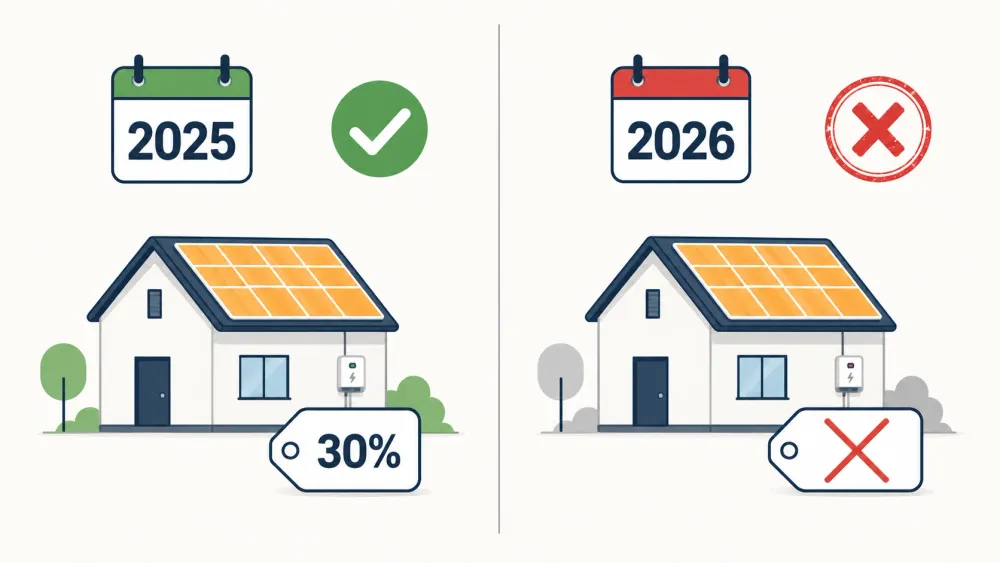
The federal residential solar tax credit, Section 25D, ended on December 31, 2025, under the One Big Beautiful Bill Act signed July 4, 2025. If you buy a home solar system with cash or a loan in 2026, you receive $0 in federal tax credit, with no phase-down and no exception for buyers who missed the deadline. If your system was installed and operating in 2025, you can still claim the credit on your 2025 taxes, and unused credit carries forward.
That's the whole change in one paragraph. The rest of this article separates the two situations you might actually be in, because most confusion comes from mixing them up.
If your solar system's original installation was completed by December 31, 2025, you remain eligible to claim the 30% Section 25D credit when you file that year's taxes. There is no cap on the dollar value you can claim, and no income limit for eligibility. If your tax liability for that year is smaller than your credit, the unused portion carries forward to future tax years rather than being lost. This applies regardless of when you actually file the paperwork, as long as the system itself was operating by the deadline.
A system placed in service on or after January 1, 2026, and purchased with cash or a loan, receives no federal residential tax credit. This is the fact that's easiest to miss in marketing materials still referencing "30% off," which may be describing a 2025 install, a lease structure (below), or simply outdated content that hasn't caught up with the law. If a salesperson tells you a 2026 cash or loan purchase still qualifies for the 30% federal credit, that claim does not match the current law and is worth verifying directly against IRS guidance rather than taking on faith.
The one federal mechanism that still touches a 2026 buyer is indirect: it runs through a lease or PPA, not a purchase, and is explained next.
Section 48E is a business-side investment tax credit, not a homeowner credit. A solar leasing or PPA company that owns systems it installs on homeowners' roofs can, as a business, still claim a 30% credit under Section 48E. The timing rule runs the opposite way from how it is usually summarized, so it is worth stating carefully: under IRS Notice 2025-42, a solar facility that begins construction after July 4, 2026 must be placed in service by December 31, 2027 to qualify, while a facility that begins construction on or before that date is not bound by the 2027 deadline at all. Because the company owns the system, it is the one claiming the credit, not you.
In theory, some of that value gets passed through to the homeowner in the form of a lower monthly lease payment or per-kWh PPA rate than would otherwise be offered. Whether that actually happens, and by how much, varies by company and offer, and is not something a homeowner can verify independently the way you can check a tax form. This is the core reason a lease or PPA and a cash or loan purchase now produce genuinely different financial pictures in 2026, which Cash, Loan, Lease or PPA: How to Pay for Solar in 2026 walks through in full.
The 30% residential credit under Section 25D was originally scheduled to step down gradually in the mid-2030s under prior law. The One Big Beautiful Bill Act, signed July 4, 2025, moved the end date up sharply, ending the residential credit entirely after 2025 rather than phasing it out over years, while leaving the business-side Section 48E credit (which reaches homeowners only through leases and PPAs) running through 2027. Homeowners partway through a decision when the law changed had a genuinely short window to act if they wanted to lock in the credit through a 2025 install, which is part of why the change caused real confusion rather than a clean transition.
If you're currently comparing quotes and haven't signed anything, you are making this decision under 2026 rules: $0 federal credit for a purchase, with the lease/PPA route as the only remaining path to any federal credit exposure. That doesn't mean you should default to a lease to chase the credit; it means the credit should not be a deciding factor in cash vs. loan vs. lease the way it might have been in 2025, since a purchase gets none of it either way. The decision instead comes down to the factors in Cash, Loan, Lease or PPA: How to Pay for Solar in 2026: whether you have the cash, whether you want to own the system, and how long you plan to stay in the house.
Losing a 30% credit is a real change, not a rounding error, and it lengthens payback for a cash or loan purchase compared to a 2025 install. It does not automatically make solar a bad decision. Electricity rates in most utility territories have trended upward for years independent of any solar incentive, and that trend, not the credit, is the other half of whether solar pays for a given house. Whether it still makes sense for you specifically depends on your own numbers, not on the credit's absence alone; Solar Payback Period: How to Calculate Yours, Not the Average shows you how to run that math with your own bill, and Are Solar Panels Still Worth It in the US in 2026? is the starting point for the broader question.
State-level incentives are a separate matter from the federal credit discussed here, change on their own schedules, and should be checked against your own state and utility rather than assumed from a national article.
Is the 30% federal solar tax credit completely gone in 2026? For a homeowner buying with cash or a loan, yes, as of January 1, 2026, following the OBBBA signed July 4, 2025. It survives only indirectly, through Section 48E, for leases and PPAs where a third-party company owns the system, through the end of 2027.
I installed solar in 2025 but haven't filed my taxes yet. Do I still get the credit? Yes. Eligibility depends on when the system was placed in service, not when you file. A system operating by December 31, 2025 remains eligible for the 30% Section 25D credit on that year's return, and any unused amount carries forward to future tax years.
Why do some solar ads in 2026 still mention a 30% credit? That's most likely referring to a lease or PPA structure, where the leasing company (not the homeowner) claims a business-side Section 48E credit and may pass some value through as a lower rate, or the ad may simply be outdated. It is worth asking directly which structure is being offered and confirming the claim against current IRS guidance.
Can I still get any tax credit if I buy my system outright in 2026? Not a federal one under Section 25D or 48E, since 48E is only available to the business entity that owns the system. Some state or utility-level incentives may still apply depending on where you live; those are separate from the expired federal credit and should be verified for your own state.
Does losing the tax credit mean solar isn't worth it anymore? Not automatically. It lengthens the payback period for a purchase compared to 2025, but whether solar still makes financial sense depends on your own electricity rate, system cost, and financing choice. See Are Solar Panels Still Worth It in the US in 2026? for the full picture.
Why did the federal credit end so abruptly instead of phasing out gradually? Under prior law, the residential credit was scheduled to step down gradually into the mid-2030s. The One Big Beautiful Bill Act, signed July 4, 2025, moved the end date up to a hard stop after December 31, 2025, for the residential Section 25D credit specifically, while leaving the business-side Section 48E credit running through 2027 for leases and PPAs.
One email a week with new guides, tips, and solar news. Zero fluff, no sales pitch.