Time of Use Battery Savings: Does the Math Add Up?

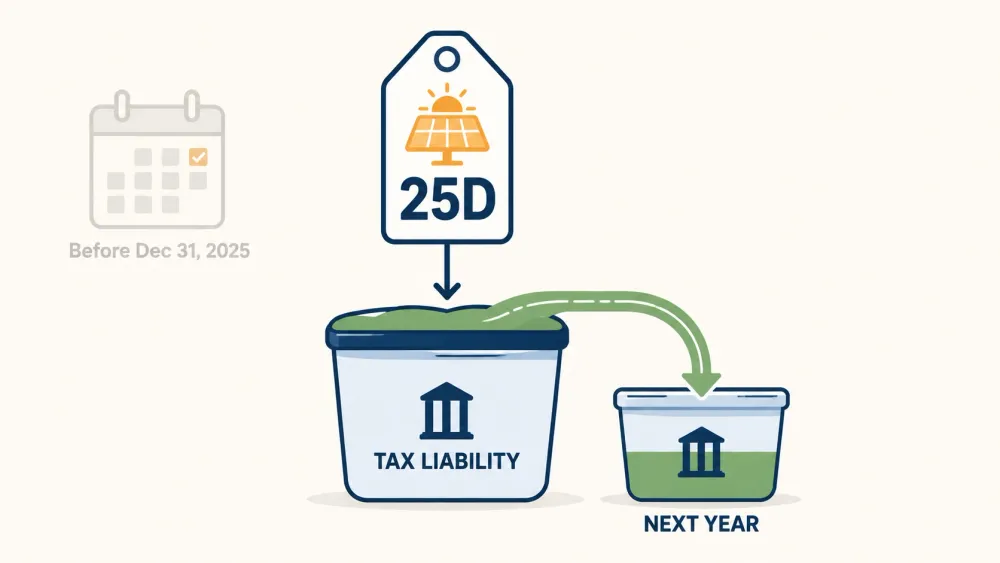
In the United States, generally yes. If your solar system was placed in service on or before December 31, 2025, and you qualified for the 30% Section 25D credit but owed less in federal tax that year than the credit was worth, the unused portion generally carries forward to your next tax return rather than disappearing. This applies only to systems that met the deadline. It is not a way to claim the credit on a 2026 purchase.
Reviewed on August 18, 2026. Next review: September 18, 2026. This article is general information, not tax advice, and it does not tell you what you personally are entitled to claim. Whether the carryforward mechanism applies to your specific return, and for how much, depends on your own filing history and current tax liability. Confirm both against the current instructions for IRS Form 5695 and with a qualified tax professional before you rely on anything below.
Section 25D, the federal residential clean energy credit, is a nonrefundable credit. That single word, nonrefundable, is the reason this question exists at all. A nonrefundable credit can reduce your federal tax liability down to zero, but it cannot push you into a refund beyond what you actually owed, and any amount left over once your liability hits zero is not simply forfeited under this provision. Instead, the excess generally rolls forward and gets applied against your tax liability in a later year. That is the mechanism this article walks through, using IRS Form 5695 and the underlying statute as the source, not a guess at how it should work.
This entire question is downstream of one fact: Section 25D no longer applies to any system placed in service on or after January 1, 2026. According to IRS guidance on the One Big Beautiful Bill Act's energy provisions, an expenditure is treated as made when a system's installation is completed, so a system finished in 2026 was never eligible for a 25D credit in the first place and has nothing to carry forward. If that describes your situation, Is There Still a Federal Solar Tax Credit in 2026? covers what, if anything, still applies to you, and it is not this mechanism. Carryforward only has something to work with if the underlying credit was actually earned, which for Section 25D means the system was operating on or before December 31, 2025. What Changed for Solar Buyers When the 30% Federal Credit Expired covers that transition in full.
A 30% credit on a full solar installation is often a large dollar figure relative to a single household's annual federal tax bill, especially for a large system, a retired household with lower taxable income, or a household whose other deductions and credits already reduced its liability before the solar credit was even applied. Because the credit cannot generate a refund on its own, a household whose total tax liability for the installation year was smaller than the credit amount could not use the full credit that year no matter how the return was filed. That is not a filing mistake. It is how a nonrefundable credit behaves by design, and it is exactly the situation the carryforward provision exists to address.
The underlying statute, Internal Revenue Code Section 25D(c), states that where the credit allowable exceeds a taxpayer's applicable tax liability limitation for the year, the excess "shall be carried to the succeeding taxable year and added to the credit allowable" for that following year.
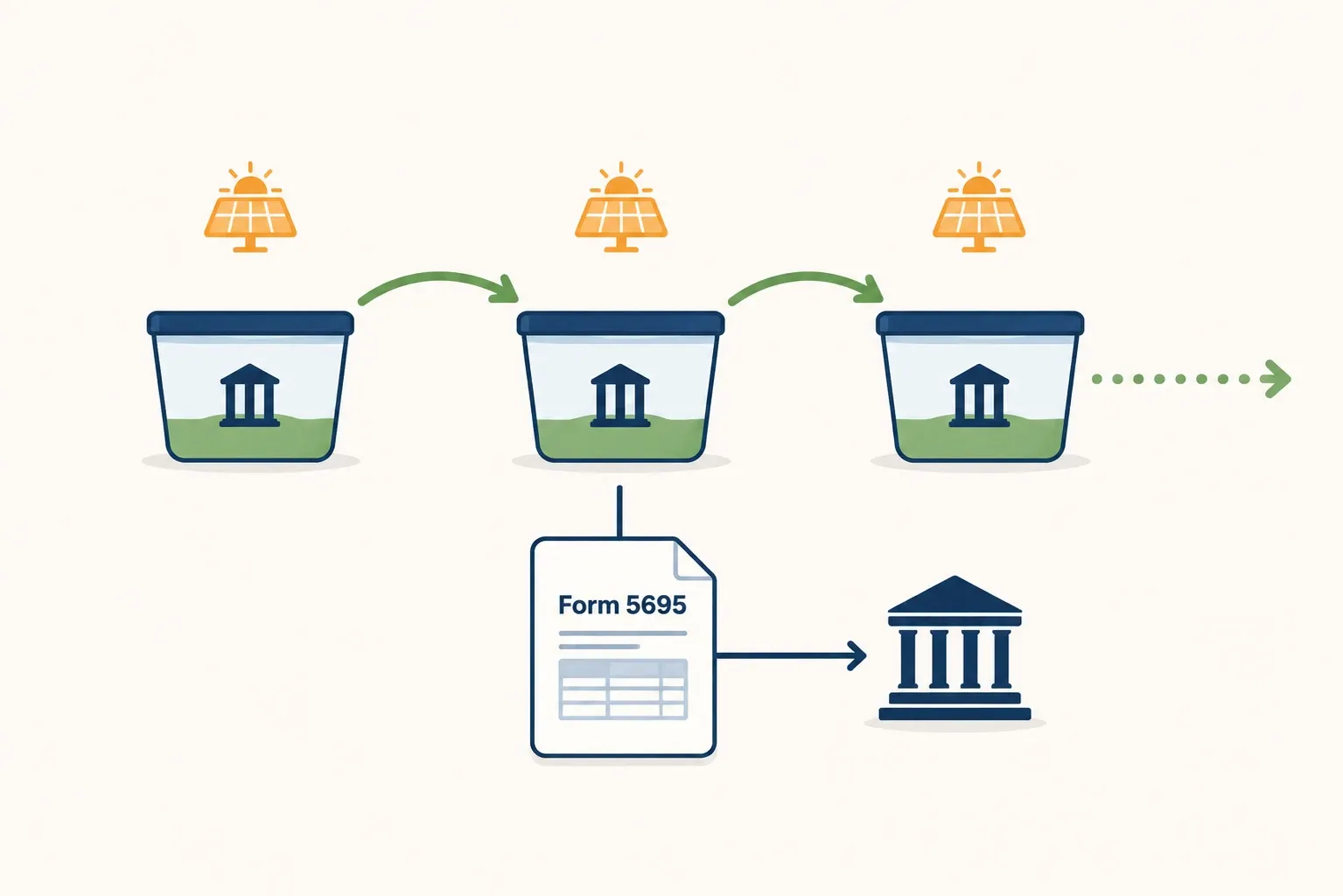
The current IRS instructions for Form 5695 describe the practical side of the same rule: if you cannot use all of the credit because your tax liability limit is smaller than the credit amount, you carry the unused portion forward, entering it on the appropriate carryforward line, and a filer with only a prior-year carryforward amount and no new qualifying expenditures can skip most of the form's earlier sections. As written, this rolls forward one tax year at a time and does not state a fixed number of years after which it stops. This article is not going to put a specific year count or dollar cap on that, because the current guidance available at the time of this review does not state one; if you see a specific number of years or an expiration claimed elsewhere, verify it against the current Form 5695 instructions directly rather than trusting either source blind.
Carrying forward an unused credit only moves an amount you already earned into a later tax year. It does not create a new credit, and it does not open any path for a homeowner who installs a system in 2026 or later to claim Section 25D on that new purchase. The two situations are entirely separate: an installation completed on or before December 31, 2025 earned a credit that may still have unused value to carry forward; an installation completed after that date earned nothing under Section 25D at all, and no carryforward provision changes that fact. If you are trying to work out what a 2026 purchase itself qualifies for, that question belongs on Is There Still a Federal Solar Tax Credit in 2026?, not here. Solar Incentives in the US in 2026: What Actually Survived maps this carryforward question against the rest of the 2026 incentive picture, and for the wider question of whether solar remains financially worthwhile without that credit, Are Solar Panels Still Worth It in the US in 2026? is the place to start.
I installed solar in 2025 and could not use the whole credit. Is it gone? Generally no. If your system was placed in service on or before December 31, 2025, the unused portion of your Section 25D credit generally carries forward to a later tax year under the statute and current Form 5695 instructions. This is general information, not a statement about your specific return; confirm with a tax professional.
How many years can I carry the credit forward? The statute and current Form 5695 instructions describe the excess rolling forward one tax year at a time without stating a fixed number of years. This article will not put a specific cap on it because none is confirmed in current guidance at the time of this review; check the current instructions directly for the most up to date treatment.
Do I need to refile anything to carry the credit forward? You generally file Form 5695 again in the following tax year to claim the carried-forward amount, using the prior year's form to determine the carryforward figure. A tax professional or current Form 5695 instructions can walk through the exact lines for your situation.
Can I use a 2025 carryforward to offset taxes on a completely unrelated 2026 solar purchase? No. A carryforward is unused value from a credit you already earned on a system placed in service on or before December 31, 2025. It has no connection to a separate, newly installed 2026 system, which does not qualify for Section 25D regardless of any carryforward you may be claiming.
What if I never installed solar and just want the credit for a 2026 project? There is nothing to carry forward if a credit was never earned. Section 25D does not apply to systems placed in service in 2026 or later, so this carryforward mechanism has no relevance to a new 2026 purchase. See the article on the current federal credit for what, if anything, applies to a 2026 installation.
One email a week with new guides, tips, and solar news. Zero fluff, no sales pitch.