Time of Use Battery Savings: Does the Math Add Up?

Reviewed on August 5, 2026.
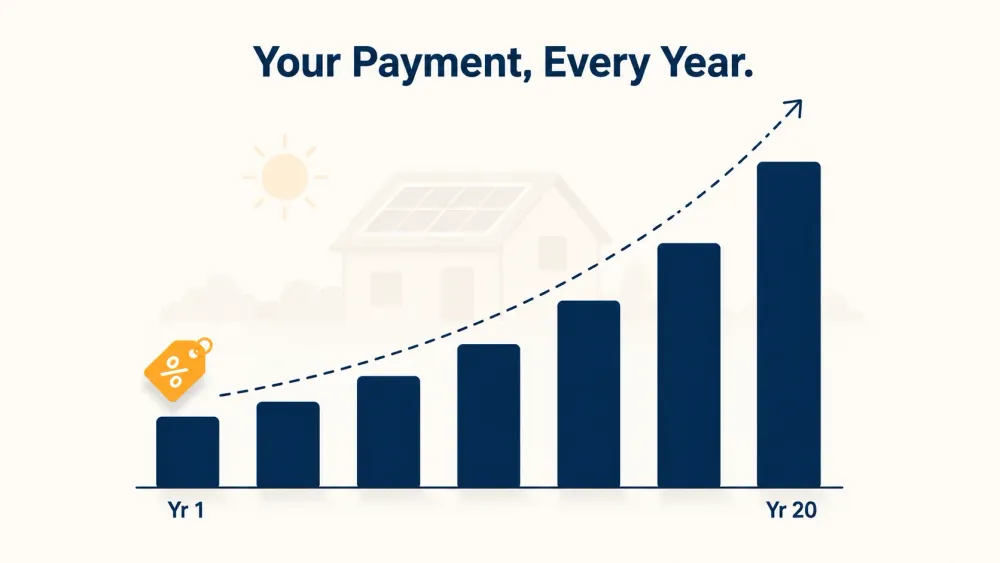
A solar PPA escalator clause raises what you pay per kilowatt-hour, or your fixed lease payment, by a set percentage every year for the life of the contract, typically 15 to 25 years. In the United States, this is standard in most lease and power purchase agreement (PPA) offers, not an unusual add-on, and it compounds: each year's increase applies to an already-increased payment, not to the original one. Over a 20-year contract, even a small annual percentage adds up to meaningfully more than the number a salesperson quotes you for "year one." The rest of this article shows the method, using clearly illustrative numbers, and where to check your own rate.
Under a lease, you pay a fixed monthly amount for the use of a system you don't own. Under a PPA, you pay a rate per kilowatt-hour for the electricity the system produces, again without owning the equipment. In both structures, the company that owns the system is contracting to maintain and, in the case of a PPA, generate power from that system for a decade or more. An escalator clause is the mechanism the company uses to have its revenue keep pace with its own rising costs and with general inflation over that period, rather than locking in a single flat number for the entire contract term. It is standard business practice for a long-term contract, not a hidden trick by itself; the issue is that many buyers don't realize how much it moves the total over 20 years, which is what the rest of this article works through.
Look for a section labeled "escalator," "annual increase," "rate adjustment," or similar in your lease or PPA agreement, usually near the payment terms. It should state a specific percentage and confirm that it's fixed for the life of the contract, not variable or tied to an index that could move unpredictably. If you cannot find this language, or if it's vague, ask the provider directly: what is the exact annual percentage, does it compound (apply to the prior year's already-increased payment), and is it fixed for the full term or subject to change? A contract that doesn't state this plainly, or that leaves it as an estimate rather than a defined number, is one you should not sign until it's clarified in writing.
Here is the method, using round, clearly illustrative numbers chosen only to demonstrate the arithmetic, not because they represent any typical or real contract.
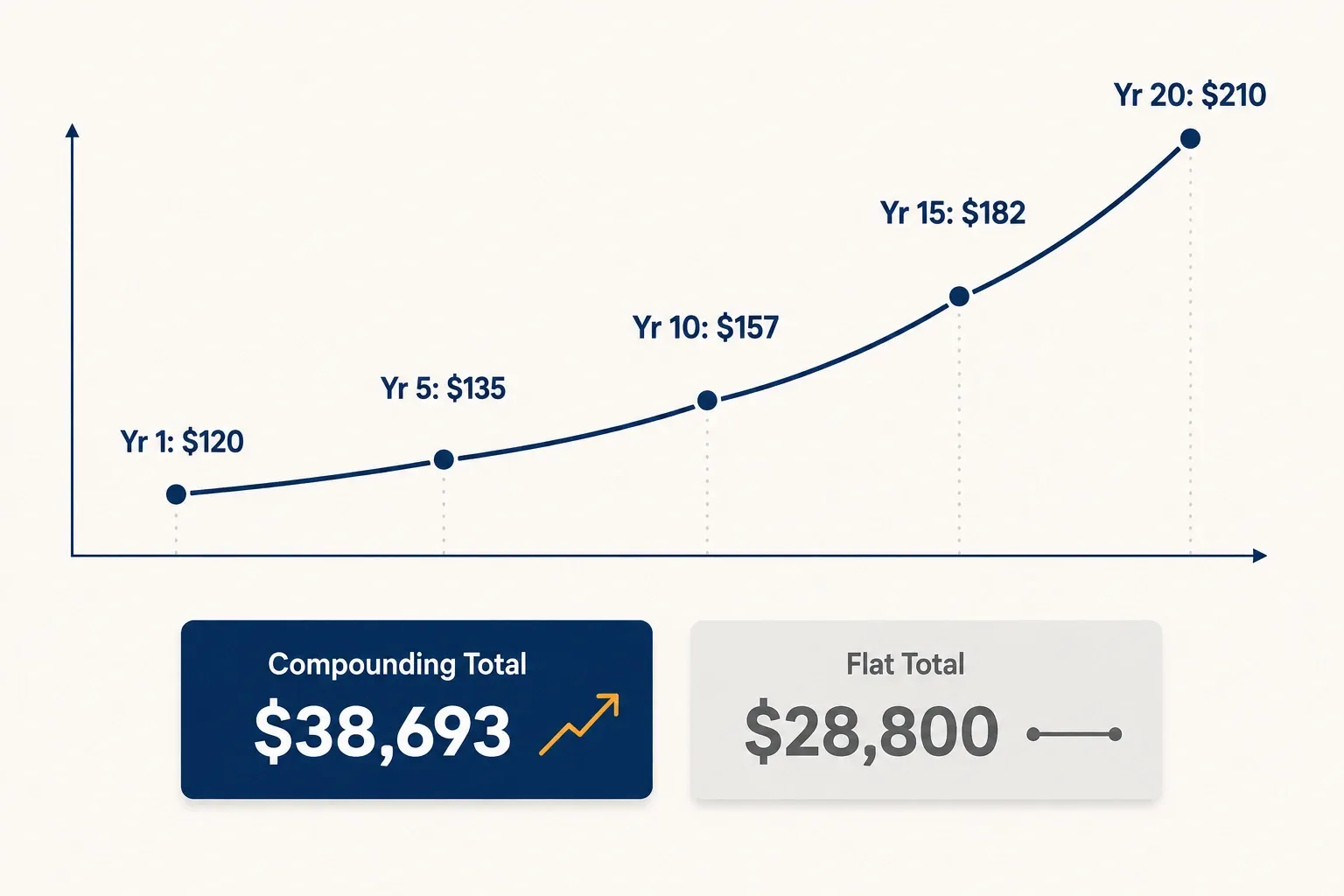
Assume a starting monthly payment of $120 rising 3% a year, compounding annually, over a 20-year term:
| Year | Monthly payment (illustrative) | That year's total (12 months) |
|---|---|---|
| 1 | $120.00 | $1,440 |
| 5 | $135.06 | $1,621 |
| 10 | $156.57 | $1,879 |
| 15 | $181.51 | $2,178 |
| 20 | $210.42 | $2,525 |
By year 20, the monthly payment in this illustration has grown to about $210, roughly 75% higher than the year-1 payment, purely from the 3% annual compounding. Add up all 20 years of payments in this illustration (calculated as the sum of a compounding geometric series, not by adding the rounded rows above) and the total comes to approximately $38,693, compared with $28,800 if the same $120 monthly payment had simply stayed flat for 20 years, about 34% more paid over the life of the contract than the flat-payment scenario. The method is what matters here: take your own starting payment, apply your own contract's actual escalator percentage compounding annually, and run the same calculation, because a 1 or 2 percentage-point difference in the rate changes this total substantially over 20 years.
A note on sourcing: some industry sources describe a "typical" escalator rate in the 1 to 3% range, but a current, citable figure from a primary research source that tracks actual signed lease and PPA contract terms was not confirmed at the time of writing. This article does not state a typical rate as fact for that reason. Your contract's actual number, stated in your own paperwork, is the only figure that matters for your situation.
An escalator clause does not operate in isolation. Whether a rising lease or PPA payment still saves you money depends on how it compares with what your utility would otherwise charge you over the same period, and utility rates have their own trajectory, generally trending upward over time in most territories, independent of anything solar-related. If your escalator rate is lower than your utility's own rate of increase, the gap between what you'd pay the utility and what you pay under the contract widens in your favor over time. If your escalator rate is higher than your utility's own trend, that gap narrows, and could eventually close or reverse. Because your own utility's future rate trend is not something any contract can guarantee, this comparison is inherently uncertain in both directions, which is exactly why the escalator percentage in your specific contract, not a general assumption, is the number worth scrutinizing before you sign. Lease vs Buy After the Credit Expired: What Actually Changed covers the wider financial comparison between owning and leasing that this fits inside.
Before signing a lease or PPA, ask the provider these questions directly and get the answers in writing:
Some providers do offer a capped or lower escalator option, sometimes at a slightly higher starting rate, as an alternative structure; whether that trade-off is worth it depends on the same compounding math above, run with your own numbers. If a provider is unwilling to state the escalator in writing or walk you through the full-term schedule, treat that reluctance as information. For how an escalator sits inside broader lease and PPA marketing, including offers framed as free or no-cost, see Why "Free Solar" Is Never Free, and for the full range of ways to pay for a system, see Cash, Loan, Lease or PPA: How to Pay for Solar in 2026. The broader question of whether any of these paths still makes financial sense starts at Are Solar Panels Still Worth It in the US in 2026?
What is a typical escalator rate for a solar lease or PPA? This article does not state a national "typical" figure, because a current, citable source tracking actual signed contract terms was not confirmed at the time of writing. Ask your provider for the exact percentage in your own contract and run the compounding math on that number, not an assumed average.
Does the escalator apply to the original payment or the previous year's payment? In a standard compounding escalator, each year's increase applies to the prior year's already-increased payment, not the original starting amount. That compounding is why the effect grows faster than a flat annual increase of the same percentage would suggest.
Can I negotiate a lower or capped escalator? Some providers offer this as an alternative structure, sometimes with a higher starting payment in exchange. Ask directly whether it's available and compare the full 20-year total under each option using the same method shown above.
What happens to the escalator clause if I sell my house? Typically the contract, including its escalator schedule, transfers to the new homeowner or must be bought out before closing. This varies by provider and should be confirmed directly, since it affects how you market the home at resale.
Is an escalator clause a sign that a lease or PPA is a bad deal? Not by itself. It's standard in most lease and PPA contracts. The question is whether the specific percentage in your contract, compounded over the full term, still leaves you paying less than your utility would have charged over the same years, which depends on your own numbers rather than a general rule.
One email a week with new guides, tips, and solar news. Zero fluff, no sales pitch.