Time of Use Battery Savings: Does the Math Add Up?

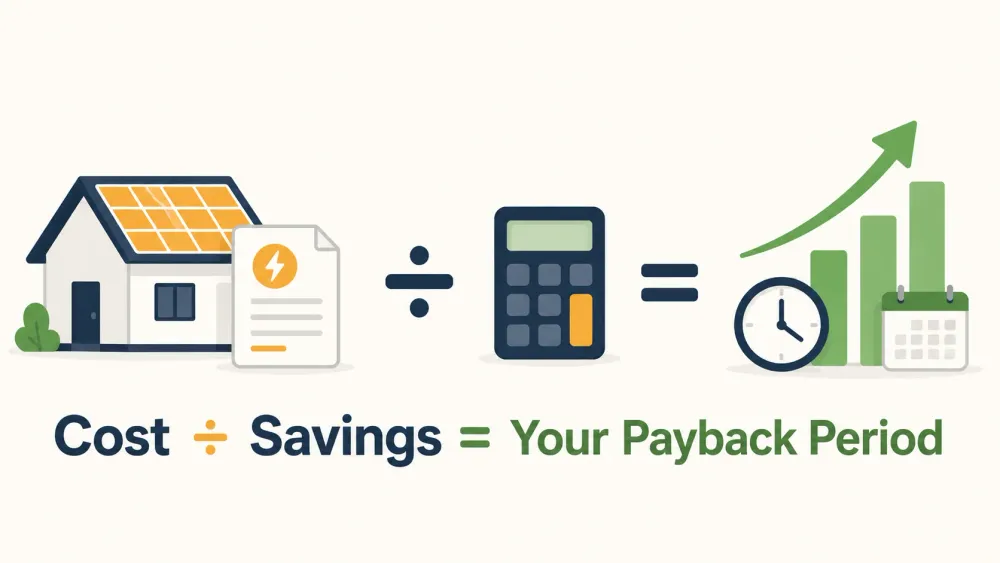
Your solar payback period is your net system cost divided by your annual electricity-bill savings. That's the whole formula. The part that actually determines your answer isn't the math, it's which two numbers you plug in: your own quoted net cost, and your own realistic annual savings, not a national average of either. Most published "average payback period" figures blend a national average cost with a national average electricity rate, which describes almost nobody's actual bill. If you haven't yet worked out whether solar makes sense for you at all, Are Solar Panels Still Worth It in the US in 2026? is the broader starting point this calculation feeds into.
Payback period (years) = net system cost ÷ annual electricity-bill savings.
"Net system cost" means your quoted total price, minus any incentive you can actually verify you qualify for. In 2026, that means: no federal Section 25D credit for a cash or loan purchase (it expired December 31, 2025), plus whatever state or utility incentive genuinely applies to your address and utility. See what changed when the credit expired for the current federal picture, and what home solar actually costs for realistic cost ranges to sanity-check your own quote against.
"Annual electricity-bill savings" is not your entire old electric bill. It's the portion of your usage the system actually offsets, at the rate your utility credits you for exported and self-consumed power, which depends on your specific net metering arrangement. This number comes from your utility bill and your solar company's production estimate, not from a headline percentage.
Pull your last 12 months of utility bills, or at minimum a recent bill that shows annual usage, and note your annual kWh consumption and your effective rate per kWh (total dollar amount divided by kWh used, not just the posted rate, since fees and taxes are part of what you're actually paying). Your solar quote should include an estimated annual production figure in kWh for the proposed system; compare that to your usage rather than assuming the system covers 100% of it. Multiply the smaller of the two (your usage or the system's estimated production) by your effective rate to get a realistic first-year savings estimate, understanding that your utility's export compensation may differ from your import rate.
Payback period tells you how long until the system has paid for its own cost. It does not tell you what the system is worth to you over its full life, which for most panels extends well beyond the payback point. A system with a 12-year payback and a 25-year expected life is not a worse investment than one with an 8-year payback and a 15-year life; they're different questions. Payback is useful for "when do I break even," not for "which system is the better investment," and conflating the two is a common source of confusing marketing claims.
The basic payback formula assumes you paid cash and that your electricity rate never changes, and neither assumption is universal. If you finance with a loan, your real monthly outlay includes interest, so your break-even point in cash-flow terms differs from the simple payback formula; Cash, Loan, Lease or PPA walks through how financing changes the picture. If you finance with a lease or PPA, the payback-period framing doesn't really apply the same way, because you never own the system outright; your comparison there is your monthly lease or PPA payment against your old bill, not a cost-recovery calculation. The formula also doesn't account for routine maintenance, though a well-installed grid-tied system typically has low ongoing costs, or for the possibility that your utility rate rises over time, which would shorten your real payback versus the static estimate.
Once you have a payback period, two related figures are worth working out alongside it, because they answer questions payback doesn't. The first is total savings over the system's remaining useful life after payback, which for a well-installed system commonly extends a decade or more past the break-even point; that later stretch is where most of the total financial benefit actually accumulates, not in the payback years themselves. The second is what happens if your electricity rate rises during the payback period, which is common over any multi-year stretch independent of solar; a rising rate shortens your real payback versus the static estimate you calculated on day one, because each kWh you offset becomes worth more. Neither of these requires a new formula, just revisiting the same inputs periodically rather than treating your day-one estimate as fixed forever.
Suppose a homeowner's own utility bill shows 10,000 kWh of annual usage at an effective rate of $0.16/kWh, roughly $1,600 per year in electricity costs. A quote proposes a system estimated to produce 9,000 kWh annually, priced at $24,000 installed with no federal credit applied (2026 cash purchase). If the utility credits exported and offset power close to the retail rate, annual savings might approach the value of the 9,000 kWh offset, before adjusting for any export-rate difference: roughly $24,000 ÷ (an annual savings figure the homeowner would calculate from their own bill and their utility's specific net metering terms) gives the payback in years. These are illustrative placeholder inputs, not a claimed real bill or a promised outcome; run the same formula with your own bill and your own quote, because your rate, your usage, and your utility's export terms will not match this example.
What is a good solar payback period in 2026? There is no universal "good" number, because it depends entirely on your own cost and your own rate. Published averages circulate widely, but we could not trace one to a source worth quoting, and an average built from other people's electricity rates cannot tell you about yours. What moves your own number is the installed cost you are quoted, the rate you currently pay, how much of your production you use rather than export, and what your utility pays for exports. Run the formula above with those four inputs from your own bill and quote.
Is payback period the same as return on investment? No. Payback period tells you when you break even; it says nothing about total value over the system's remaining life after that point, or about the rate of return compared to other uses of the same money. Treat them as two different questions.
How does financing change my payback period? A cash purchase's payback is straightforward: net cost divided by savings. A loan adds interest, so your real cash-flow break-even point is later than the simple formula suggests, though you may see savings from month one if the loan payment is lower than your old bill. A lease or PPA doesn't have a traditional payback point at all, since you never own the system. See Cash, Loan, Lease or PPA.
Does the expired federal tax credit change how I calculate payback? Yes, directly. Through 2025, the credit effectively reduced net system cost by 30% for a purchase, shortening payback. For a 2026 cash or loan purchase, that reduction is $0, so net cost in the formula is the full quoted price unless a state or utility incentive applies. Full detail in what changed when the credit expired.
Can I trust the payback number my solar salesperson gave me? Ask them to show their inputs: the exact net cost after any incentive they applied, and the exact annual savings figure and how they calculated it from your bill and your utility's net metering terms. If they can't show the inputs, or the incentive they applied no longer exists, recalculate it yourself with your own bill using the method above.
Does my payback period change if electricity rates go up after I install solar? Yes, and usually in your favor. The formula above uses your rate at the time of calculation. If your utility's rate rises in later years, as it commonly does over any multi-year period, each kWh your system offsets becomes worth more, which shortens your real payback compared to the static estimate. It's worth revisiting the calculation periodically with your current rate rather than treating a day-one estimate as permanent.
One email a week with new guides, tips, and solar news. Zero fluff, no sales pitch.