Time of Use Battery Savings: Does the Math Add Up?

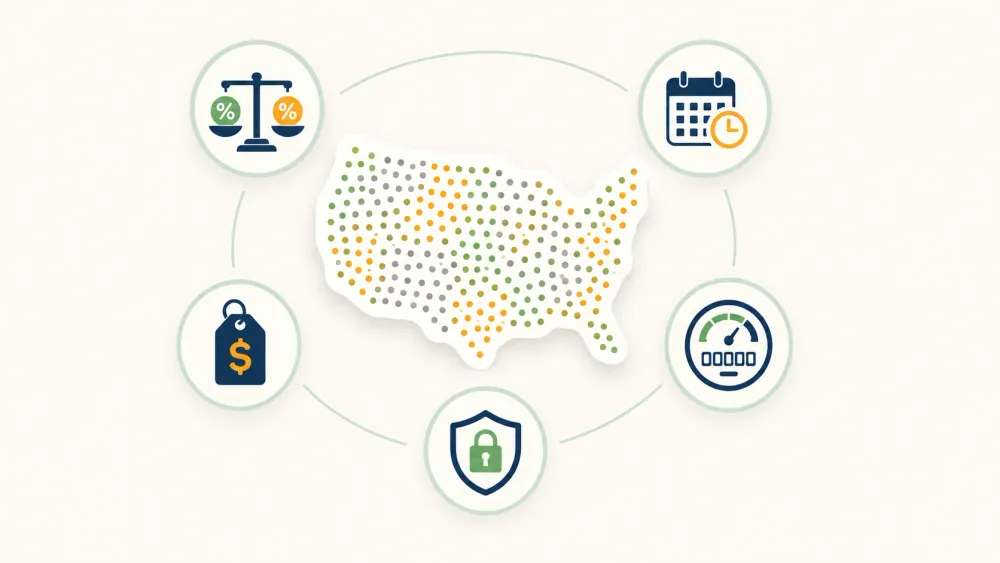
Net metering in the United States is set state by state and then administered utility by utility, so there is no national rule and no single ranking that stays true for long. What makes a state good or bad for solar exports is structural, and it comes down to five things: whether exports are credited at retail or at avoided cost, how often the account settles, whether there is an enrollment cap, whether existing customers are grandfathered and for how long, and what fixed charges sit underneath. This article explains those five, and points you at the primary databases where your own state and utility's current position is recorded.
Sources for this article were verified against primary regulatory and database sources at the time of writing. This is general information about how these programs are structured. It is not tax, legal or financial advice, and it is not a statement about what your utility offers today. Programs change independently of this page.
Almost every page competing for this query publishes one: a grid of states, a color code, sometimes a cents per kilowatt hour figure per state. They are the most confidently wrong artifacts in solar content, for three reasons that are worth understanding before you trust any of them.
A state is not a tariff. In most states, the public utilities commission authorizes a framework and each utility files its own tariff underneath it. A large investor owned utility and a rural electric cooperative in the same state can operate genuinely different programs. Municipal utilities frequently sit outside commission jurisdiction altogether.
A state's answer is not one answer over time. Programs are routinely closed to new applicants while remaining in force for existing customers, which means the correct answer for your neighbor who connected in 2021 and for you connecting today can be different in the same territory under the same utility.
These tables date fast and quietly. Nothing on the page tells you it has gone stale. A dollar figure printed in a table looks equally authoritative the day it is right and two years after it stopped being right.
The Database of State Incentives for Renewables and Efficiency, known as DSIRE, is operated by the N.C. Clean Energy Technology Center at N.C. State University and describes itself as the most comprehensive source of information on incentives and policies supporting renewables and efficiency in the United States, covering all US states, the District of Columbia, US territories and federal policy. That is the lookup layer. This page is the interpretation layer: what to do with what you find there.
This is the biggest single lever. Under a traditional retail rate arrangement, a kilowatt hour exported offsets a kilowatt hour imported at the same price. Under a net billing or avoided cost arrangement, the export is credited at a separately calculated value that is typically lower than the retail rate.
California is the clearest documented example of the second form. The CPUC adopted the Net Billing Tariff in Decision D.22-12-056 and states that customers applying for interconnection have taken service on it since April 15, 2023, with exports compensated at a rate reflecting the value of that generation to the grid, which the CPUC describes as usually lower than the retail rate. California NEM 3.0: What You Actually Get Paid for Exports covers that tariff in detail.
Ask your utility which of these two structures your account would fall under. The answer is in a filed tariff document, not in a brochure.
A program that banks surplus credits across months lets summer production offset winter consumption up to an annual true up. A program that settles monthly, or that pays out surplus at a lower rate at each cycle, gives that seasonal shape back to the utility. Two programs that both call themselves net metering and both credit at the same rate can produce materially different annual outcomes purely on settlement frequency.
North Carolina is a documented case of monthly credit handling with an annual reset. The North Carolina Utilities Commission Public Staff describes legacy Rider NM credits as accumulating monthly but resetting annually, with different reset dates for Duke Energy Carolinas and Duke Energy Progress.
Many programs are capped, either as a share of utility peak load or as an annual megawatt allocation, and operate first come first served. A capped program can be excellent and still be unavailable to you, which is a distinction that rankings never capture. The Public Staff notes that North Carolina's Net Metering Bridge rider is open to a limited number of customers each year, and that when the limit is reached, new customers are required to take service under the Residential Solar Choice rider instead.
Grandfathering is what determines whether the terms you sign up under survive the next regulatory decision. The CPUC states that California NEM 2.0 customer generators may remain on the NEM 2.0 tariff for 20 years from the date they interconnected. North Carolina's Public Staff describes the Net Metering Bridge rider as available for up to 15 years from the date of the interconnection request application, after which customers move to the Residential Solar Choice rider or whichever tariff applies then.
Note what both of those have in common: the clock runs from an interconnection date, and the period is finite. A grandfathering promise is a term of years, not permanence.
Export credits are only one side of a bill. Minimum monthly bills, non bypassable charges, grid access fees and mandatory rate schedules all reduce what a credit is actually worth to you. The Public Staff describes North Carolina's Residential Solar Choice rider as introducing a minimum monthly bill, non bypassable charges for storm recovery and cyber security costs, a grid access fee for systems above 15 kW AC, and a requirement to take service under a time of use with critical peak pricing schedule.
A state with generous headline export credits and heavy fixed charges can easily be worse for a given household than a modest program with none. This is the row that rankings almost always omit, because it does not compress into a color code.
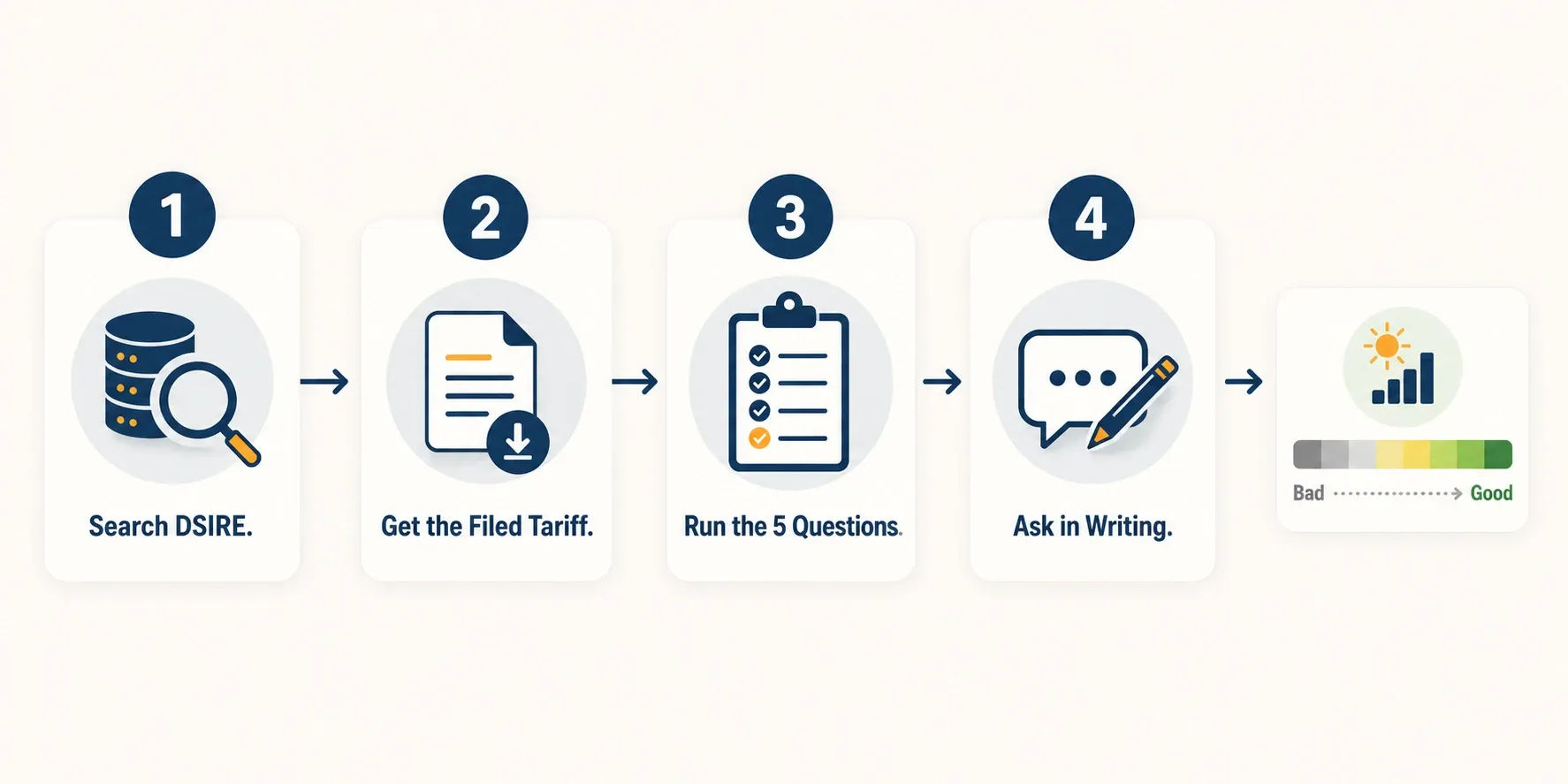
A state is good for net metering when exports credit at or near retail, credits bank across seasons, enrollment is open, grandfathering is long and dated from a fact you can prove, and fixed charges are light. A state is bad when the opposite is true. Everything else is a label.
This page names states only where a specific rule could be attributed to the body that issued it, which is why California and North Carolina appear and most states do not. That is a limitation of what can be verified in one sitting, not a judgment that other states are unremarkable. It publishes no export rate for any state, and no ranking. It also does not tell you whether solar pays where you live: for that, Are Solar Panels Still Worth It in the US in 2026? and Solar Incentives in the US in 2026: What Actually Survived are the starting points, and Net Metering Explained for US Homeowners covers the mechanism itself.
Which states have the best net metering? There is no durable ranking, because the terms are set by individual utility tariffs and change by enrollment date. A program is strong when exports credit at or near the retail rate, credits bank across seasons, enrollment is open, grandfathering runs a long term from your interconnection date, and fixed charges are light. Check your own utility's filed tariff against those five points.
Do all US states have net metering? No. Net metering and net billing programs are authorized state by state, and some states have no statewide requirement at all, leaving the decision to individual utilities. DSIRE, operated by the N.C. Clean Energy Technology Center at N.C. State University, records what exists by state.
Why does my neighbor get better credits than I would? Most likely because they enrolled under an earlier version of the program. Grandfathering typically locks a customer's terms for a fixed period dated from interconnection, so two houses on the same street can sit on genuinely different tariffs.
Is net billing the same as net metering? Not exactly. Traditional net metering credits exports at the retail rate. Net billing credits exports at a separately set value, often calculated as an avoided cost, which is typically lower than the retail rate. Both are commonly called net metering in conversation.
Where can I check my state's current rules? DSIRE is the standard database for identifying what programs exist in your state and territory. Once you know the program name, request the filed tariff from your own utility, since that document, not a database summary, governs your account.
One email a week with new guides, tips, and solar news. Zero fluff, no sales pitch.