Time of Use Battery Savings: Does the Math Add Up?

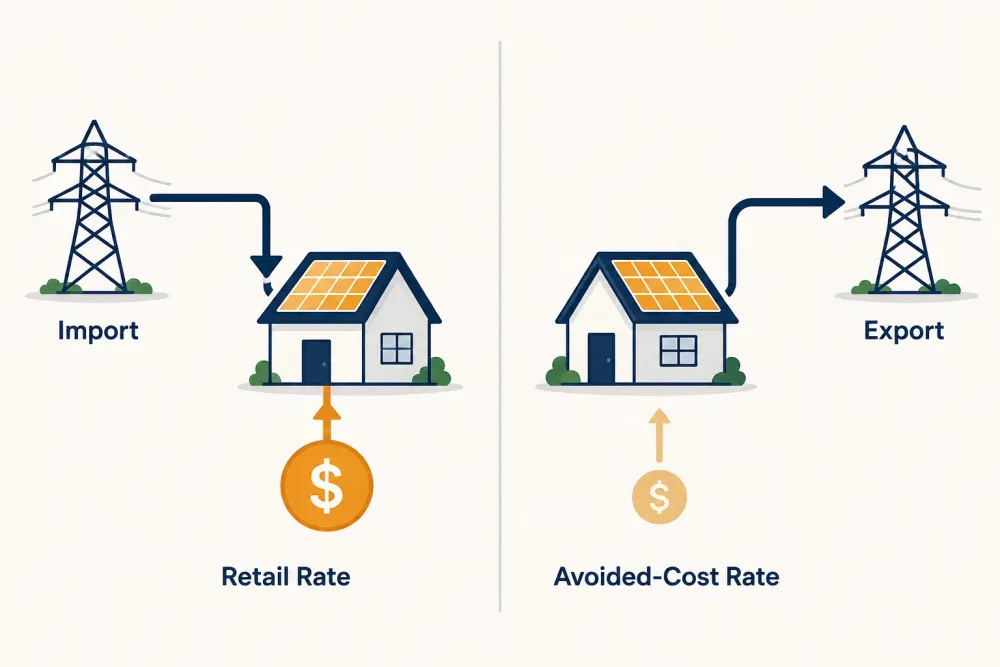
"NEM 3.0" is the nickname for California's Net Billing Tariff, adopted by the California Public Utilities Commission in Decision D.22-12-056 on December 15, 2022. The CPUC states that since April 15, 2023, customers applying for interconnection have taken service on it. Under the Net Billing Tariff, electricity you export to the grid is credited at avoided-cost values rather than at the retail rate you pay for the power you import. It applies in the territories of Pacific Gas and Electric, Southern California Edison and San Diego Gas and Electric.
Sources for this article were verified against the CPUC's own published materials at the time of writing. This is general information about how a tariff works in California. It is not tax, legal or financial advice, it is not a recommendation to install or to wait, and it is not a description of what your own quote will actually earn. Tariffs change, and only your utility's filed tariff and your own interconnection paperwork govern your account.
The change is narrower than the headlines suggest, and it matters that you know exactly which part moved.
What did not change: you stay connected to the grid, you still draw power from it, and you are still billed at retail rates for everything you import. What changed is the value of what you send out. The CPUC describes compensation for excess generation exported to the grid as being applied to a customer's bill "at a rate reflecting the value of this generation to the grid," which it says is "usually lower than the retail rate."
That single sentence is the whole story. Under a traditional retail-rate net metering arrangement, a kilowatt-hour out cancels a kilowatt-hour in. Under net billing, a kilowatt-hour out is credited at a separately calculated value, and the two sides of your bill are no longer symmetrical. If you want the general mechanism before the California specifics, Net Metering Explained for US Homeowners covers the difference between net metering and net billing without a state attached.
Export credits under the Net Billing Tariff are derived from the CPUC's Avoided Cost Calculator, a regulatory model that estimates what the utility avoids spending by not having to procure that electricity elsewhere at that moment.
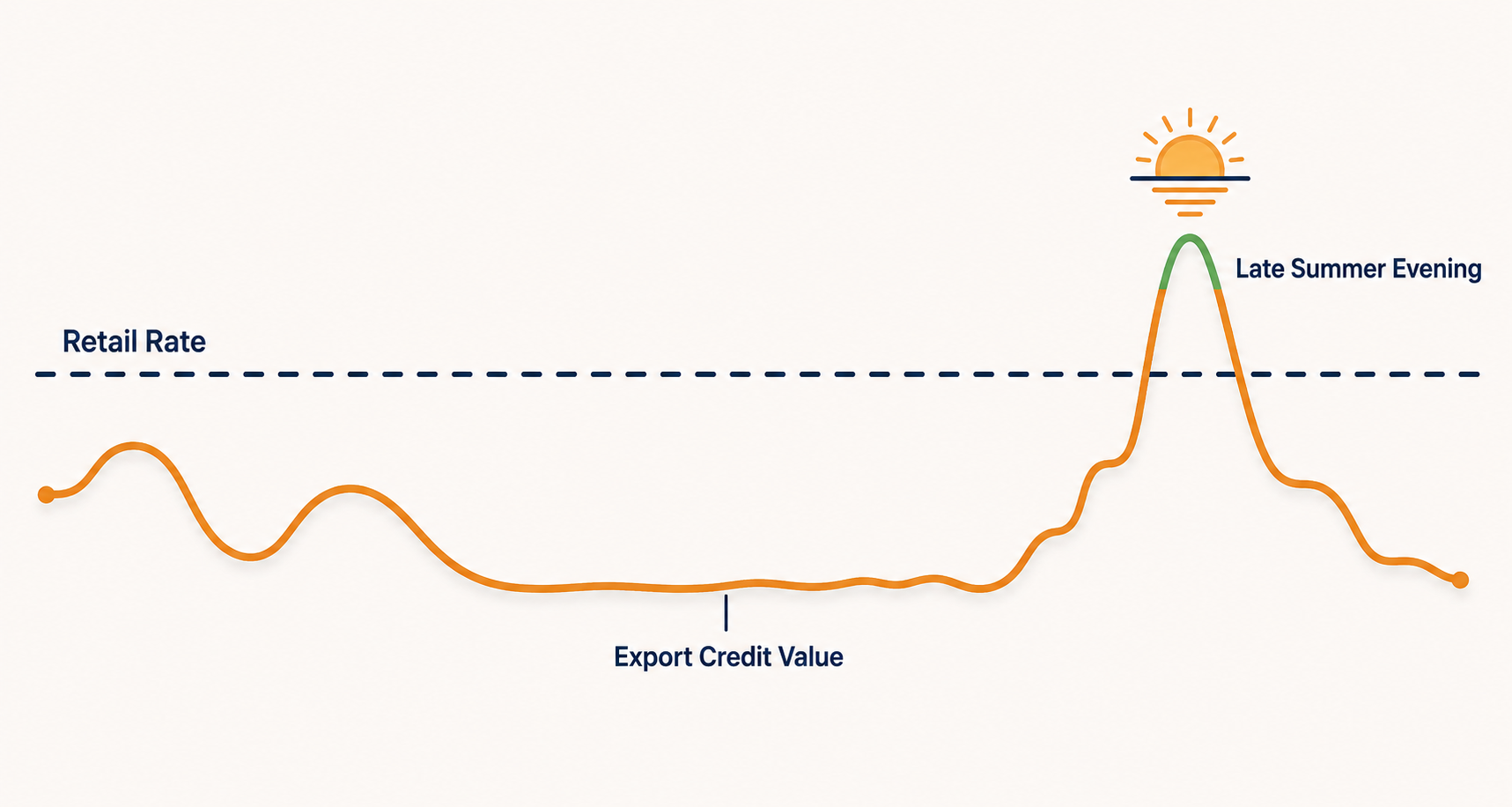
Three properties of that model drive everything a California homeowner experiences:
| Property | What it means on your bill |
|---|---|
| It is hourly | The credit for a kilowatt-hour exported at 1pm in April is not the same as one exported at 7pm in September |
| It is seasonal | Summer evening hours carry very different values from spring midday hours |
| It can exceed retail | The CPUC notes the value is usually lower than the retail rate "but can rise above the retail rate on late summer evenings" |
That last row is the part almost no summary includes, and it is the CPUC's own language. The Net Billing Tariff is not a flat haircut applied to your exports. It is a schedule that rewards exporting at the hours the grid is most strained and pays very little at the hours it is not.
The CPUC's Net Billing Tariff materials describe export compensation as based on a locked-in nine-year schedule of hourly values, taken from the Avoided Cost Calculator adopted as of January 1 of the calendar year in which the customer interconnects.
Read that carefully, because it is easy to over-read.
What appears to be fixed is the schedule of export values for that nine-year window, tied to the vintage of the calculator in force in your interconnection year. What is not fixed by it is the retail rate you pay for imports, your rate schedule's time-of-use windows, fixed charges, or anything else on the import side of your bill. A homeowner who reads "locked in for nine years" as "my solar economics are locked in for nine years" has misread it, and that misreading is common enough that it is worth stating plainly.
Confirm the exact locking terms and your applicable vintage against your utility's filed tariff sheet, not against a sales summary.
The Net Billing Tariff applies in the territories of the three large investor-owned utilities: PG&E, SCE and SDG&E. California also has publicly owned municipal utilities and irrigation districts that are not regulated by the CPUC in this respect and set their own customer generation rules. If your power bill comes from a municipal utility, the CPUC's Net Billing Tariff is not automatically your tariff, and searching "NEM 3.0" will hand you an answer for a utility you are not a customer of.
Separately, existing solar owners are on a different footing. The CPUC states that NEM 2.0 customer generators "are allowed to remain on the NEM 2.0 tariff for 20 years from the date they interconnected, or they are permitted to switch to the current tariff." That legacy question has its own article: The California NEM Legacy Transition deals with what is and is not scheduled to move existing customers off their old terms.
Search this topic and you will be handed a single cents-per-kilowatt-hour figure for what NEM 3.0 pays, usually contrasted against a single figure for NEM 2.0, usually with a percentage drop attached. This article is not going to give you one, and the reason is the point of this section.
There is no single NEM 3.0 export rate. There is an hourly, seasonal schedule, and what a specific household earns from it depends on the shape of its own production and consumption across every hour of the year. Any single number is the output of somebody's model, using somebody's assumptions about your roof, your usage curve, your rate schedule, and which vintage of the Avoided Cost Calculator applies to you.
So when a proposal shows you an annual export credit, treat it as a modeled input you are allowed to interrogate. Reasonable questions to ask the company that produced it:
That last pair matters because the Net Billing Tariff's hourly structure is precisely what makes storage look attractive in a proposal. That is not automatically wrong. It does mean the value shown is a function of assumptions about dispatch, and you are entitled to see them separately.
This page does not tell you whether solar pays in California. It cannot: that depends on your rate schedule, your usage, your roof and your price, and Are Solar Panels Still Worth It in the US in 2026? plus Solar Payback Period: How to Calculate Yours, Not the Average are where that work actually gets done. It also does not carry a dollar figure for exports, because the honest version of that figure is a schedule, not a number. And with the federal residential credit under Section 25D having expired at the end of 2025, the California export question now sits inside a different overall picture, which Solar Incentives in the US in 2026: What Actually Survived covers.
What is NEM 3.0 in California? NEM 3.0 is the informal name for California's Net Billing Tariff, adopted by the CPUC in Decision D.22-12-056 in December 2022. The CPUC states that customers applying for interconnection have taken service on it since April 15, 2023. It credits exported electricity at avoided-cost values rather than at the full retail rate.
How much does NEM 3.0 pay for exported electricity? There is no single rate. Compensation is based on the CPUC's Avoided Cost Calculator, which produces values that vary by hour and season. The CPUC describes those values as usually lower than the retail rate, but notes they can rise above it on late summer evenings. Your own result depends on when your system exports.
Does NEM 3.0 apply to every California utility? No. It applies in the territories of PG&E, SCE and SDG&E, the large investor-owned utilities regulated by the CPUC. Municipal utilities and other publicly owned providers set their own customer generation rules, so check with your own utility.
I already have solar. Am I on NEM 3.0? Not automatically. The CPUC states that NEM 2.0 customer generators may remain on the NEM 2.0 tariff for 20 years from their interconnection date, or switch to the current tariff. Your interconnection date and your utility's records determine which tariff governs your account.
Do I need a battery under NEM 3.0? This page will not tell you to buy one. What is verifiable is that export values under the Net Billing Tariff vary by hour, which is why storage features heavily in California proposals. Whether that changes the economics for your specific household is a modeling question, and you should ask to see the same proposal with the battery removed before deciding.
One email a week with new guides, tips, and solar news. Zero fluff, no sales pitch.