Time of Use Battery Savings: Does the Math Add Up?

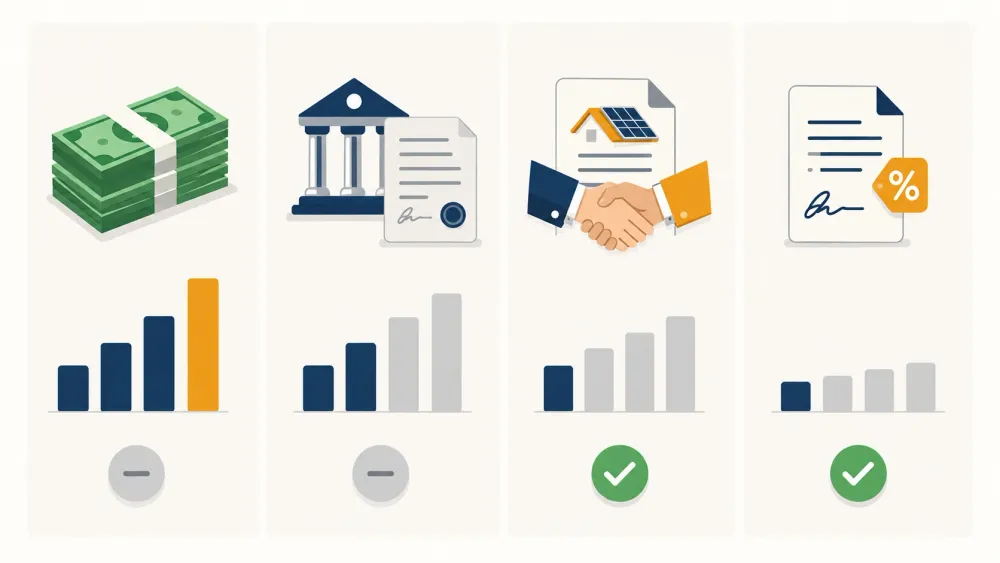
There are four common ways to pay for home solar in 2026: cash, a solar loan, a lease or power purchase agreement (PPA), and a prepaid lease or PPA. The one thing that changed this year is that only the lease and PPA structures still have any route to a federal tax credit, because the company that owns the system can claim the business-side Section 48E credit; a cash or loan purchase gets $0 federal credit in 2026. Which structure fits you depends on your cash position, your credit, and how long you plan to stay in the house, not on any one being universally best.
Paying cash means you own the system outright from day one and keep every dollar of electricity-bill savings for the system's life, with no monthly loan payment or lease bill layered on top. It's the structure with the highest total savings over 25 years in most comparisons, because there's no financing cost eating into the return. The tradeoff is upfront: you need the full installed cost, discussed in What Home Solar Actually Costs in the US in 2026, available now, with no federal credit reducing that number in 2026. Cash buyers also carry all of the risk if the system underperforms its estimate or if a major repair is needed outside the warranty.
A solar loan lets you own the system the same as a cash purchase, financed through fixed monthly payments instead of one lump sum. You still get $0 federal tax credit on the purchase in 2026, and the interest on the loan is a real cost that a pure payback calculation, like the one in Solar Payback Period: How to Calculate Yours, doesn't capture unless you factor it in. Depending on the loan's rate and term, many homeowners see their new loan payment come in lower than their old electric bill from month one, even before the system is paid off, which is the appeal over cash for someone without the full amount available upfront. Total 25-year savings are typically second-best after cash, because interest reduces the net benefit.
Under a lease, you pay a fixed monthly rate for the system's use. Under a PPA, you pay a rate per kilowatt-hour actually produced. In both cases, a third-party company owns, installs, and maintains the system, and that company, not you, can claim the Section 48E credit as a business, which is why these structures still have federal credit exposure in 2026 that a purchase doesn't. These structures are normally priced below your current utility rate, which is the whole pitch. How far below is not something anyone can honestly state as a general figure: it depends on the starting rate in your contract, the escalator attached to it, and what your own utility charges you today. Treat any blanket percentage you see quoted as marketing, and compare the offer in front of you against your own bill instead. What this article won't do is claim your specific savings, because that depends on your rate, your usage, and your contract terms, which vary by provider. What it will say plainly: you don't own the system, you generally can't independently verify how much of the 48E credit value was actually passed through to you, and read your contract for the escalator clause, since many lease and PPA agreements include an annual rate increase written into the contract, which compounds meaningfully over 20 years.
A less common fourth option is a prepaid lease or PPA: instead of monthly payments, you pay the full lease or PPA amount upfront, at a discount to the pay-as-you-go rate, and in some contracts take ownership of the system after a set period. Whether ownership transfers at all, and after how long, is a contract term that varies by company, so read it in the offer rather than assuming there is a standard. This gets you day-one savings similar to a lease, without an ongoing monthly bill, but it requires the same upfront cash a cash purchase would, so the appeal is narrower: mainly for someone who has the cash available but specifically wants to access the third party's Section 48E credit advantage rather than buying outright with none.
A few questions apply no matter which of the four you're leaning toward. Who owns the system, and does that change at any point during the contract (relevant for prepaid leases and PPAs specifically)? What happens to the financing or lease if you sell the house, since a loan may need to be paid off or transferred, and a lease or PPA typically needs to be assumed by the buyer or paid out? Is there an annual rate increase written into the contract, and if so, what is it and over what term? What maintenance and repair responsibilities fall on you versus the financing company or lessor? None of these questions has a single right answer, but a contract that doesn't answer them clearly, or an installer unwilling to walk through them, is a reason to slow down before signing.
If you have the cash available and plan to stay in the house long enough to see the full payback play out, cash purchase produces the most total savings and the least ongoing complexity. If you don't have the cash but qualify for reasonable loan terms, a loan preserves ownership and most of the savings, at the cost of interest.
If your priority is avoiding upfront cost and any exposure to system performance risk, a lease or PPA trades some long-term savings for that lower barrier to entry, and is worth comparing directly against your current utility bill, not against a purchase's theoretical savings. Whichever structure you're leaning toward, run the numbers with your own bill using Solar Payback Period: How to Calculate Yours, Not the Average, and revisit Are Solar Panels Still Worth It in the US in 2026? if you're still deciding whether to buy at all.
What is the best way to pay for solar panels in 2026? There isn't a universally best option. Cash produces the highest total savings if you have it available. A loan preserves ownership without the upfront cost, at the price of interest. A lease or PPA lowers the barrier to entry and currently has the only remaining route to a federal tax credit, through the company's Section 48E claim, but you never own the system.
Can I still get a tax credit if I buy solar with cash or a loan in 2026? No. The federal Section 25D residential credit expired December 31, 2025. A 2026 cash or loan purchase receives $0 federal credit. See what changed when the credit expired for the full timeline.
Why do leases and PPAs still mention a tax credit if I don't own the system? The leasing or PPA company can claim the Section 48E business credit on the system it owns, and may pass some of that value through as a lower monthly rate or per-kWh price. You as the homeowner are not personally claiming a federal credit in this structure.
What is an escalator clause, and why does it matter in a lease or PPA? Many lease and PPA contracts include an annual rate increase, often in the low single digits, written into the agreement. Over a 20-year contract, that increase compounds and can meaningfully change your total savings compared to a flat rate, so it's worth reading for specifically before signing.
Is a solar loan the same as owning the system outright? Yes. A solar loan finances the purchase, but you own the system from day one, the same as a cash buyer, just with a monthly loan payment instead of a lump-sum payment. This differs from a lease or PPA, where a third party retains ownership for the life of the contract.
What happens to my solar loan or lease if I sell my house? It depends on the structure. A solar loan is typically your personal debt, separate from the house, so it needs to be paid off or otherwise settled at sale, similar to any other personal loan. A lease or PPA is usually tied to the system and the property, meaning the buyer typically needs to agree to assume the remaining contract or you need to pay it out before closing. Confirm the specific transfer terms in your contract, since they vary by provider, before you sign.
One email a week with new guides, tips, and solar news. Zero fluff, no sales pitch.