Time of Use Battery Savings: Does the Math Add Up?

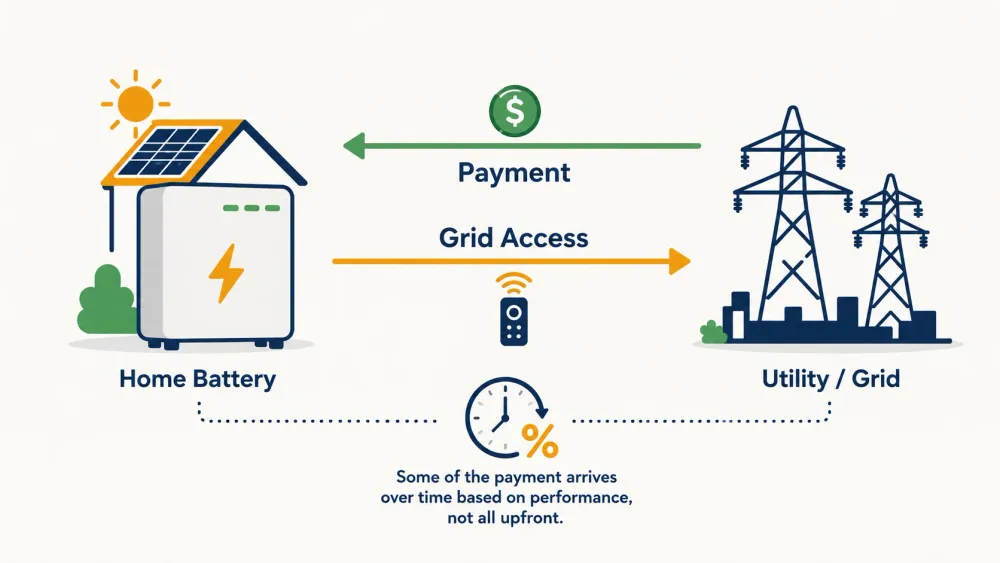
The largest state programs for home batteries in the United States are not simple discounts on hardware. They are grid service arrangements: you receive money in exchange for the utility or program being able to call on your battery, and an increasing share of that money is paid over time based on how your battery actually performs during those events rather than upfront at purchase. California's Self-Generation Incentive Program requires customer enrollment in a qualified demand response program as a condition of its incentives. Connecticut's Energy Storage Solutions program moved new participants, effective April 1, 2026, onto a framework that replaces the previous upfront incentive structure with a smaller enrollment incentive plus higher performance payments over ten years tied to active dispatch participation.
Sources for this article were verified against the CPUC and Connecticut program records at the time of writing. This is general information about program structure. It is not financial advice, not a recommendation to buy a battery, and not a statement of what you qualify for. Program terms and budgets change, and only the administrator can confirm current availability.
A solar panel produces when the sun allows. A battery can be told when to discharge, which makes it useful to a grid operator in a way that a panel is not. Programs are designed around that difference.
The consequence for a homeowner is that battery money tends to come with obligations attached to the operation of the equipment, not just conditions attached to its purchase. This is a genuinely different arrangement from a solar rebate, and it is the thing most coverage of "battery rebates by state" leaves out entirely while publishing a table of dollar figures.
The California Public Utilities Commission's Self-Generation Incentive Program, universally known as SGIP, "provides incentives for qualifying distributed energy systems installed on the customer's side of the utility meter." Qualifying technologies include advanced energy storage systems and combined solar and energy storage, alongside a range of other generation technologies.
Two features of the program's design matter more than any dollar figure.
There is a demand response condition. The CPUC states that all applicants have one year after reserving funds to meet the program requirements, "which include customer enrollment in a qualified Demand Response program." That is the trade. The incentive is not paid for owning a battery, it is paid for a battery that participates.
The budget is segmented, not general. SGIP operates through separate budget categories rather than one pot. Among them is a Residential Solar and Storage Equity budget aimed at low income residential electric or gas customers in California, with $280 million authorized for that category, and the CPUC recorded reservations opening for those incentives on June 2, 2025. Other categories carry their own criteria.
The practical implication is that "does California have a battery rebate" is the wrong question. The right questions are which budget category you would apply under, whether that category currently has funds available for reservation, and whether you are prepared to meet the demand response enrollment requirement within the required window.
Connecticut's Energy Storage Solutions program is a useful case because the direction of travel is documented rather than inferred.
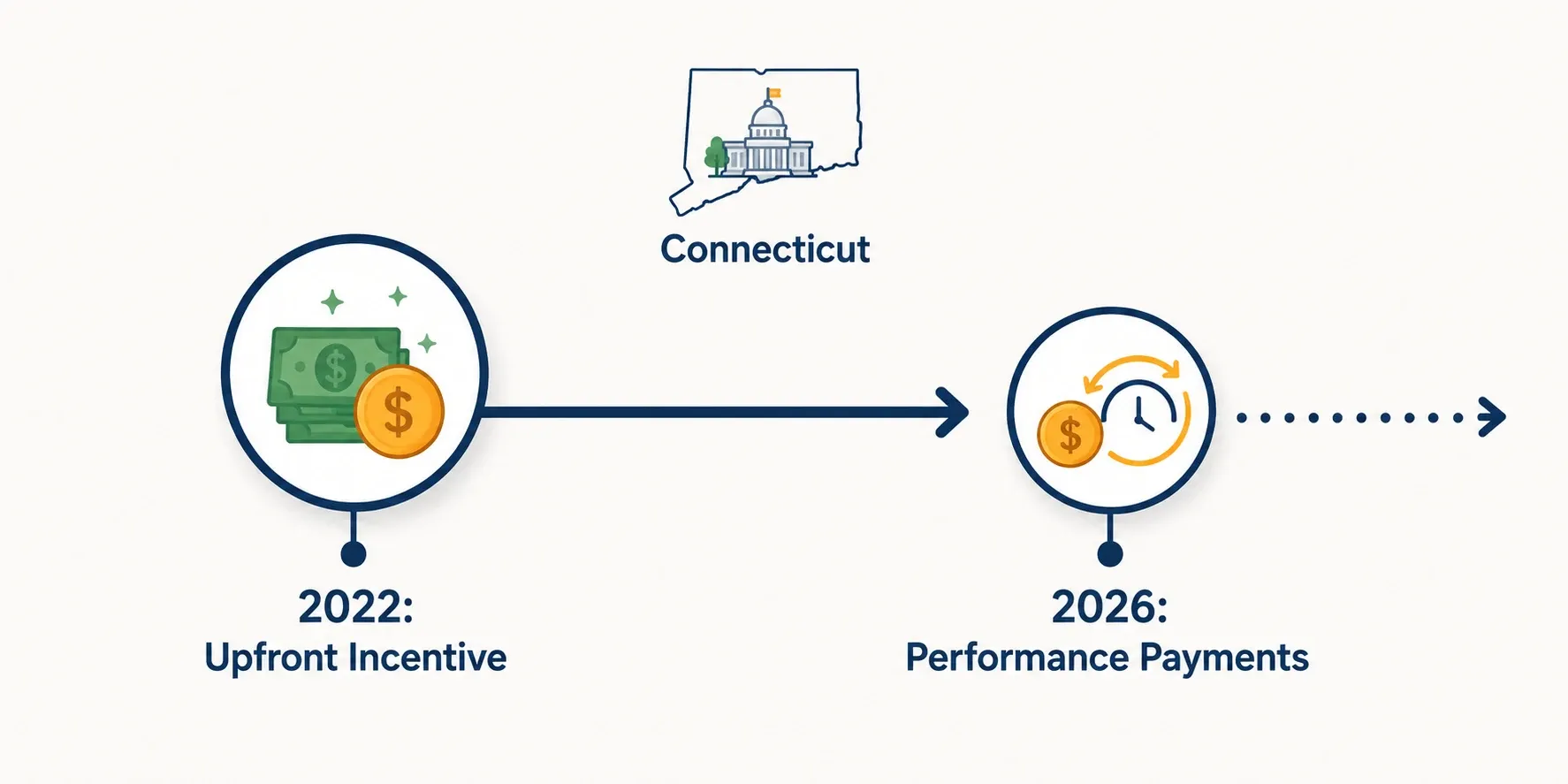
The program is overseen by the Public Utilities Regulatory Authority, is paid for by electric ratepayers, and is administered by the Connecticut Green Bank together with Eversource and The United Illuminating Company. PURA authorized it in Docket No. 17-12-03RE03, issued July 28, 2021. It launched in January 2022 as a nine year program, aiming to deploy 580 MW of electric storage by 2030. Its most recent program year decision at the time of writing was Docket No. 25-08-05, dated December 17, 2025.
What changed on April 1, 2026. New participants enroll in a framework that replaces the prior upfront incentive and passive dispatch structure with a smaller enrollment incentive and higher ongoing performance payments over a ten year period, tied directly to active dispatch participation. The published enrollment incentive figures for residential customers under the new structure are $30 per kWh of battery capacity for standard customers and $130 per kWh for grid edge customers, with performance payments made twice annually based on performance during individual discharge events. The program's own materials describe the previous structure as having paid substantially more upfront, and the change as shifting compensation toward payment over time.
Two things follow. First, a battery incentive is now, in this state, mostly a stream rather than a discount, and a stream has term risk that a discount does not. Second, any article or proposal quoting Connecticut's older and larger upfront figure to a new applicant is quoting a structure that has been replaced.
Every page competing on this query leads with dollar figures by state. Almost none states what the money buys from you.
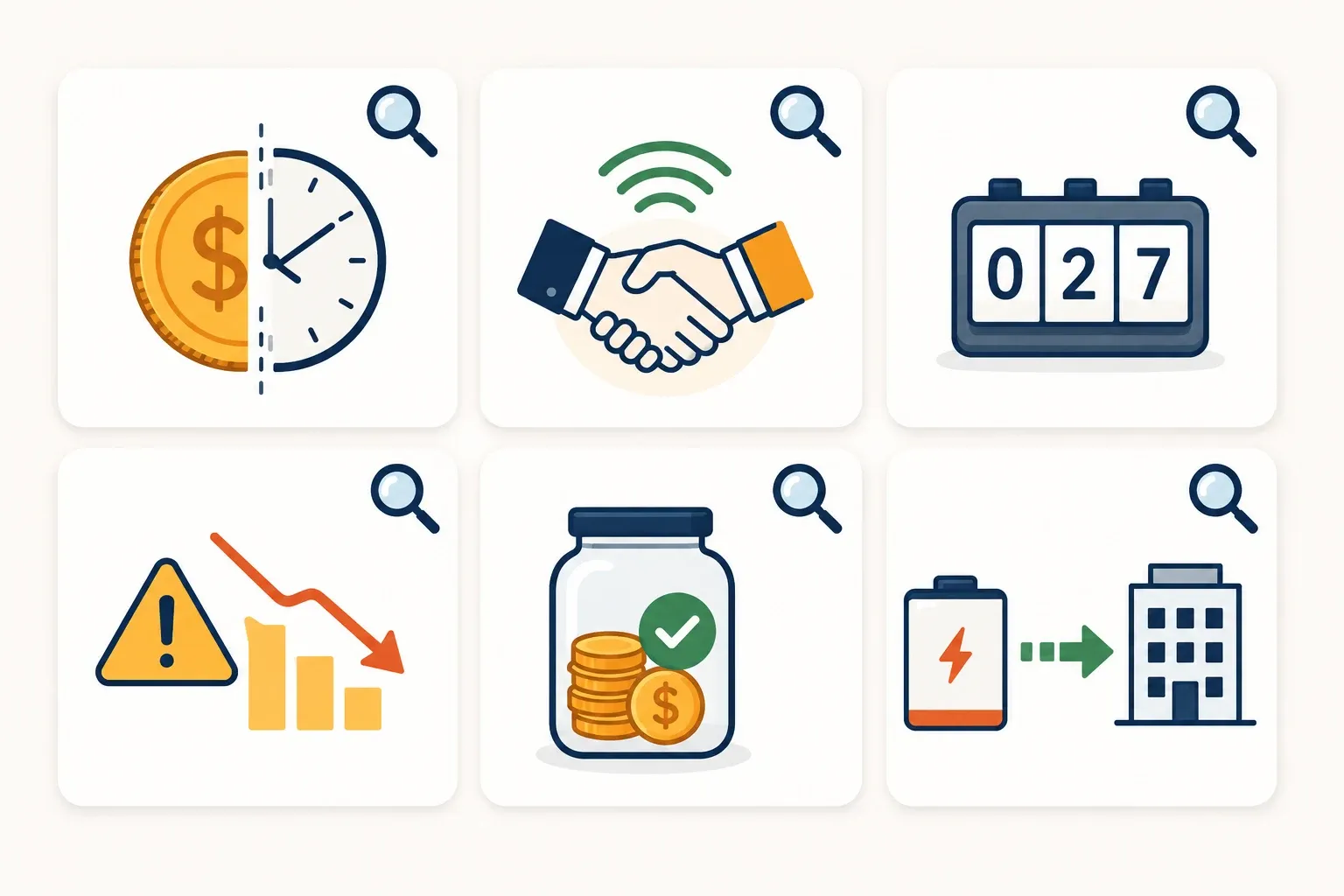
Here is the frame that makes battery programs legible anywhere in the US.
| Question | Why it decides the value |
|---|---|
| Is the payment upfront, over time, or both? | An upfront rebate reduces what you finance. A ten year performance stream does not, and it depends on the program surviving ten years |
| What operational commitment is attached? | Demand response enrollment, active dispatch participation, minimum event participation. This is the real price of the incentive |
| How many discharge events can be called, and when? | This determines how often your battery is not doing what you bought it for |
| What happens if you do not perform? | Reduced payment, clawback, or removal from the program. Ask for the specific consequence in writing |
| Is the budget open right now? | Segmented budgets and annual allocations run out. An advertised program is not an available program |
| Who receives the money? | As with solar incentives, some programs route payment through approved vendors rather than to you |
That last row connects to the wider pattern covered in State Solar Rebates in 2026: What Stacking Actually Means, and it catches people just as often on storage as on panels.
The federal residential credit under Section 25D expired at the end of 2025, and its expiry applies to residential purchases generally rather than carving out storage. A homeowner buying a battery outright with cash or a loan in 2026 should not assume a federal residential credit is available to them. Is There Still a Federal Solar Tax Credit in 2026? covers the federal position, and The Solar Tax Credit Expired: What Now? covers what it changed for buyers. Confirm your own position with a qualified tax professional rather than with a sales proposal.
This page covers two state programs in detail because two could be verified against the bodies that run them. It is not a fifty state table, it publishes no incentive figure that could not be attributed to a program record, and it does not tell you whether a battery is worth buying, which depends on your rate structure, your outage exposure and your price. It also says nothing about which battery to buy or what equipment to compare, which is a different subject entirely. If you are still working out whether solar itself pays for your household, Are Solar Panels Still Worth It in the US in 2026? is the place to start, and When Solar Is Not Worth It is the honest other half.
Is there a home battery rebate in 2026? State and utility programs exist, but most large ones are structured as performance or grid service programs rather than simple purchase rebates. California's SGIP conditions its incentives on enrollment in a qualified demand response program, and Connecticut's Energy Storage Solutions program moved new participants onto a performance weighted structure effective April 1, 2026.
What is California's SGIP? The Self-Generation Incentive Program, run by the California Public Utilities Commission, provides incentives for qualifying distributed energy systems installed on the customer's side of the utility meter, including advanced energy storage. Applicants have one year after reserving funds to meet program requirements, which include enrolling in a qualified demand response program.
What did Connecticut change in 2026? Effective April 1, 2026, new participants in Energy Storage Solutions enroll in a framework that replaces the previous upfront incentive and passive dispatch structure with a smaller enrollment incentive and higher performance payments over ten years tied to active dispatch. The program is overseen by PURA and administered by the Connecticut Green Bank, Eversource and United Illuminating.
Does the utility control my battery if I take an incentive? In performance and demand response based programs, the program can call on your battery during defined events, which is what the payment is for. The number of events, the notice given and the consequences of not participating are program specific, so ask for those terms in writing before enrolling.
Can I still get a federal tax credit on a home battery? The federal residential credit under Section 25D expired at the end of 2025, so a homeowner buying outright in 2026 should not assume one is available. This is not tax advice, and your specific position should be confirmed with a qualified tax professional.
One email a week with new guides, tips, and solar news. Zero fluff, no sales pitch.