How to Get Out of a Solar Contract: Your Options

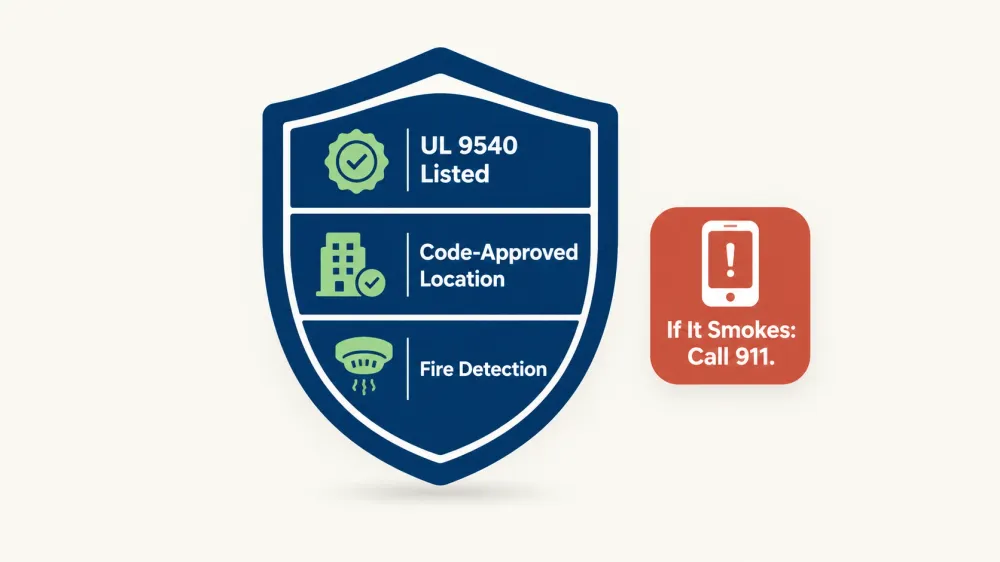
Home battery fire safety rests on three layers: a battery system tested and listed to the UL 9540 safety standard, an installation in a location the building and fire codes allow, and fire detection in the space around it. A home battery can fail and burn, and when it does the fire service treats it as an explosion hazard, not an ordinary appliance fire. The risk is managed by those layers, by a licensed electrician doing the install under a permit, and by the owner knowing what to do if a battery ever smokes: get out, call 911, and say there is a home battery.
This page covers US homes. It explains what the codes require and why, so you can check a proposal and live with the system sensibly. It is not installation guidance, and it does not rank or compare products.
It is, and it is fair to say so plainly. The Clean Energy Group, a nonprofit that works on battery storage policy, describes battery storage in its residential fire safety FAQ (published December 9, 2025, read September 25, 2026) as having "proven to be a safe technology" that "is becoming safer every year". That is a reasonable summary, and it is also not the same as "no risk".
The failure the codes are written around is called thermal runaway: a battery cell overheats, the heat spreads to neighboring cells, and the process feeds itself. The Fire Safety Research Institute, part of UL Research Institutes, reported in its October 31, 2022 update on garage experiments (read September 25, 2026) that lithium-ion battery thermal runaway "effectively always produces a flammable mixture of gas and vapor". The same research looked at what happens when that gas builds up in a garage and ignites late, and found explosion hazards.
Real recalls exist too. The Consumer Product Safety Commission's recall notice for LG Chem RESU10H home batteries (August 4, 2021, read September 25, 2026) covered about 10,000 units that "can overheat, posing a risk of fire and emission of harmful smoke", after five reports of batteries smoking and catching fire, with property damage and one injury. The remedy was a free replacement.
None of that makes a home battery unusually dangerous. It does explain why the code treats one differently from a refrigerator.
The first thing the codes ask is whether the battery system has been tested as a system. UL Solutions' Q&A on residential energy storage (published November 18, 2021, read September 25, 2026) explains the two standards involved:
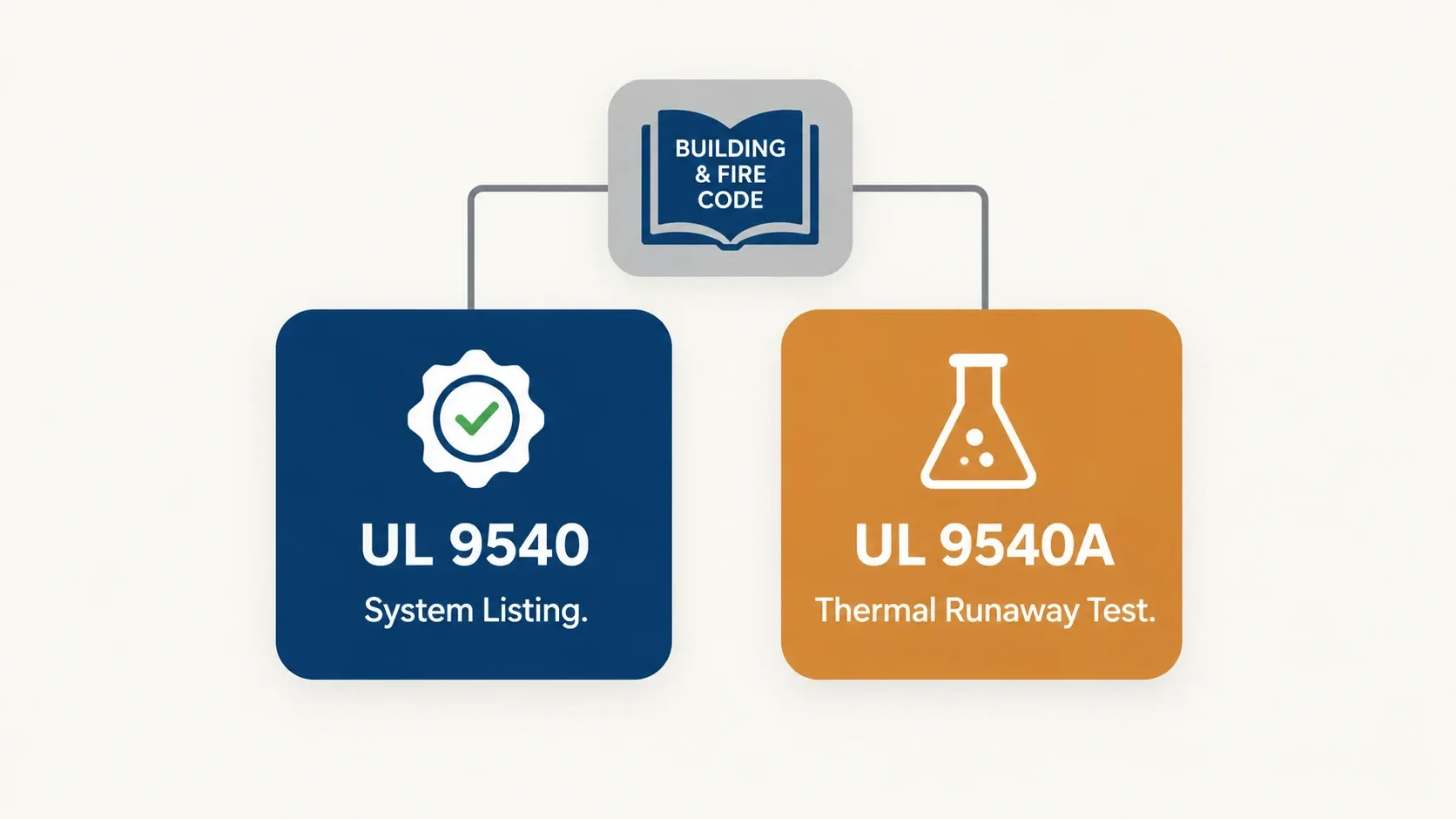
The same Q&A notes that the model codes typically cap an individual residential unit at 20 kWh of stored energy. For a homeowner, the practical question is simple: ask the installer for the UL 9540 listing of the exact system quoted, and do not accept a battery that is not listed. Loose battery modules, unlisted imports and systems assembled from parts sit outside the protection this layer provides.
The location rules exist for fire safety. In the model codes, residential batteries are allowed in garages, detached structures, on outside walls with clearance from doors and windows, and in enclosed utility spaces, and are kept out of the rooms people live and sleep in. Aggregate limits cap how much battery can sit in one space, and units are spaced apart unless fire testing supports a closer spacing.
Garages get particular attention because that is where most batteries go. The Fire Safety Research Institute's update notes that the most common residential installation location is anticipated to be inside an attached two-car garage, which is exactly why its experiments were built there. Garage installations typically also need protection from vehicle impact, because a car bumper is a realistic way to damage a battery.
Your state and local building department decide which code edition applies and what they have amended. Ask the building department which edition it enforces, and ask the installer which code section allows the location they propose.
A battery fire you do not know about is the dangerous one. The residential code text we read requires smoke alarms in the rooms and attached garages where batteries are installed, and where a smoke alarm cannot be used, as in many garages, a heat detector interconnected with the home's smoke alarms. Interconnection is the point: a detector in the garage that only sounds in the garage does little for people asleep upstairs.
Check that the detection shown on the permit drawings is actually installed, and test the alarms as the manufacturer directs. Adding, moving or interconnecting alarms on the home's wiring is electrician work.
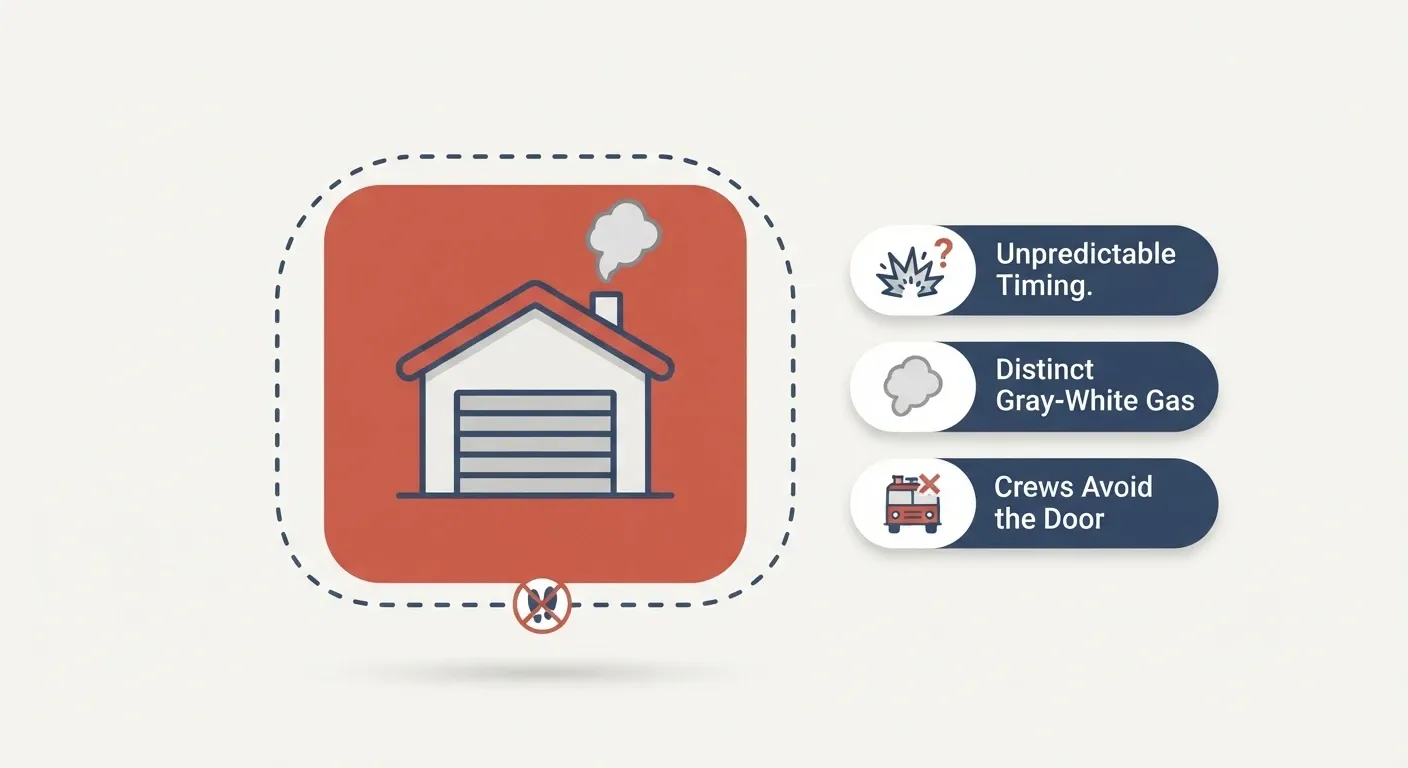
The U.S. Fire Administration, part of FEMA, summarized a firefighter union report on residential battery incidents in a December 21, 2023 blog post (read September 25, 2026). It lists rapid fire growth and explosion hazards, and warns that "the timing and severity of a battery gas explosion is unpredictable". It describes distinct white or gray battery gas leaking from a structure as a sign of thermal runaway, and advises fire crews not to park in front of garage doors because of explosion hazards at vent points.
If trained firefighters are told to stay away from the garage door, a homeowner has no business opening it to look.
This is general safety information, not a substitute for your fire department's instructions:
Most of home battery fire safety is designed in by the listing, the location and the installer. A few habits sit with the owner:
If the installer has closed, recall and warranty work goes through the manufacturer. Checking whether your installer will still exist is worth doing before the battery goes in, not after.
Fire safety rarely appears in a battery proposal, and that is not because it does not matter. It is because the requirements that make a battery safe also add cost: fire-rated wall covering in a basement, a barrier in a garage, extra detection, a different location than the one closest to the panel. A quote that skips them looks cheaper and may not pass inspection, or may pass with work the homeowner then pays for separately.
Ask for the UL 9540 listing, the proposed location and its code basis, the detection plan and the permit to be written into the proposal. Add them to the questions to ask before you sign, and compare quotes only once they include the same safety work, the way the hidden costs of solar should be compared too.
Listed home batteries installed to code are widely considered safe, and the Clean Energy Group describes battery storage as becoming safer every year. They can still fail, which is why the codes require listing, controlled locations and fire detection, and why recalls happen.
It means the energy storage system has been certified to UL 9540, the safety standard for energy storage systems that the International Residential Code and NFPA 855 reference. Ask the installer for the listing of the exact system quoted.
No. Battery fires can involve flammable gas and explosion hazards that the fire service itself approaches with caution. Get everyone out, call 911 and tell the dispatcher there is a home battery.
The residential code text we read requires fire detection in attached garages with batteries, often a heat detector interconnected with the home's smoke alarms where a smoke alarm cannot be used. Your local code edition decides the details, and an electrician installs them.
Check the Consumer Product Safety Commission's recall listings and the manufacturer's website using the model and serial number from the battery's label or your installation paperwork, and make sure the product is registered so the manufacturer can reach you.
One email a week with new guides, tips, and solar news. Zero fluff, no sales pitch.