Time of Use Battery Savings: Does the Math Add Up?

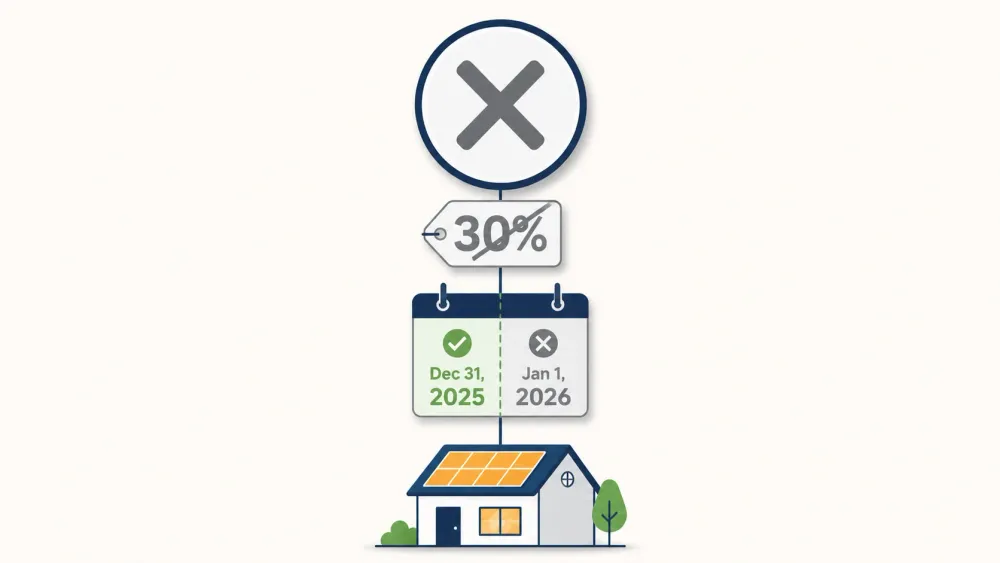
In the United States, the answer for most homeowners is no. Buying a home solar system with cash or a loan in 2026 comes with no federal tax credit. Section 25D, the 30% residential credit, ended for any system placed in service after December 31, 2025, under the One Big Beautiful Bill Act, signed July 4, 2025. The one federal mechanism still reaching solar in 2026 runs through a lease or PPA, and it works differently. That distinction, and how to check it for yourself, is the rest of this article.
Reviewed on August 16, 2026. Next review: September 16, 2026. This article explains a federal tax rule tied to 2025 legislation. It is general information, not tax advice, and it is not a statement about what you personally qualify for. Whether any of this applies to your own return is a question for a qualified tax professional and the current instructions for IRS Form 5695, not for this article or any other one.
If you buy a home solar system outright, whether with cash or a loan, and it is placed in service on or after January 1, 2026, there is no federal tax credit tied to that purchase. There is no phase-down, no partial credit, and no exception written into the law for buyers who missed the December 31, 2025 cutoff by a matter of weeks. This is specific to Section 25D and to ownership. Two situations sit outside this direct answer and are covered elsewhere on this site: a system that was already placed in service in 2025, which can still claim the credit on that year's return, and a lease or power purchase agreement (PPA), where a different part of the tax code may apply to the company that owns the equipment, not to you. That second case is the subject of the next section and of a full article linked below.
Section 25D of the Internal Revenue Code was the residential clean energy credit: a nonrefundable personal tax credit worth 30% of the qualified cost of a solar electric system a homeowner owned outright, claimed on IRS Form 5695 with the taxpayer's own return. It applied to systems you bought and owned, not to systems a company leased to you.
The IRS's own guidance is direct about when that ended. In FAQs addressing the One Big Beautiful Bill Act's changes to several energy credits, the IRS states that for Section 25D, "the credit will not be allowed for any expenditures made after December 31, 2025." The same guidance clarifies that an expenditure is treated as made when the installation is completed, meaning a system finished after that date does not qualify, regardless of when you signed a contract or made a payment. The One Big Beautiful Bill Act itself was signed into law on July 4, 2025, and it moved this end date up from the gradual step-down that prior law had scheduled for the mid-2030s to a hard stop after 2025.
A meaningful share of the content ranking for solar tax credit questions right now was published or drafted before this change took effect, or before it was announced at all, and has not been revised since. Some of it describes a schedule that no longer exists. Separately, some marketing content blurs together two different provisions: it describes a homeowner "still getting 30%" in 2026 without being clear about whether that is Section 25D (which ended for purchases) or Section 48E, a business-side credit that a lease or PPA company might claim on equipment it owns, not you. Both readings can look identical in a headline. If you read a claim that a 2026 cash or loan purchase still qualifies for a 30% federal credit, that claim does not match current IRS guidance and is worth checking directly rather than taking on faith, including anything on this site.
The one federal credit mechanism that still touches solar installed in 2026 is Section 48E, and it is a business investment credit, not a homeowner credit. According to the IRS's own guidance on the Clean Electricity Investment Credit, an eligible facility can claim a base rate of 6% of its qualified investment, rising to as much as 30% if the project meets the law's labor standards, with additional percentage points possible for other qualifying conditions. A solar leasing or PPA company that owns the system installed on your roof, rather than you, can be the taxpayer that claims this credit, provided the project meets its own deadlines: under IRS Notice 2025-42, construction generally needed to begin by July 4, 2026, and under the One Big Beautiful Bill Act, a project that did not meet that earlier construction start must be placed in service by December 31, 2027.
None of that reaches you automatically. Because the company owns the equipment, it is the one filing for the credit, and whether or how much of that value shows up in your monthly lease payment or per-kilowatt-hour PPA rate is a private business decision the company makes, not a published rate. Section 48E: Why Leases and PPAs Still Get a Federal Credit walks through that mechanism, its limits, and what to ask a provider before assuming any of it applies to your specific offer.
The honest way to check any of this is to go to the source rather than to compare articles against each other.
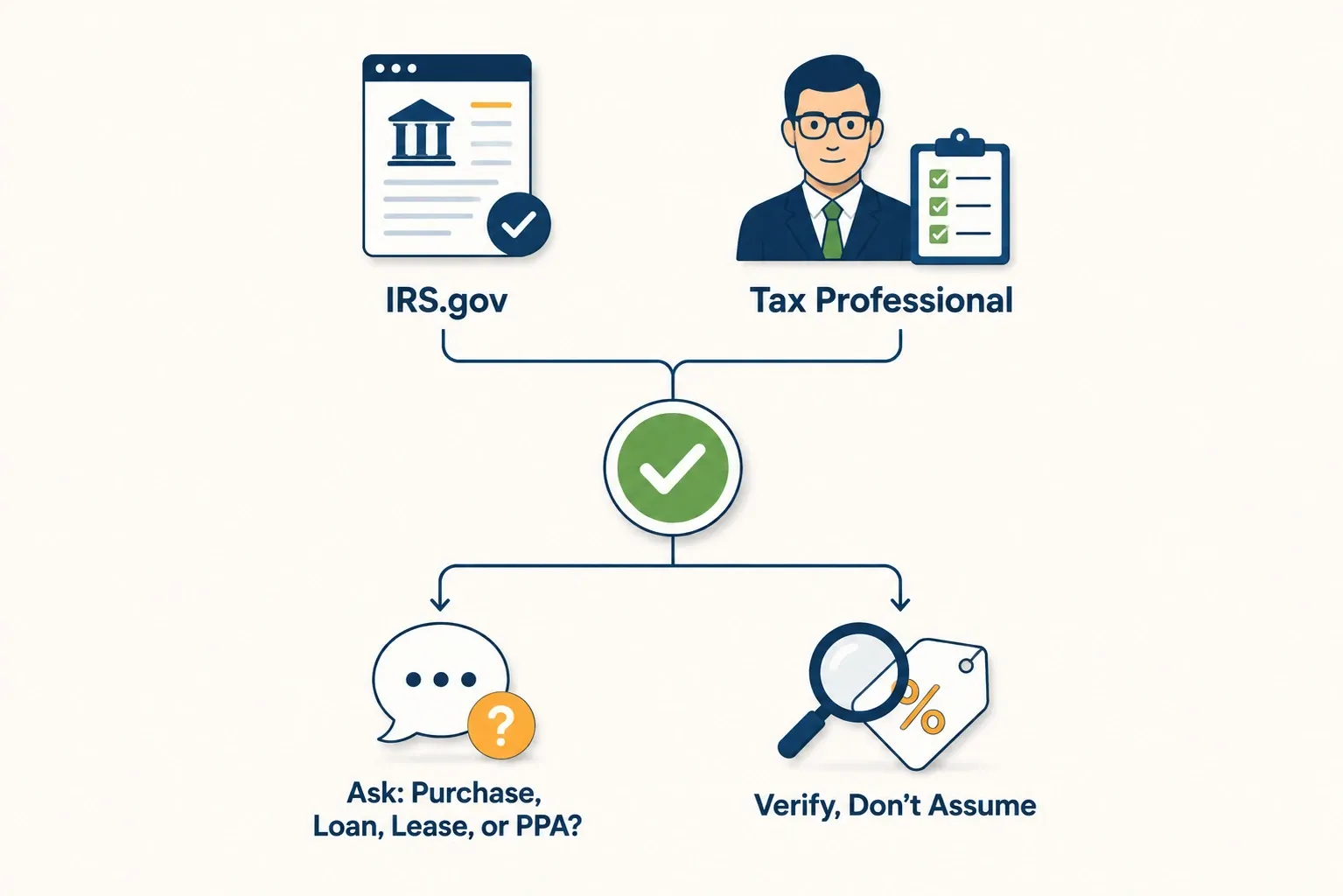
IRS.gov publishes the current instructions for Form 5695 and FAQ guidance on the One Big Beautiful Bill Act's energy provisions directly, and both are free to read without a login. A tax professional who prepares your return can also confirm what applies to your specific situation, which this article cannot do, since eligibility depends on facts about your household that no general article has access to.
Two habits are worth carrying into any solar conversation in 2026. First, ask directly whether an offer is a purchase, a loan, a lease, or a PPA, since the tax treatment genuinely differs by structure. Second, treat "still 30% off" as a claim to verify, not a fact to assume, whether it comes from a salesperson, an old blog post, or this article past its review date above. For a single map of the whole 2026 incentive picture rather than this one question, see Solar Incentives in the US in 2026: What Actually Survived. For the broader question of whether solar still makes financial sense without that credit, Are Solar Panels Still Worth It in the US in 2026? is the starting point, and What Changed for Solar Buyers When the 30% Federal Credit Expired covers the full transition in more depth than the summary above.
Is the federal solar tax credit completely gone for homeowners in 2026? For a cash or loan purchase, yes. Section 25D does not apply to a system placed in service on or after January 1, 2026, according to IRS guidance following the One Big Beautiful Bill Act. It survives only indirectly, through Section 48E, for leases and PPAs where a company other than the homeowner owns the system.
Why do some 2026 ads still mention a 30% credit? That is most likely describing a lease or PPA, where the company that owns the system, not the homeowner, may claim a business credit under Section 48E and choose to pass some value through as a lower rate. It could also simply be outdated content. Ask directly which structure is being offered.
I signed a solar contract in late 2025 but installation finished in January 2026. Do I qualify? Based on IRS guidance, eligibility follows when the system was placed in service, not when the contract was signed or paid for. A system completed after December 31, 2025 falls outside Section 25D regardless of contract date. Confirm your own placed-in-service date with your installer and a tax professional.
Can financing a purchase with a solar loan restore the credit in 2026? No. A loan changes who fronts the money, not who owns the system or what the tax code allows. Section 25D's expiration applies to ownership, and a loan-financed purchase is still an owned system with no credit attached in 2026.
Where can I read the actual IRS guidance instead of a summary? IRS.gov publishes its FAQs on the One Big Beautiful Bill Act's energy provisions and the current instructions for Form 5695 directly. Both are public and do not require a tax preparer account to read.
One email a week with new guides, tips, and solar news. Zero fluff, no sales pitch.