Time of Use Battery Savings: Does the Math Add Up?

California only. Sources checked on August 23 and 24, 2026. Tariff rules change, and this page tells you which body to ask rather than asking you to trust it later.
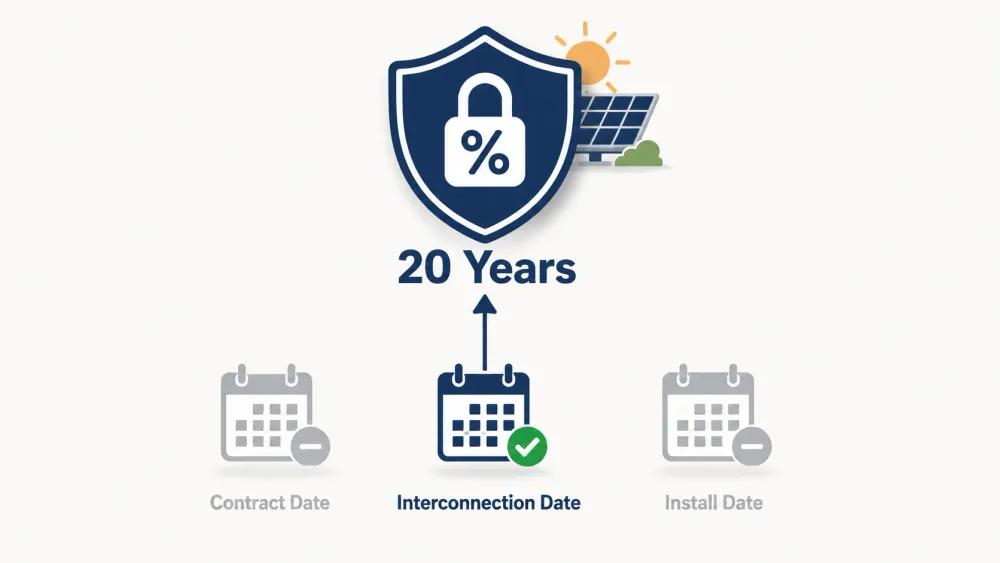
If you took service under California's NEM 2.0 tariff, the California Public Utilities Commission's own page on net energy metering and net billing, read on August 24, 2026, states that customer-generators "are allowed to remain on the NEM 2.0 tariff for 20 years from the date they interconnected." That same CPUC page attributes the 20 year period to Decision D.14-03-041. The clock runs from your interconnection date, not your contract date and not your installation date. A different decision, D.22-12-056, is the one that closed NEM 2.0 to new applicants and started the net billing tariff.
This is general information about how a tariff is structured. It is not financial, tax or legal advice, it is not a prediction, and it cannot tell you what is on your account. Only your utility can do that.
A large amount of writing on this topic, including a row in this site's own content plan, attributes the 20 year legacy period to D.22-12-056. Checked against the Commission's own pages on August 24, 2026, that attribution is wrong, and the correction matters because the two decisions do different jobs.
| Decision | What the CPUC's own pages say it did |
|---|---|
| D.14-03-041 | The decision the CPUC's net energy metering page cites for the rule that NEM 2.0 customer-generators may remain on the tariff for 20 years from the date they interconnected |
| D.22-12-056 | Adopted December 15, 2022. Established the net billing tariff as the successor to NEM 2.0. The CPUC's net billing tariff page states that the tariff "will apply to customers who submit an interconnection application on or after April 15, 2023" |
Citing the wrong decision is not a trivia problem. If you write to your utility or to the Commission quoting a decision that does not contain the rule you are relying on, the answer you get back will not help you. The correction here comes from the Commission's own published pages, not from commentary about them, and it is worth carrying into any conversation you have about your account.
Most coverage prints a single number, 20 years, and stops. The Commission's own pages describe at least three different situations, and the difference between them is thousands of dollars over a system's life.
NEM 2.0, standard residential. The CPUC's net energy metering and net billing page states the 20 year period, measured from the date of interconnection, and cites D.14-03-041 for it. This is the case most California homeowners with rooftop solar are in.
Virtual net energy metering after the sunset. The CPUC's virtual net metering page, read on August 24, 2026, states that D.22-12-056 "reduced the legacy period from 20 years to 9 years for new customers applying to interconnect after the NEM 2.0 tariff sunset date (April 14, 2023)." Virtual net metering is the arrangement used where generation is shared across multiple metered accounts on one property, such as a multifamily building. If that describes your situation, the widely repeated 20 year figure is not your number, and no article that prints only 20 years will tell you so.
The net billing tariff itself. Customers who submitted an interconnection application on or after April 15, 2023 are on the net billing tariff. There is no earlier tariff to be protected on, so the legacy question does not arise in the same form. What exports pay under that tariff is a separate subject, covered in what California NEM 3.0 actually pays for exports.
One honest gap: the CPUC page we read names the 20 year period in connection with NEM 2.0 and does not state a duration for NEM 1.0 customers on that page. If you interconnected under NEM 1.0, treat the duration as something to confirm with your utility in writing rather than something to read off this page.
A legacy period protects the tariff you are enrolled under. That is a narrower promise than most homeowners hear.
It is a fixed window with an end. Twenty years from interconnection is a date, and it arrives. Nothing in the Commission's language describes a permanent entitlement, and a household that treats it as permanent has assumed something the decision does not say.
It is tied to a date you may not have written down. Interconnection is the point at which your utility gives permission to operate, which is not the day the panels went up and not the day you signed. If you do not know your interconnection date, that single piece of paperwork is the most useful thing you can retrieve this month, because it is the input to every other question on this page.
It does not cover everything on your bill. Rates, fixed charges and non-bypassable charges are set through separate proceedings and can change without your tariff changing. Being on a legacy tariff and being on a fixed bill are not the same thing, and if you are trying to work out whether your rate structure still makes solar pay, how your electricity rate decides whether solar pays off is the underlying question.
It is described as permitted, not compulsory. The Commission's wording allows a legacy customer to move to the current tariff. Whether that would ever suit a particular household is a modeling question about that household's usage and rate, and this page does not answer it and will not recommend it.
Assembly Bill 942 is the reason many California solar owners think a deadline is coming. Here is what the Legislature's own bill records showed when we read them on August 24, 2026.
The bill's most recent recorded action is dated August 29, 2025: "From committee: Do pass and re-refer to Com. on RLS. (Ayes 5. Noes 2.)" Its location is the Senate Committee on Rules. It has not been chaptered, it has not been signed, and it has not been vetoed. No action later than August 29, 2025 appears in the history.
The most recent version of the text on the Legislature's site is the copy amended in the Senate on July 17, 2025, and its title is "Electricity: climate credits." That version contains no 10 year sunset of legacy net energy metering tariffs and no July 1, 2026 date. Those provisions are where the widely reported deadline came from, and they are not in the current text.
So the accurate statement is narrower than "AB 942 never passed" and much narrower than "a deadline is coming." The bill was not enacted, its most alarming provision was amended out more than a year ago, and it has been sitting in a committee with no recorded movement since August 2025. It is also not dead by any recorded action, which is why this page tells you where to look rather than telling you it is over. The companion piece, what the California NEM legacy transition reporting actually got wrong, traces how the reporting drifted from the record.
One provision in that July 17, 2025 version is worth knowing about even though it is not law, because it is the kind of rule that would affect a homeowner who sells: the text addresses how a new owner who acquires a property with an existing renewable generation facility is treated, and it addresses climate credit eligibility. None of it is in force. If you are selling a home with solar on it, ask your utility what happens to that specific account on transfer under the rules in force on the day of the sale, and get the answer in writing.
Four facts decide your outcome, and all four are answerable now rather than by watching the news.
If you are outside California entirely, the rules are different in ways that are not small, and how net metering varies by state is the better starting point. The concept itself is explained in what net metering is and how it works.
This page reports what the CPUC's published pages and the California Legislature's bill records showed on August 23 and 24, 2026. It cannot tell you what the Commission or the Legislature will do next, and it does not predict. It does not tell any solar owner whether to switch tariffs, expand a system, add a battery, or sell a house, because those depend on numbers this page does not have and should not guess. Legislation and tariffs in California move quickly. If you are reading this months from now, treat every date above as something to re-check at the source before you act on it.
Which CPUC decision actually sets the 20 year legacy period? The CPUC's own net energy metering and net billing page, read August 24, 2026, cites D.14-03-041 for the rule that NEM 2.0 customer-generators may remain on the tariff for 20 years from the date they interconnected. D.22-12-056 is the decision that established the net billing tariff for interconnection applications submitted on or after April 15, 2023.
Is my legacy period always 20 years? No. The CPUC's virtual net metering page states that D.22-12-056 reduced the legacy period from 20 years to 9 years for new customers applying to interconnect after the NEM 2.0 sunset date of April 14, 2023. Confirm which arrangement your account is on before assuming any number.
Which date starts the clock? The date you interconnected, which your utility may refer to as permission to operate. It is not your contract date and not your installation date.
Has AB 942 become law? Not according to the Legislature's own bill history read on August 24, 2026, which shows the most recent action as August 29, 2025 and the bill in the Senate Committee on Rules. It has not been chaptered. Check the Legislature's site for the current status before relying on this.
Does selling my house end my legacy tariff? That depends on the rules in force on the day of the sale, and it has been the subject of proposed legislation that is not law. Ask your utility what happens to your specific account on transfer, in writing, before you list.
One email a week with new guides, tips, and solar news. Zero fluff, no sales pitch.